According to the biography by Diogenes Laertius, Pythagoras (c.570–c.490 BCE) ‘held that the most beautiful figure is the sphere among solids, and the circle among plane figures’.

This aesthetic preference for the circle and sphere can be traced through thinkers like Plato (who, according to later writers, set the problem of describing the movements of the heavens using uniform circular motions), Cicero (106–43 BCE), and Proclus (410/12–485 CE), and into the middle ages.

Thomas Bradwardine (1290/1300–1349), one of the mediaeval ‘Oxford calculators’, was obviously influenced by this tradition when he wrote that the circle ‘is the first and most perfect of figures, the simplest and most regular, the most capacious and the most beautiful of figures’.

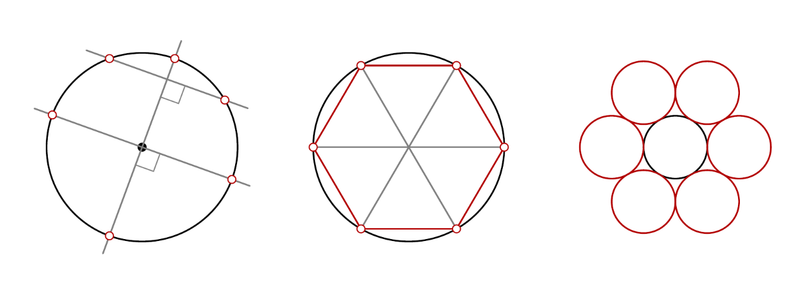
But Bradwardine then presented evidence that he saw as attesting to the beauty and perfection of the circle: (1) the construction to find the centre of a circle by bisecting a diameter found as the perpendicular bisector of a chord; (2) that the intersections of six equally-spaced radii with the circumference define a regular hexagon; (3) that exactly six circles of equal size can touch a given circle (see attached image).

For Bradwardine, the perfection of the circle was thus linked to the perfection of the number 6 = 1+2+3: the construction involves six intersections with the circle; the hexagon is made up of six lines; the third result involves six outer circles.

1/2

#MathematicalBeauty #HistMath #Pythagoras #Bradwardine #geometry #aesthetics #PerfectNumber
For each day of February, I intend to post a short interesting story/image/fact/anecdote related to the aesthetics of mathematics.

February has 28 days, and 28 is the second perfect number, so let's start there.

Definitions first: a ‘perfect’ number is equal to the sum of its own proper divisors (28 = 1+2+4+7+14). If the sum of proper divisors is greater than the number itself, the number is ‘abundant’; if less, it is ‘deficient’.

Philo of Alexandria (fl. early 1st century CE) seems to have connected perfect numbers with beauty, at least via the order emplaced in the world during the Biblical 6 (= 1+2+3) days of creation. (The perfect number of days of the hexaëmeron was emphasized by later writers like Methodius of Olympus (d. c.310 CE) and Augustine of Hippo (354–430 CE), though not in explicitly aesthetic terms.)

Nicomachus of Gerasa (fl. 100 CE) seems to have thought that the (rare) perfect numbers were beautiful, and that the much more common abundant and deficient numbers were ugly, likening them to monstrous creatures with too many or too few limbs, mouths, eyes.

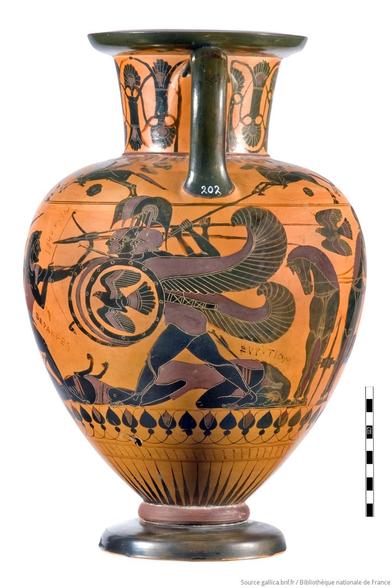
Boethius (c.480–c.524 CE) agreed with Nicomachus and was even more specific about the parallel to monsters: deficient numbers were like the one-eyed Cyclopes; abundant numbers were like the triple-headed or -bodied Geryon (image attached).

1/2

#MathematicalBeauty #MathHist #PerfectNumber #aesthetics

Adapted my primality test algorithm to do a check for if a number is a "Perfect Number" (the sum of all its dividends equals the number itself). This one was fun and turned out to be super fast as well. It was written in Haskell.

#PerfectNumber #Haskell #Programming #Mathematics