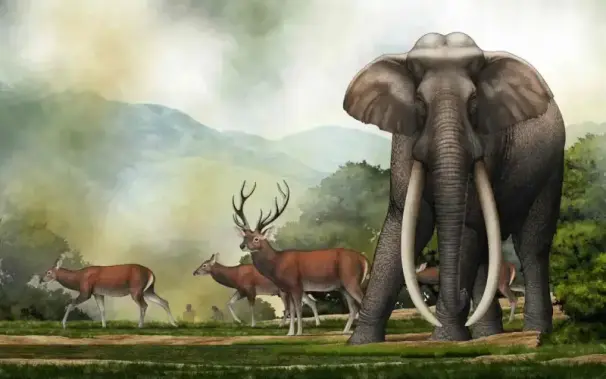
This weeks #Lego #FossilFriday is #Palaeoloxodon

In 1695, straight-tusked elephant remains were found near Thuringia, Germany. They were declared minerals. Wilhelm Ernst Tentzel, a polymath in the employ of the ducal court of Saxe-Gotha-Altenburg, correctly recognised that they represented the remains of an elephant.

Before 1845, Eurasian Palaeoloxodon were thought to be woolly mammoths.

In 1846, paleontologists Hugh Falconer and Proby Cautley named the first Eurasian Palaeoloxodon.

Giant prehistoric #elephant skull belongs to mysterious #extinct species
https://phys.org/news/2024-10-giant-prehistoric-elephant-skull-india.html

A remarkable #Palaeoloxodon (Mammalia, Proboscidea) skull from the intermontane #Kashmir Valley https://www.tandfonline.com/doi/full/10.1080/02724634.2024.2396821

"The giant fossil skull of an extinct elephant, discovered #KashmirValley in 2000, sheds light on a poorly known episode in elephant evolutionary history. The elephant skull was buried with 87 #StoneTools used by prehistoric humans"

Giant prehistoric elephant skull from India belongs to mysterious extinct species

The giant fossil skull of an extinct elephant, discovered in northern India's Kashmir Valley in 2000, sheds light on a poorly known episode in elephant evolutionary history.

Phys.org