 DataCite
Wrapping up #DataCite’s 15th Anniversary week with a slideshow showcasing our metadata journey! Explore DOIs registered since Dec 2009, the #PIDGraph, real-life DOI connections & more. https://tinyurl.com/mtzchm95
 PID Network Deutschland
Exploring research collaborations and activities through Connected PIDs. Paolo Gujilde and Sheila Rabun presented the #ORCID & Crossref Data Visualization using R and Tableau at #pidfest
Data Visualization - ORCID US Community
Data Visualization In 2022, the ORCID US Community partnered with the Drexel University LEADING program to create a set of resources for visualizing publication collaboration activity based on public data from researchers’ ORCID records and Crossref DOI publication metadata. Thanks to the two fellows who worked on this project, Negeen Aghassibake and Olivia Given Castello,
 hauschke
I see the famous #PIDgraph visualization for the first time now on a slide at the #PIDfest.
Can be found in the blog of @[email protected] too:
https://blog.front-matter.io/posts/introducing-the-pid-graph/
PS: Edited because of wrong attribution to Martin. Thanks for the correction!
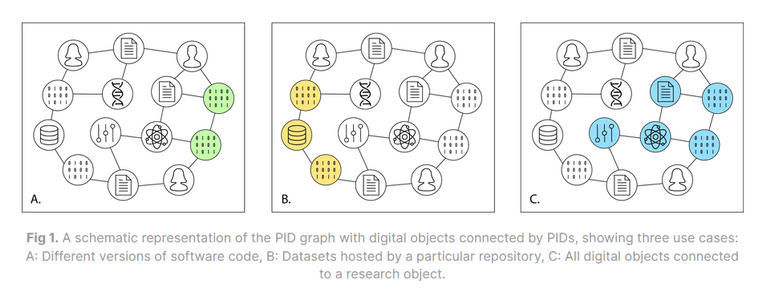

Introducing the PID Graph
Persistent identifiers (PIDs) are not only important to uniquely identify a publication, dataset, or person, but the metadata for these persistent identifiers can provide unambiguous linking between persistent identifiers of the same type, e.g. journal articles citing other journal articles, or of different types, e.g. linking a researcher
 George Macgregor
Here's a paper to announce, authored with my colleagues, Barbara Lancho-Barrantes and Diane Pennington Rasumussen!
'Measuring the concept of #PID literacy : user perceptions and understanding of persistent identifiers in support of open #scholarly #infrastructure
The paper is available openly here: https://doi.org/10.1515/opis-2022-0142 or https://strathprints.strath.ac.uk/84311/
#PersistentIdentifiers #PIDgraph #repositories #OpenInfrastructure #scholarlyinfrastructure #metadata #repositories #retrieval @openstrath

Measuring the Concept of PID Literacy: User Perceptions and Understanding of PIDs in Support of Open Scholarly Infrastructure
The increasing centrality of persistent identifiers (PIDs) to scholarly ecosystems and the contribution they can make to the burgeoning “PID graph” has the potential to transform scholarship. Despite their importance as originators of PID data, little is known about researchers’ awareness and understanding of PIDs, or their efficacy in using them. In this article, we report on the results of an online interactive test designed to elicit exploratory data about researcher awareness and understanding of PIDs. This instrument was designed to explore recognition of PIDs (e.g. Digital Object Identifiers [DOIs], Open Researcher and Contributor IDs [ORCIDs], etc.) and the extent to which researchers correctly apply PIDs within digital scholarly ecosystems, as well as measure researchers’ perceptions of PIDs. Our results reveal irregular patterns of PID understanding and certainty across all participants, though statistically significant disciplinary and academic job role differences were observed in some instances. Uncertainty and confusion were found to exist in relation to dominant schemes such as ORCID and DOIs, even when contextualized within real-world examples. We also show researchers’ perceptions of PIDs to be generally positive but that disciplinary differences can be noted, as well as higher levels of aversion to PIDs in specific use cases and negative perceptions where PIDs are measured on an “activity” semantic dimension. This work therefore contributes to our understanding of scholars’ “PID literacy” and should inform those designing PID-centric scholarly infrastructures that a significant need for training and outreach to active researchers remains necessary.
 George Macgregor
Colleagues & I have posted a preprint if anyone in the fediverse is interested...
Exploring the concept of PID literacy: user perceptions and understanding of persistent identifiers in support of open scholarly infrastructure https://arxiv.org/abs/2211.07367 #PIDs #PersistentIdentifiers #repositories #scholarship #PIDgraph #OpenAccess #OpenResearch
Exploring the concept of PID literacy: user perceptions and understanding of persistent identifiers in support of open scholarly infrastructure
The increasing centrality of persistent identifiers (PIDs) to scholarly ecosystems and the contribution they can make to the burgeoning 'PID graph' has the potential to transform scholarship. Despite their importance as originators of PID data, little is known about researchers' awareness and understanding of PIDs, or their efficacy in using them. In this article we report on the results of an online interactive test designed to elicit exploratory data about researcher awareness and understanding of PIDs. This instrument was designed to explore recognition of PIDs and the extent to which researchers correctly apply PIDs within digital scholarly ecosystems, as well as measure researchers' perceptions of PIDs. Our results reveal irregular patterns of PID understanding and certainty across all participants, though statistically significant disciplinary and academic job role differences were observed in some instances. Uncertainty and confusion were found to exist in relation to dominant schemes such as ORCID and DOIs, even when contextualized within real-world examples. We also show researchers' perceptions of PIDs to be generally positive but that disciplinary differences can be noted, as well as higher levels of aversion to PIDs in specific use cases and negative perceptions where PIDs are measured on an 'activity' semantic dimension. This work therefore contributes to our understanding of academics' 'PID literacy' and should inform those designing PID-centric scholarly infrastructures, that a significant need for training and outreach to active researchers remains necessary.