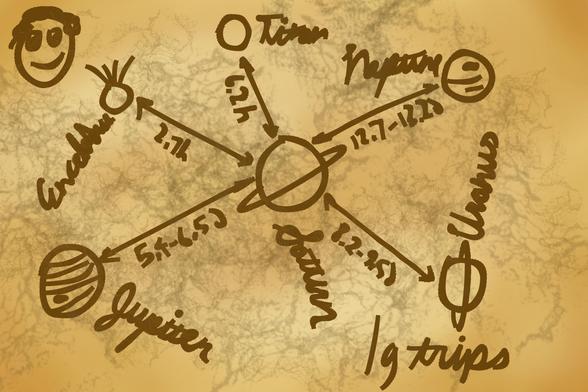
Alright, I should probably do more work on this old thing, but I actually quite like the concept. Travel times to and from Saturn using constant acceleration...of one Earth gravity! Quite achievable with nuclear pulse propulsion...

"Outer solar system at 1g parchment map", by yours truly.

#art #digitalart #map #space #spaceflight #scifi #sciencefiction #constantacceleration #solarsystem #outersolarsystem #planets #interplanetarytravel

❄️ Beyond Neptune lies a twilight realm where sunlight becomes memory, and many ice worlds orbit for longer than human civilization has existed. What secrets do these frozen time capsules preserve?

✍️ Journey to the edge: https://TPC8.short.gy/5N5UMSY7

🌌 Where knowledge itself begins to soften

#KuiperBelt #Astronomy #SolarSystem #PlutoAndBeyond #OuterSolarSystem #PlanetaryScience #TPC8

Where the Solar System Whispers Its Secrets: A Journey to the Kuiper Belt 🌌

Explore the Kuiper Belt beyond Neptune: home to dwarf planets like Pluto and Makemake, plus countless icy worlds. Discover cosmic mysteries and distan

Astronomers Announce Evidence That Our Solar System Has Nine Planets Once Again

Astronomers may have uncovered a massive hidden planet far beyond Neptune, using decades-old infrared data. The object’s faint signal and strange motion suggest something big is lurking in the dark.

Indian Defence Review

Japan's OPENS Program Aims to Explore the Outer Solar System with Solar Sails

This hype glosses over the real limits—solar sails inch along on scarce power, risky science returns, and long transit times. Excitement aside, practical hurdles and budget constraints could throttle this dream from Saturn flybys to mere demonstrations.

[View original comment]

Japan's OPENS Program Aims to Explore the Outer Solar System with Solar Sails

The OPENS program, initiated by Japan's space agency JAXA, is an ambitious project to explore the outer solar system using small solar sails. The project follows in the footsteps of the IKAROS mission, which in 2010 became the first to successfully deploy an interplanetary solar sail. OPENS will beg... [More info]

NASA: Sao chổi 3I/ATLAS dường như có nguồn gốc tự nhiên, có thể đến từ đám mây Oort, đang lao về phía Mặt Trời và sẽ rời đi. Trái Đất an toàn. Giả thuyết công nghệ ngoại văn minh hiện chưa có bằng chứng. #SaoChổi #3IATLAS #NASA #SpaceNews #KhoaHọc #VũTrụ #Astronomy #Comet #OuterSolarSystem #ScienceNews

https://vietnamnet.vn/sao-choi-khong-lo-3i-atlas-dang-lao-ve-phia-mat-troi-trai-dat-co-an-toan-2458561.html

Sao chổi khổng lồ 3I/ATLAS đang lao về phía Mặt Trời, Trái Đất có an toàn?

NASA đã đưa ra quan điểm chính thức về sao chổi 3I/ATLAS, dù vẫn còn nhiều câu hỏi liên quan, nghi ngờ sao chổi khổng lồ này là công nghệ từ nền văn minh khác.

Vietnamnet.vn

🍾 Simulations show Saturn's moon Enceladus shoots less ice into space than previous estimates

https://phys.org/news/2025-09-simulations-saturn-moon-enceladus-ice.html

#saturn #planets #moon #astronomy #space #enceladus #frontline #outersolarsystem #ice

Simulations show Saturn's moon Enceladus shoots less ice into space than previous estimates

In the 17th century, astronomers Christiaan Huygens and Giovanni Cassini trained their telescopes on Saturn and uncovered a startling truth: the planet's luminous bands were not solid appendages, but vast, separate rings composed of countless nested arcs.

Phys.org

Discovery of 2023 KQ14 Ammonite challenges models of outer solar system formation

Astronomers have identified a new distant object in the solar system's outer reaches, named 2023 KQ14 or Ammonite, belonging to the rare class of sednoids—trans-Neptunian bodies with orbits far beyond Neptune. Unlike the three previously known sednoids, Ammonite's orbit does not align with theirs, i... [More info]

La mystérieuse Planète Neuf serait cachée aux confins du Système solaire. Comment est-elle arrivée là?

Une neuvième planète massive serait tapie en périphérie de notre système solaire. Selon une étude parue en juin, elle aurait été malmenée par d'autres planètes il y a plusieurs milliards d'années.

Geo.fr