
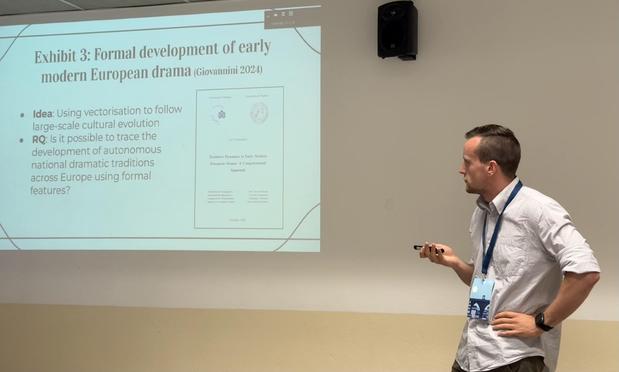
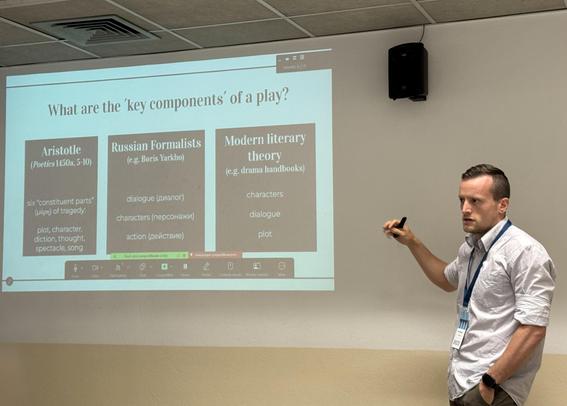
#DH2025: Luca Giovannini takes us on a tour through centuries of thinking from #Aristotle’s #Poetics, through Russian formalism, to modern literary theory and unpacks the question offering a fresh perspective.
#drama #operationalization #CLS
This contribution discusses the relation between the (computational) operationalization of literary studies concepts and the property of interpretation dependence, which applies to many relevant literary studies research questions and poses specific challenges to operationalization. Using the attempt to operationalize the narratological concept of unreliable narration as an illustrative example, the paper addresses three crucial subtasks for operationalizing a concept (definition, identification of steps necessary to decide if it applies and the actual application) and explicates if and why interpretation dependence complicates them. The paper concludes with general recommendations for operationalizing complex concepts coupled with a high degree of interpretation dependence.
Another paper, this time on #translation of #Japanese #poetry:
Xudong Chen, Hilofumi Yamamoto & Bor Hodošček (2023), "Translation-based connotation #visualization for classical poetic Japanese vocabulary of the Kokin Wakashū ca. 905", Journal of Computational Literary Studies 2 (1), 1–32. doi: https://doi.org/10.48694/jcls.3596.
Keywords: classical poetic Japanese text, parallel corpora, #connotation, #operationalization, parallel corpora connotation, Kokin Wakashū
To offer a visualization of connotation in the classical poetic Japanese vocabulary of the Kokin Wakashū as an independent supplement for poetic language dictionaries, this paper presents an operationalization to tackle connotations using non-literal elements which are unveiled during the cross-cultural communication process, i.e., the translation process. Grounded on Schramm's communication model, we suggest calculating the set difference between the Kokin Wakashū and its ten contemporary Japanese translations to visualize the lexical explanatory additions (non-literal elements) in the translations. Methodologically, we apply the set difference in two distinct ways and implement the visualization on the six most frequent poetic flora words in the Kokin Wakashū, resulting in various depictions of non-literal elements. The set difference-based approaches to non-literal element visualization showed associative images and rhetorical techniques related to the flora words, which are two crucial aspects of connotation. While the other aspects of connotation, such as encyclopedic knowledge, sociolinguistic style, and emotion, are not covered by the proposed visualizations.
Enterprises spend $ on #cybersecurity tools. But do they optimize their operations? No!
@ReachSecurity has developed an #AI solution to help and just raised $20M #funding.
https://www.finsmes.com/2024/03/reach-security-raises-20m-in-funding.html
#cybersecurity #security #funding #AI #operationalization #optimization
#CallForPapers für den Workshop „Measuring Meanings | Computing Concepts. Practices of #Operationalization and their Implications for #TextStudies“
Deadline: 1. Mai
Der Workshop von CRETA findet vom 25.-26. September in Köln statt!
#AIEthics #MachineLearning #ArtificialIntelligence #AlgorithmicFairness #Operationalization
---
"Operationalization"
It's not an easy word to say. Somehow I always end up putting an extra "z" in there. My friends find that quite amusing, though probably not as amusing as hearing me say "nuclear" in my native Midwestern.