4/
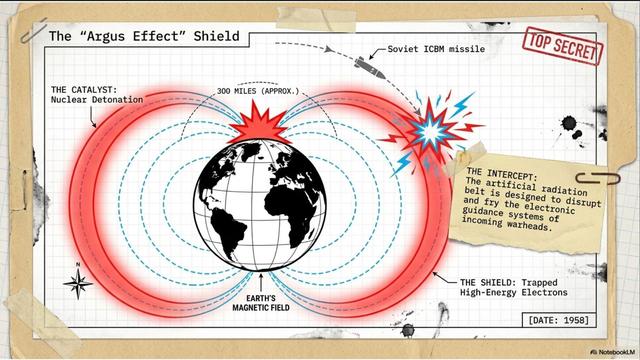
The goal was to see if this "plasma shield" could:

Blind Soviet Radar: Making it impossible for them to track incoming missiles.

Fry Enemy Electronics: The radiation belt could potentially "cook" the guidance systems of incoming Soviet warheads.

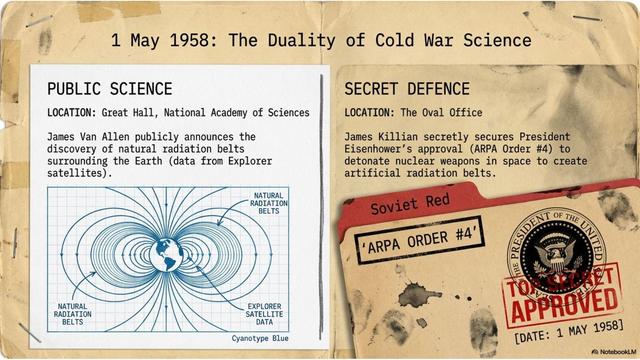
The project was so secret that the public didn't find out about it until the New York Times broke the story a year later in 1959.

https://youtu.be/Pt6n-boPBNg

#NuclearTests
#OperationArgus
#US
#history

The Hidden Victims of Two Thousand Bombs: Unveiling the Global Hibakusha

YouTube

3/
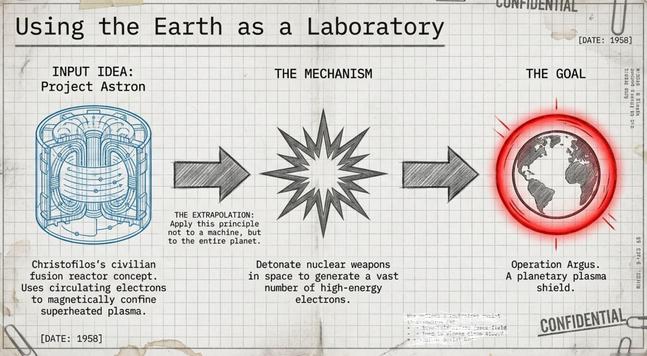
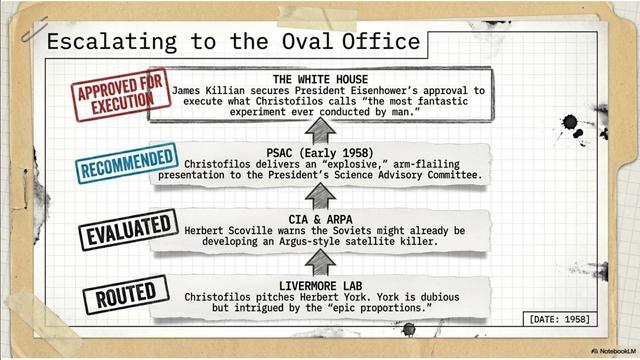
The experiment was based on a theory by a Greek physicist named Nicholas Christofilos. He predicted that a nuclear explosion in space would create an artificial Van Allen radiation belt.

He was right. The explosions created a shell of high-energy electrons that wrapped around the entire planet for several weeks.

https://youtu.be/Pt6n-boPBNg

#NuclearTests
#OperationArgus
#US
#history

The Hidden Victims of Two Thousand Bombs: Unveiling the Global Hibakusha

YouTube

2/
The Actual Stats:

The Weapons: They launched three modified X-17A missiles, each carrying a 1.7-kiloton W-25 nuclear warhead.

The Altitudes: These weren't just "high altitude" shots; they were true space shots. The detonations occurred at:

Argus I: 100 miles (approx. 161 km)

Argus II: 182 miles (approx. 293 km)

Argus III: 466 miles (approx. 750 km)—deep into the exosphere.

https://youtu.be/Pt6n-boPBNg

#NuclearTests
#OperationArgus
#US
#history

The Hidden Victims of Two Thousand Bombs: Unveiling the Global Hibakusha

YouTube

In August and September of 1958, the United States secretly sent a fleet of nine ships (Task Force 88) into the South Atlantic. Their mission was to launch nuclear missiles into space to see what would happen to the Earth's atmosphere.

https://youtu.be/Pt6n-boPBNg

#NuclearTests
#OperationArgus
#US
#history

1/