We are looking for a Computer scientist πŸ€– : High Performance Computing for Earth Observation data. Are you good at #geocomputing / organizing computing of Big Data, working on Linux-type systems and making sure we run robust workflows while saving electricity? Come and work for OpenGeoHub and join our high profile Horizon Europe projects #OpenEarthMonitor Open Geospatial Carbon Registry (#OGCR), @landcarbonlab and similar. Apply here before 1st of August 2025: https://opengeohub.org/jobs/computer-scientist-high-performance-computing-for-earth-observation-data/
Computer scientist: High Performance Computing for Earth Observation data - OpenGeoHub Foundation: Connect | Create | Share | Repeat

Come to OpenGeoHub and help us improve, optimize and extend HPC infrastructures for Machine Learning so we can contribute together to the global good.

OpenGeoHub Foundation: Connect | Create | Share | Repeat

πŸŒ²πŸ›°οΈ Are you interested in forests and technology?

Join to the 14th #OpenEarthMonitor Science Webinar on Zoom, Thursday, May 8 | 1–2 PM CEST!

Discover how UAVs, LiDAR & satellites are transforming forest monitoring in two expert-led talks.

✨Free registration: https://us02web.zoom.us/webinar/register/WN_ul2L_7OVQRuGIPU1HleWqw#/registration

Welcome! You are invited to join a webinar: OEMC Science webinar #14. After registering, you will receive a confirmation email about joining the webinar.

Join us and learn more about the OEMC Use Cases. Every two months, on the first Thursday of the month, the Open-Earth-Monitor project hosts science webinars, inviting use case leaders and stakeholders to share their research and work on one of the Open-Earth-Monitor use cases.

Zoom
Looking for a #Pedometrics job? OpenGeoHub foundation is looking for 1–2 assistant researchers / post-doctoral researchers in the field of pedometrics 🌍 geo-computation, soil data modeling and geoinformatics πŸ€“ (programming in R, Python, Bash, Julia), specifically focused on using state-of-the-art geocomputing frameworks/algorithms and GIS software to help import, organize and model multivariate static & dynamic soil variables #AI4SoilHealth #OpenEarthMonitor To apply: https://opengeohub.org/jobs/post-doctoral-researcher-dynamic-soil-landscape-modeling/
Post-doctoral researcher: dynamic soil-landscape modeling – OpenGeoHub Foundation: Connect | Create | Share | Repeat

The session recordings from the Open-Earth Monitor Global Workshop 2024 are now available for watching via: https://www.youtube.com/playlist?list=PLXUoTpMa_9s3g9lD7_aP0XB12wluSPhRJ

πŸ“Ή Over 20 hours of scientific content including keynote speeches, expert presentations, and demonstrative workshops covering geospatial applications, climate policies, biodiversity monitoring, and more. Workshop programme is at: https://earthmonitor.org/global-workshop-2024/

🌐 #ClimateAction #OpenEarthMonitor #GeospatialData #OpenData #OpenEO #OpenLandMap

Funded by @REA

Open Earth Monitor β€” Global Workshop 2024

YouTube
In June we run a 1-week hackathon @geo_wiki entitled "GEO-OPEN-HACK-2024: Big Geospatial Data Hackathon with Open Infrastructure and Tools". The videos from the workshop are now available for watching from: https://youtube.com/playlist?list=PLXUoTpMa_9s1aCPQUulIWj6OYVssMvewz&si=mHM3n5fSnaZTqRxt
#Geodata #machinelearning #foss4g #python #HPC #DataScience #JupyterNotebooks
Many thanks to all presenters and especially to @pangeo_data
@SURF and Spatial-ecology
This event was sponsored by the #OpenEarthMonitor project / Horizon Europe @REA
Before you continue to YouTube

I made a time-series of global annual cropland fractions (0-100%) for 2000 to 2022 based on the GLAD cropland product (https://glad.umd.edu/dataset/croplands). You can download the data from here: https://zenodo.org/doi/10.5281/zenodo.12527545

I prepared data in 4 spatial resolutions: 30-m, 100-m, 250-m and 1km (the 100-m and 30-m resolution data does not fit Zenodo, so you need to used links provided). Total size of this data is about 120GB. I've run all processing using GDAL and terra pkg in R. #OpenEarthMonitor #OpenData

Global cropland expansion in the 21st century | GLAD

The dataset represents a globally consistent cropland extent time-series at 30-m spatial resolution. Cropland defined as land used for annual and perennial herbaceous crops for human consumption, forage (including hay), and biofuel. Perennial woody crops, permanent pastures, and shifting cultivation are excluded from the definition. The fallow length is limited to four years

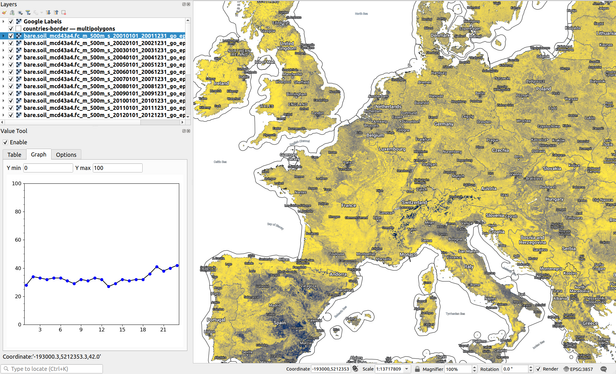
I've created the annual mean, max and standard deviation for (1) bare soil fraction, and (2) photosynthetic and (3) non-photosynthetic vegetation annual at 500 m resolution for 2001–2023 (the original data source is explained in Hill and Guerschman, 2022 / MCD43A4 product). You can access the data from: https://zenodo.org/doi/10.5281/zenodo.11961219
If you spot an issue or bug, please post here.
#OpenData #AI4SoilHealth #OpenEarthMonitor
We are hiring! Communication officer (Communication, Events, Multimedia) to support our Horizon Europe projects #OpenEarthMonitor (2022–2026); #AI4SoilHealth (2023–2026) and the int. projects such as WRI Land Carbon Lab / Global Pasture Watch (2022–2026). Do you have 3+ yrs experience in PR, event management and multimedia? Do you have a graphic design eye and can handle ultra-enthusiastic researchers from 5 continents? We might be a match. Deadline: 1st of July 2024. https://opengeohub.org/jobs/2024-communication-officer/
Communication officer - OpenGeoHub Foundation: Connect | Create | Share | Repeat

Application deadline: 1st of July 2024Possible start date: 1st of August 2024Duration: 2+ yearsJob location: Waldeck Pyrmontlaan 14, 6965HK Doorwerth, The

OpenGeoHub Foundation: Connect | Create | Share | Repeat
Are you looking for #OpenScience global environmental data sets to use for modeling or decision making? We are putting terrabytes of global COGs on https://OpenLandMap.org, part of our Horizon Europe #OpenEarthMonitor project and with many thanks to @gilabrs and colleagues from the OEMC project. To download data or analyze smaller parts in #qgis please use the oemc QGIS plugin (all explained in the GIF below). Let us know if you have problems accessing the data or ideas what we could add next!
OpenLandMap

Web site created using create-react-app

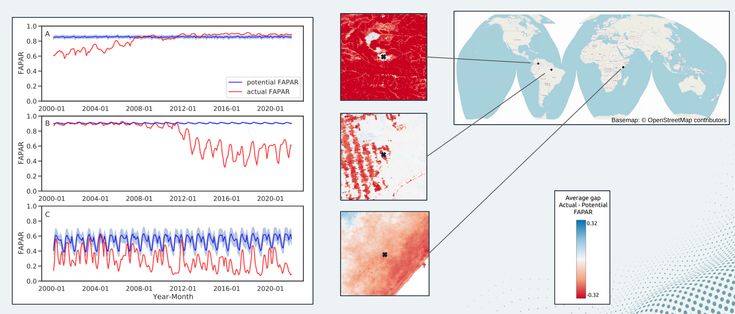
So proud of Julia @opengeohub and the #OpenEarthMonitor project in general for delivering cca. 1.4TB ARCO (analysis-ready cloud-optimized) #OpenData + models and trend-analysis all explained in @PeerJ paper:
"FAPAR monthly time-series at 250 m spatial resolution for 2000-2021"
https://peerj.com/articles/16972/
We specifically looked at differences between potential FAPAR and trends in FAPAR over the last 22 years. The gaps we estimated could help environmental agencies assess land degradation.
Land potential assessment and trend-analysis using 2000–2021 FAPAR monthly time-series at 250 m spatial resolution

The article presents results of using remote sensing images and machine learning to map and assess land potential based on time-series of potential Fraction of Absorbed Photosynthetically Active Radiation (FAPAR) composites. Land potential here refers to the potential vegetation productivity in the hypothetical absence of short–term anthropogenic influence, such as intensive agriculture and urbanization. Knowledge on this ecological land potential could support the assessment of levels of land degradation as well as restoration potentials. Monthly aggregated FAPAR time-series of three percentiles (0.05, 0.50 and 0.95 probability) at 250 m spatial resolution were derived from the 8-day GLASS FAPAR V6 product for 2000–2021 and used to determine long-term trends in FAPAR, as well as to model potential FAPAR in the absence of human pressure. CCa 3 million training points sampled from 12,500 locations across the globe were overlaid with 68 bio-physical variables representing climate, terrain, landform, and vegetation cover, as well as several variables representing human pressure including: population count, cropland intensity, nightlights and a human footprint index. The training points were used in an ensemble machine learning model that stacks three base learners (extremely randomized trees, gradient descended trees and artificial neural network) using a linear regressor as meta-learner. The potential FAPAR was then projected by removing the impact of urbanization and intensive agriculture in the covariate layers. The results of strict cross-validation show that the global distribution of FAPAR can be explained with an R2 of 0.89, with the most important covariates being growing season length, forest cover indicator and annual precipitation. From this model, a global map of potential monthly FAPAR for the recent year (2021) was produced, and used to predict gaps in actual vs. potential FAPAR. The produced global maps of actual vs. potential FAPAR and long-term trends were each spatially matched with stable and transitional land cover classes. The assessment showed large negative FAPAR gaps (actual lower than potential) for classes: urban, needle-leave deciduous trees, and flooded shrub or herbaceous cover, while strong negative FAPAR trends were found for classes: urban, sparse vegetation and rainfed cropland. On the other hand, classes: irrigated or post-flooded cropland, tree cover mixed leaf type, and broad-leave deciduous showed largely positive trends. The framework allows land managers to assess potential land degradation from two aspects: as an actual declining trend in observed FAPAR and as a difference between actual and potential vegetation FAPAR.

PeerJ