Thank you I. Asimov

Over in my Open + Curious project, I’ve been working intentionally to improve my writing. For Open + Curious the more recent articles all begin with a clear posit (a statement which is made on the assumption that it will prove to be true) and then go on to explain why I believe that to be true; that’s their finished form. I was generally writing each piece, editing it to find and hone a single line of thinking, and then finishing up by crafting the leading posit. Yes, I know, “Craig discovers the essay.”

I’m reading I. Asimov and this advice leapt off the page:

What I do now is think up a problem and a resolution to that problem. I then begin the story, making it up as I go along, having all the excitement of finding out what will happen to the characters and how they will get out of their scrapes, but working steadily toward the known resolution so that I don’t get lost en route.

When asked for advice by beginners, I always stress that. Know your ending, I say, or the river of your story may finally sink into the desert sands and never reach the sea.

~ Isaac Asimov

slip:4a1193.

I’ve now written thousands of posts where I’ve led with a quotation from something. I’m forever writing some observation about what I’ve quoted, and then trying to pivot to what I actually want to say. Unfortunately, this style has begun to feel constraining.

Going forward, I’m going to see what happens if I think of what I’m quoting as giving me a direction. This piece starts with my thoughts about my writing for Open + Curious, and then looking “in the direction” of Asimov’s quoted contribution, beyond that I “see” this gibberish about my writing process. Sorry, maybe that’s all too meta? It’s noisy in my head.

ɕ

#7ForSunday #IsaacAsimov #Meta #OnWriting #OpenCurious
Open + Curious

Open + Curious

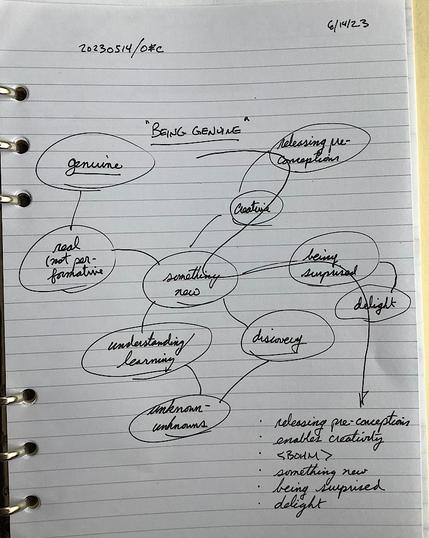
Maybe try a map?

First a hat tip to Austin Kleon. His most-recent post, Do you have a nemesis? included a mind map, which is the most-recent of the countless times I’ve encountered mind mapping. I’m a fan of Kleon for many reasons, not least of which is that he, like me, flouts the usual guidelines for the capitalization of one’s titles.

I’ve tried mind mapping a few times. (What’s that? Did I overdo it with software and processes? …yes, of course!) Today, I was feeling unmotivated to write for Open + Curious. I thought, “Just start. JUST START!” But I simply didn’t want to face the blank screen of the digital document.

Instead, I opened my idea garden wherein I capture interesting nuggets to be seeds for future writing. In my garden, I rarely (I first wrote “never,” but I don’t want to jinx myself) have trouble finding a nugget to write about. I grabbed my favorite pen, and flipped to a blank sheet in the little binder I keep. So much action! I felt like I was already writing. /s

On that mind map I wrote the “something new” at the center. It’s not a meaningless bit of meta; it’s the central idea from a captured nugget. At this point, staring at the paper with my pen in hand felt great, versus facing a digital document which always feels too structured for me to think in. (ref. Sönke Ahrens.) In just a few minutes of thinking and scribbling I had all those bubbles. Then I had a title. …then a route. …an outline. And from there the writing felt doable.

ɕ

#7ForSunday #MindMaps #OnWriting #OpenCurious #SönkeAhrens

Fragmentation

What if I don’t know how to take something apart? One option is to apply excessive force and break the thing open. That works, but obviously sacrifices the thing; this is particularly useless if I wanted to take something apart because I need to fix it, or understand it. Generally, the smash method always works, but is almost never useful.

Yet thought also goes wrong somehow, and produces destruction. This arises from a certain way of thinking, i.e., fragmentation. This is to break things up into bits, as if they were independent. It’s not merely making divisions, but it is breaking things up which are not really spearate. It’s like taking a watch and smashing it into fragments, rather than taking it apart and finding its parts. The parts are parts of a whole, but the fragments are just arbitrarily broken off from each other. Things which really fit, and belong together, are treated as if they do not. That’s one of the features of thought that’s going wrong.

~ David Bohm from, On Dialogue p56

I’m perpetually on a journey of self-awareness. I’m quite often applying my mind to understand things. This idea from Bohm about fragmentation, and in particular fragmentation being bad because it misses out on the relationships and inherent properties of the natural parts (in the sense of disassembled-watch parts versus smashed-watch bits). This idea of fragmentation is a warning against my running with the first way I manage to understand something; just because I’ve found one way to understand (smash) something into understandable pieces, doesn’t mean that’s the best way.

ɕ

#7ForSunday #Books #DavidBohm #OpenCurious #ThoughtAndPhilosophy
Craig Constantine

Presence, not pursuit.

Craig Constantine

Open + Curious Salon today

In the tradition of the literary and philosophical movements, each Open + Curious Salon is an opportunity to gather in real-time. It is a space where the exchange of ideas flourishes, where minds come together in spirited discussion, and where conversation skills are honed and practiced. Within the walls of the salon, the spirit of intellectual curiosity reigns supreme.

Details at https://openandcurious.org/

#OpenCurious

How do you end?

https://openandcurious.org/2024/07/06/how-do-you-end-2/

How can you effectively and gracefully end a conversation while maintaining its value and mutual appreciation?

Understand the balance between leaving a conversation fulfilled and seeking more.

Craig and Jesse discuss the complexities of ending conversations, beginning with the idea that most conversations naturally conclude due to external factors like time constraints. Craig notes that in many casual interactions, such as those at events or in public spaces, the end is often dictated by circumstances rather than a conscious decision.

I know I didn’t even try to get everything [from a conversation] because I know I can’t get everything. So it’s somehow finding a balance between: “Okay, my cup is full. I should really move away and just revel in what I have.” Finding a balance between that, and just going to the well until the cup comes up empty. I think that’s probably the compass for how to find a good ending.

~ Craig Constantine (4:25)

They explore the notion that it can be beneficial to end conversations while they are still engaging, rather than waiting until all topics are exhausted. Craig shares his experiences from recording podcasts, where he finds it challenging to end on a high note, emphasizing the importance of planning and strategies for graceful conclusions.

We’re here looking for ways to make conversation more alive […]. I’ve adopted this strategy of, stop eating when I want to eat a little bit more. stop talking when I want to talk a little bit more. Stop training, moving around and exercising when I want to move a little bit more. So that I’m actually left in the wanting of it […]

~ Jesse Danger (5:13)

They also touch on the distinction between enjoyable and uncomfortable conversations. Jesse brings up the idea of stopping activities, such as talking or training, while still wanting more, to maintain a sense of aliveness and enthusiasm. The conversation shifts to practical strategies for ending conversations, including honesty about one’s need to leave and expressing appreciation for the interaction.

Jesse references Peter Block’s concept from the book “Community,” suggesting that when ending a conversation, participants can share what they gained from the interaction, fostering a sense of closure and mutual respect. This approach, they agree, can enhance the quality and impact of the conversation.

Takeaways

Ending conversations naturally — External factors often dictate the conclusion of casual interactions.

Ending on a high note — Beneficial to conclude conversations while they are still engaging.

Challenges in planned endings — Strategies and planning are crucial for graceful podcast conclusions.

Distinction between conversation types — Different approaches are needed for enjoyable and uncomfortable conversations.

Maintaining enthusiasm — Stopping activities while still wanting more helps preserve a sense of aliveness.

Practical strategies — Honesty about the need to leave and expressing appreciation can aid in ending conversations.

Concept of shared appreciation — Participants can share what they gained from the interaction to foster closure.

Spontaneity in conversation exits — Creative and spontaneous actions can make leaving a conversation smoother.

Balancing conversation engagement — Finding a balance between getting enough out of a conversation and not exhausting all topics.

Resources

Community by Peter Block — Discusses the importance of commitment and shared appreciation in group settings.

The concept of “single-serving friends” from the movie Fight Club — Refers to brief, context-specific interactions that end naturally.

ɕ

(Written with help from Chat-GPT.)

#7ForSunday #Conversation #JesseDanger #OpenCurious

How do you end?

How can you effectively and gracefully end a conversation while maintaining its value and mutual appreciation? Understand the balance between leaving a conve

Open + Curious

Once awakened

https://openandcurious.org/2024/07/01/once-awakened-2/

What role does dialogue play in fostering a sense of connection and transformation within individuals and communities?

Can dialogue itself be more important than the decisions it leads to?

In this conversation, Craig and Jesse explore the concept of dialogue and its transformative power within communities. They begin by discussing a quote from the book “Dialogue” by Isaac, which suggests that once people experience genuine dialogue, they do not revert to superficial interactions.

So then I have to ask myself, how do I have to be in the world so that I can create more moments like that for myself? And for others? And what [for] the spaces that I create? When I’m creating spaces for groups? Or when I’m entering into spaces that already exist for groups? What can I do to bring that feeling? …that dialog? …that awakeness?

~ Jesse Danger (11:30)

Craig expresses uncertainty about the quote’s validity, as he feels he lacks enough sustained experiences of deep dialogue within consistent groups. He contrasts his sporadic podcast conversations with Isaac’s examples of embedded dialogue practices in communities. Jesse, on the other hand, shares his experiences of practicing deep dialogue within his company and recalls his time at a Danish school where dialogue was a core part of daily activities.

The conversation shifts to the impact of dialogue on individuals and groups. Jesse reflects on how his exposure to structured, meaningful conversations in school and at work has shaped his approach to relationships and decision-making. Craig ponders the possibility of creating similar spaces and recognizes that meaningful dialogue doesn’t necessarily require a large group; it can also occur in one-on-one interactions. They discuss the challenge of fostering these dialogic spaces in various contexts and contemplate how to bring the principles of deep dialogue into their everyday lives and communities.

Takeaways

The power of dialogue — Genuine dialogue has the potential to transform individuals and communities, making it hard to revert to superficial interactions once experienced.

Challenges of sustaining dialogue — Consistent deep conversations within the same group are rare and difficult to maintain, highlighting the challenge of embedding dialogue in daily routines.

Experiences in educational settings — Structured dialogue practices in schools can profoundly impact participants, fostering a sense of connection and mutual understanding.

Dialogue in professional environments — Prioritizing dialogue over decision-making in a company can lead to healthier organizational dynamics and better overall outcomes.

Personal growth through dialogue — Meaningful conversations with strangers or colleagues can open up new perspectives and deepen relationships.

Creating dialogic spaces — It is possible to foster spaces for dialogue in various contexts, from small groups to larger communities, by being intentional about conversation practices.

Individual responsibility in dialogue — One must consider how to bring the principles of deep dialogue into their daily interactions and be proactive in creating opportunities for meaningful conversations.

Reflecting on past dialogue experiences — Looking back at previous instances of deep dialogue can help identify the elements that made those conversations impactful and how to replicate them.

Resources

Dialogue by William Isaacs — A book exploring the transformative power of genuine dialogue within communities.

ɕ

(Written with help from Chat-GPT.)

#Conversation #JesseDanger #OpenCurious
Once awakened

What role does dialogue play in fostering a sense of connection and transformation within individuals and communities? Can dialogue itself be more important

Open + Curious