 Andy Arthur - Threadinburgh
The thread about a Leith communion token and how it can help us understand just why the Victorians built so many churches
This thread was originally written and published in October 2021.
Today’s Auction House Artefact is very topical given it’s the 31st October. No, it’s nothing to do with Halowe’en, sorry. It’s a Communion Token and of course today is also Reformation Day.
Front (MR. J. S. 1825) and Rear (ASSOte. CON LEITH) of a Leith Communion token. Drag the slider to compareIt’s just a small, roughly cast pewter token. But what is it, what do the abbreviations mean and what does it have to do with my usual subjects of interest? Well, obviously it’s marked LEITH, so that’s a start and the method by which it came to my attention. Beginning with what communion tokens are (and I’m no expert here, so do wade in if I’m wrong), they are peculiar to Reformed churches and the concept dates all the way back to John Calvin in the 16th Century. They were first issued in the Netherlands, but really became a thing of the Scottish reformed Kirk and all its various offshoots. There are at least 5,000 known different Communion tokens specific to Scottish churches alone. A communion token was a method to identify members of a congregation who practised “closed communion“; i.e. only known members of the congregation can participate. No token? No communion. Tokens were issued to those who had taken the necessary catechism (religious instruction).
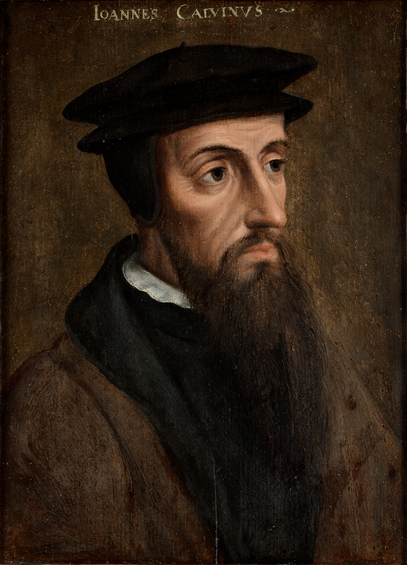
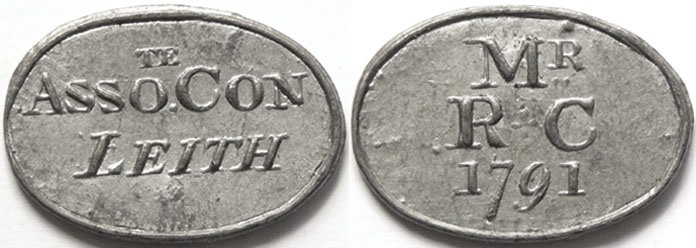
John Calvin, a key influence on John Knox, the architect of the Scottish ReformationBack to our token. What do the abbreviations mean? On the front it says, MR J. S. stands for “Minister, John Sharp”. The date of 1825 was not the date of issue of the token but most likely the date that the Rev. Sharp took over the congregation. On the rear, it stands for Associate Congregation, Leith, the name and denomination of the church. Below is an earlier issue, for Sharp’s predecessor, Robert Culbertson, who served from 1791 until his untimely death in 1823.
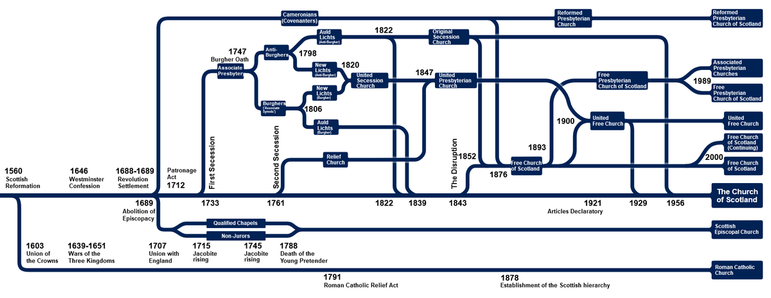
1791 Leith Associate Congregation communion tokenSo what is an Associate Congregation and why is it interesting I hear you say? Well to answer that you heave to delve into the amusingly elaborate timeline of the various reformed churches in Scotland since the (Scottish) reformation .
The timeline of the evolution of churches in Scotland from 1560If you go way back to 1733, some congregations began to secede from the established Church of Scotland (“the Kirk“). The Seceders left for various long-standing and unresolved reasons, particularly the threat of the patronage of Lairds in preventing a congregation choosing its own minister, which has been a key issue in Scottish Presbyterian churches since the Reformation. The Seceders were led by Ebenezer Erskine, minister in Stirling, formed their own church court, known as the Associate Presbytery.
Ebenezer Erskine, 1680-1754. CC-BY-NC National Galleries ScotlandThey were summoned to answer by the Kirk in 1739 but refused as they did not recognise its authority over them, so were deposed. This had two effects. Firstly, the seceder congregations were ejected from their churches so had to find new homes. It also rallied parishioners to their cause and the new churches ranks were swelled. At this time I’m not sure what presence, if any, they had in Leith. This split was around a religious clause in the oath that burgesses had to take. The burgesses were the “freemen” of the burgh, an important position in Scottish society at the time. The “Burgher Oath” had to be taken in the royal burghs of Edinburgh, Glasgow and Perth. The hardliners refused to take the oath as they felt it would mean that they recognised the authority of The Kirk. The result was that the General Associate Synod split off of the Associate Synod, these two sects are better known as the Antiburghers and Burghers. So this is why you get those odd-sounding things on old maps of Edinburgh called Burger Meeting and Antiburger Meeting houses.
Seceder Meeting House, 1765Antiburgher Meeting House, 1784Burger Meeting House, 1784Different seceder meeting houses in the 1765 and 1784 Edinburgh Town Plans. Reproduced with the permission of the National Library of ScotlandMaps of this time refer to “meeting houses” or “chapels”, likely they were not officially recognised by the mapmakers as churches in their own right, this title being reserved for the parish kirks alone. From the maps we can see a Seceders’ church on Bristo Street in 1765 and by 1784 it is the Burgher Meeting house and the Antiburghers have their own separate house.
If you’re still following, give yourself a pat on the back, because it’s about to get even more confusing…
But before then, let’s go back to Leith. The first Antiburgher Church was formed in the Kirkgate in Leith in 1766 following a stushie within the South Leith Kirk congregation over the appointment of the new minister William Aitken. They met in a meeting house on Cables Wynd, ordaining a minister John Proudfoot in 1772. Funds were raised to erect a purpose built church on the Kirkgate just over the wall from South Leith Kirk, which was completed in 1775.
The Antiburgher Meeting House off the Kirkgate in Leith, 1804 Town Plan by Ainslie. Reproduced with the permission of the National Library of ScotlandIn 1785, the Rev. Proudfoot was suspended by the Antiburgher synod and deposed. This caused a split within his congregation. Some members returned to South Leith Kirk, but most stayed with Proudfoot as a “free” Antiburgher church. Proudfoot died in 1787 and his Antiburgher congregation petitioned the Burghers to join. This was granted and so once again there was a split, and the Antiburghers left to do their own thing, leaving the Burghers in the Kirkgate. The Antiburghers who left the Kirkgate petitioned the Antiburgher church, were welcomed back in and a new congregation was established in the old Glasite Meeting House (let’s not go there!) off of St. Andrew’s Street, becoming the St. Andrew’s Street Antiburghers.
St. Andrew Street Chapel (Congregational), from 1849 OS Town Plan. Reproduced with the permission of the National Library of ScotlandAnyway, in 1791, they appointed Robert Culbertson as their minister who was quite the scholar and patron of many things. He was notable enough to be subject to a caricature by John Kay. His church was an Associated Congregation, i.e. a member of the General Associated Synod, hence the stamp on the communion tokens. In 1798 however yet another split happened resulting in the Antiburghers splitting into Auld Lichts and the New Lichts (old and new lights). The same happened to the Burghers eight years later.
John Kay’s caricature of Rev. Robert CulbertsonCulbertson was a New Licht Antiburgher, more theologically liberal than the Auld Lichts who held more strictly to Calvin and the Covenanting tradition. He was a popular and influential minister and donated heavily to the Edinburgh Bible Society and the Leith Public Library. Soon, the New Lichts of the Burgher and Antiburgher churches realised what united them was greater than what divided them, and a union took place. Culbertson was on the negotiation committee and “greatly rejoiced” on its success. The result was the United Secession Church of 1820 . Culbertson died an untimely death in 1823, falling ill during a meeting of the presbytery of the new church. He did not live to see his congregations grand new premises, which was not completed until 1826.
The Auld and New Lichts split off of the Anti-Burgher and BurghersThat church was built on land acquired from the city next to the High School of Leith, built by John and James Rutherford in the classical style. The St. Andrew’s Street congregation named the new street St. Andrew’s Place after their church. The building is now the B-listed Edinburgh Hindu Mandir & Cultural Centre.
St. Andrews Place United Secession Church. © Edinburgh Hindu Mandir & Cultural CentreIn 1825, Culbertson’s vacant pulpit was filled by the Rev. John Smart (1801-1871), who initially lived opposite on Morton Street. Smart was minister until 1845. In 1847 the United Secession Church merged with another split off of the Kirk – the Relief Church*1 of 1761 – to form the United Presbyterian Church, which is what all those “U. P. Churches” are on Victorian maps of Scottish towns.
John Smart, by Thomas Dick. CC-by-NC National Galleries ScotlandSo in 1849, the Antiburgher church is now the St. Andrew’s United Presbyterian Church, (“seats for 1400” – the established South Leith Kirk only had 1200). The original hall was half that size and kept on as a meeting hall.
St. Andrew’s United Presbyterian Church. 1849 OS Town Plan. Reproduced with the permission of the National Library of ScotlandRemarkably, a photo exists of the original meeting house off St. Andrew’s Street. It was actually on Storrie’s Alley. It is seen here in the early 1960s when it was used by the YMCA, before being swept away. The French-style roofline of Yardheads School is the giveaway of the location, peeping out to the left of the church gable. The hall stood infront of the remaining old buildings, a former bonded warehouse..
The original St. Andrew’s Street Antiburgher Church, overlaid on the modern streetIn the late 1880s/early 1890s, the St. Andrew’s Place congregation opened a mission hall on Jane Street in Leith, a charming little building which is still there and is some sort of hotel/hostel thing.
St. Andrew’s Place U. P. Church Mission HallBack to our diagram. In 1900, the U.P. Church joined with the Free Church (of the ominous sounding “Disruption of 1843“) to form the United Free Church (or U.F. Church on maps). By this time, the Kirkgate Congregation was also in this fold.
The formation of the United Free Church in 1900The Kirkgate congregation had by this time moved to a new and altogether grander premises on Henderson Street (see pictures below). While this fine and unusual looking church has unfortunately been demolished, that carving above the door and the cross survive as ornamentation on the otherwise modern and austere South Leith church halls.
Kirkgate U.P. ChurchThe frieze above the doorAnd today, the South Leith parish church hallsThe Kirkgate U.P. Church on Henderson Street,In another picture from Edinburgh City Libraries, here we see the entrance to Storrie’s Alley off of St. Andrew’s Street. In amongst all the Victoriana we see a lantern pointing the way to the St. Andrew’s Hall.
Lantern pointing to St. Andrew’s Hall © Edinburgh City LibrariesThe St. Andrews associate congregation completed its 360 degree journey in 1929 when it was one of the United Free Church congregations that merged back into The Kirk, becoming Leith St. Andrews. In 1973 it joined with the Claremont Church of Scotland at the foot of Easter/ Lochend Roads and relocated to the latter premises, which took up the name of St. Andrew. Around 2003, this combined congregation was joined by another from the district; that of Junction Road and St. Thomas’, as two more old churches in Leith became surplus to modern requirements.
St. Andrew’s Church of Scotland at the foot of Easter Road. CC-BY-SA Alan Murray-RustWhen the Kirkgate Associate Congregation moved to its new home on Henderson Street in 1886, the old church became the Princess Theatre and music hall, which burned down 2 years later (as such places often did). The New Princess, later the Gaiety, rose from the ashes. The Kirkgate Congregation followed the route of St. Andrew’s Place, and returned to the Church of Scotland in 1929. It merged with the South Leith congregation in 1973 and vacated the Kirkgate Church, which was demolished and replaced by the South Leith Church Halls.
Anyway, the moral of the story is that even if you are not religiously inclined it pays to get your head around at least a bit of it as it really helps understand maps and buildings and local history. Especially the question “why did the Victorians build so many dang churches?”.
Note to readers: unfortunately in April 2026, a third-party plug-in more than exceeded its authority and broke many of the image links on this site. No images were lost but I will have to restore them page-by-page, which may take some time. In the meantime please bear with me while I go about rectifying this issue.
If you have found this site useful, informative or amusing then you can help contribute towards its running costs by supporting me on ko-fi. This includes my commitment to keeping it 100% advert and AI free for all time coming, and in helping to find further unusual stories to bring you by acquiring books and paying for research.
Or please do just share this post on social media or amongst friends and like-minded people, sites like this thrive on being shared.
Explore Threadinburgh by map:
Travelers' Map is loading...If you see this after your page is loaded completely, leafletJS files are missing.
These threads © 2017-2026, Andy Arthur.
NO AI TRAINING: Any use of the contents of this website to “train” generative artificial intelligence (AI) technologies to generate text is expressly prohibited. The author reserves all rights to license uses of this work for generative AI training and development of machine learning language models.
#Lochend #Logan #Restalrig #StMargaret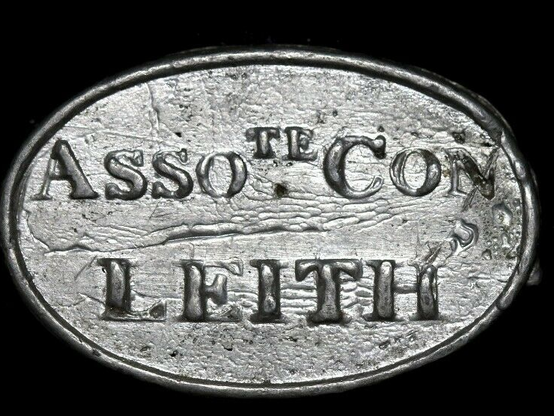
 Sofi Repengraf

 Sofi Repengraf
 Sofi Repengraf
 Sofi Repengraf
 Bahdlex