 Cuilfail
#FensterFreitag #CountryComesToTown #NationalGalleriesScotland Modern 1 Stairwell view of Charles Jenks' Landscape Art

J.M.W Turner and the Vaughan Bequest
Henry Vaughan was a prominent and philanthropic Victorian art collector, having inherited a substantial fortune from his father, a wealthy hat maker. His encounter with JMW Turner in the 1840s spurred his passion for the artist’s drawings and watercolors, resulting in an extensive collection that spanned Turner’s entire career. Influenced by John Ruskin’s advocacy for public art bequests, Vaughan generously donated pieces to various museums and galleries throughout Britain, including the National Galleries of Scotland.
Harbour View by Joseph Mallord William Turner (Creative Commons CC by NC National Galleries Scotland.) This harbour view may depict Margate on the Kent coast in south-east England, one of Turner’s favourite placesHenry Vaughan made a significant contribution to Scotland’s National Collection in 1900. His donation of 38 watercolours by J.M.W. Turner was accompanied by a stipulation that they be exhibited to the public free of charge during the month of January each year. This careful curation has played a crucial role in preserving the spectacular colour and vibrancy of these works, ensuring their lasting impact for generations to come.
One significant aspect of Vaughan’s legacy was his awareness of the need to preserve watercolours, which are prone to fading if overexposed to light. That is why he specified that the watercolours should be “exhibited to the public all at one time free of charge during the month of January,” while at all other times they were to be stored in a dedicated cabinet in the Print Room.
Senior Paper Conservator James Berry demonstrates the detrimental effects of light on watercolors – Preserving Watercolors
Conservator James Berry: Preserving WatercolorsThe Early Life of Henry Vaughan
Henry Vaughan, born on 17 April 1809 in Southwark, London, was brought up in a Quaker household alongside his elder brother George and sister Mary. Their father, George Vaughan, was a prosperous hat manufacturer. Henry received his education at a school in Higham Hill, Walthamstow, under the guidance of Eliezer Cogan. Notably, one of his fellow pupils at the school was none other than Benjamin Disraeli.
Tragedy struck in 1828 with the passing of Henry’s father, leaving him a considerable inheritance. Despite leading a seemingly self-indulgent life, Henry later established himself as an exemplary art collector and a remarkably generous philanthropist, leaving a lasting legacy in the world of art and culture.
Loch Coruisk, Skye by Joseph Mallord William Turner (Creative Commons CC by NC National Galleries Scotland), This work was engraved in 1834 and published in Scott’s Poetical Works, in the volume containing his poem The Lord of the Isles.Art Collectors & Benefactors
Art collectors and benefactors play a pivotal role in promoting art by providing crucial support for artists, preserving artistic legacies, and fostering public access to art. Their contributions help to sustain and elevate the cultural landscape by safeguarding the works of artists, ensuring their preservation for future generations. By acquiring and maintaining art collections, they prevent the loss of significant cultural treasures and encourage innovation within the art world. Their financial support of artists encourage innovation within the art world, fostering creativity and cultural experiences for future generations.
Through purchases and patronage, art collectors provide financial stability for artists, enabling them to continue creating and contributing to the art world. They facilitate public access to art by often donating or loaning their collections to museums, galleries, and cultural institutions. This allows a wider audience to appreciate and engage with diverse works of art. They encourage innovation within the art world, fostering creativity and cultural experiences for future generations.
Art collectors and benefactors nurture the vitality and accessibility of art, enriching cultural fabric of society.
https://chasingart.com/2024/05/10/conserving-the-watercolours-of-j-m-w-turner/
#FridayPainting #GLAM #HenryVaughan #JosephMallordWilliamTurner #NationalGalleriesScotland


Sir Walter Scott and J.M.W. Turner shared a connection that spanned both friendship and artistic collaboration. Their partnership began with Scott’s renowned series of narrative poems, collectively known as the “Poetical Works,” which fascinated Turner. Recognizing the power of Scott’s words to evoke vivid imagery, Turner sought to visually bring these literary masterpieces to life through his illustrations.
Turner’s admiration for Scott’s poetic talent led him to approach the publisher Archibald Constable, who introduced him to Robert Cadell, Scott’s publisher and close associate. Seeing the potential in combining Scott’s evocative poetry with Turner’s exceptional artistic skills, Cadell facilitated their collaboration.
Initially, Turner’s illustrations for Scott’s poems were based on earlier sketches and second-hand descriptions of Scottish landscapes. However, both Scott and Cadell recognized the need for authenticity and accuracy to capture the essence of Scott’s work. They insisted on Turner returning to Scotland to make fresh sketches, believing that his firsthand experience of the landscape would greatly enhance the illustrations.
In May 1831, Turner embarked on a two-month journey through Scotland.
In May 1831, Turner embarked on a two-month journey through Scotland, meticulously documenting the landscapes and architectural landmarks that served as inspiration for Scott’s poetry. He filled his sketchbooks with detailed drawings and watercolor studies, capturing the rugged beauty and romantic atmosphere of the Scottish scenery.
Upon his return, Turner set to work on the watercolor illustrations, employing his trademark luminous colors and atmospheric effects. The resulting artworks showcased his mastery of the medium, infusing each scene with a sense of drama, emotion, and historical context.
The collaboration between Turner, Scott, and Cadell proved to be a artist/writer success. The illustrations brought Scott’s poems to life, creating a visual narrative that resonated with readers and further solidified Turner’s reputation as a preeminent landscape painter.
The connection between Sir Walter Scott and J.M.W. Turner went beyond mere artistic collaboration. They developed a mutual respect and friendship that lasted throughout their lives. Scott greatly valued Turner’s artistry, and Turner, in turn, deeply appreciated Scott’s literary genius.
To this day, Turner’s watercolor illustrations for Sir Walter Scott’s “Poetical Works” are celebrated as a testament to his artistic genius and his ability to capture the spirit of a literary masterpiece through visual interpretation. They continue to inspire audiences, bridging the gap between literature and art, while serving as a remarkable testament to the enduring bond between these two great visionaries of their time.
Staffa, Fingal’s Cave
Joseph Mallord William Turner – Staffa, Fingal’s Cave (Public Domain via Wikimedia Commons)Joseph Mallord William Turner’s artwork titled “Staffa, Fingal’s Cave” showcases his mastery of capturing the sublime beauty of nature. This particular piece depicts the famous Fingal’s Cave, located on the uninhabited island of Staffa in Scotland. It is said that Turner was inspired to paint this scene after hearing about the cave’s legendary acoustics and its association with Celtic folklore.
George IV at St Giles’s, Edinburgh
Joseph Mallord William Turner; George IV at St Giles’s, Edinburgh; Tate; – Art UK, Public domain, via Wikimedia CommonsJoseph Mallord William Turner’s artwork titled “George IV at St Giles’s, Edinburgh” is a portrayal of the monarch’s visit to the iconic St Giles’s Cathedral in Edinburgh. The painting showcases Turner’s exceptional ability to capture the grandeur and atmosphere of historical events.
Melrose Abbey
Joseph Mallord William Turner, Melrose Abbey (Public Domain via Wikipedia Commons)The ruins depicted in the watercolor are those of Melrose Abbey, located on the banks of the River Tweed in Eastern Scotland. This particular artwork was commissioned by Turner’s patron, Walter Fawkes, to illustrate the poem “Lay of the Last Minstrel” by Sir Walter Scott, which was published in 1805. This collaboration between Turner, Scott, and Fawkes is a testament to their mutual appreciation for art and literature.
Chiefswood Cottage, Abbotsford
Joseph Mallord William Turner Creative Commons CC by NCSir Walter Scott’s eldest daughter, Charlotte Sophia, and her husband John Gibson Lockhart, enjoyed the idyllic charm of Chiefswood Cottage, depicted by Joseph Mallord William Turner as a fairy-tale retreat, bathed in sunshine and framed by trees. Turner’s poignant portrayal includes subtle yet powerful references to the absence of the great writer, Sir Walter Scott, such as the empty chair in the shade and the desk set with an inkwell and stool. This heartfelt depiction, worked up from earlier sketches after Scott’s passing in 1832, immortalizes the tranquil beauty of Chiefswood Cottage within the Abbotsford estate.
https://chasingart.com/2024/04/19/the-friendship-of-jmw-turner-and-sir-walter-scott/
#FridayPainting #JosephMallordWilliamTurner #NationalGalleriesScotland #Scotland #SirWalterScott


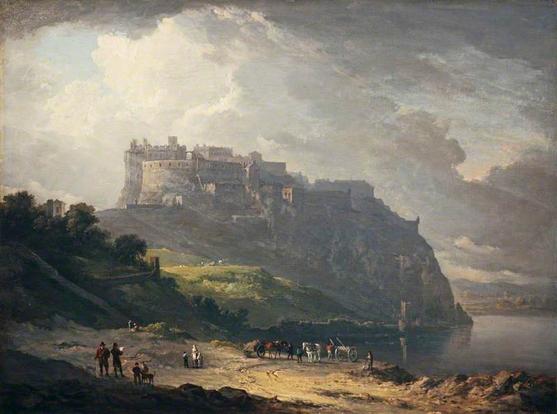
This painting shows the Nor’ Loch, which covered the ground now occupied by Princes Street Gardens. At the time Nasmyth was painting the loch had already been drained so the artist intended a reminiscence or reconstruction of the original appearance of this site. The building of the Royal Institution on The Mound in the 1820s might very naturally have prompted the artist to think about the site in its original form.
Nasmyth, Alexander; Edinburgh Castle and the Nor’ Loch; National Galleries of Scotland;Alexander Nasmyth was a Scottish landscape painter and portraitist. He is known for his picturesque and detailed depictions of the Scottish countryside, including his famous painting “Edinburgh Castle and the Nor’ Loch.” Nasmyth was born in Edinburgh, September 9, 1758. He trained under his father, Alexander Nasmyth Sr, a landscape architect.
In 1773, Nasmyth moved to London. He studied at the Royal Academy in London, where he was influenced by the works of artists such as Thomas Gainsborough and Joshua Reynolds. Nasmyth’s landscapes often featured grand subjects, such as castles, lakes, and mountains, showcasing the natural beauty of Scotland. His paintings are characterized by their precise attention to detail and atmospheric effects. Nasmyth’s works had a significant influence on later Scottish landscape painters and continue to be admired for their historical and artistic value.
Nasmyth returned to Edinburgh in 1780 and established himself as a successful portraitist and landscape painter. He became renowned for his picturesque and detailed depictions of the Scottish countryside, capturing the natural beauty of Scotland’s landscapes.
Apart from his artistic pursuits, Nasmyth also had a keen interest in engineering and played a significant role in the development of the Forth and Clyde Canal. He even designed a steam road carriage, although it was never commercially successful.
Nasmyth continued to paint throughout his life and became a respected member of the Scottish art community. He passed away on April 10, 1840, leaving behind a legacy of beautiful and influential landscape paintings. His works continue to be appreciated for their historical and artistic value and have had a lasting impact on Scottish landscape painting.
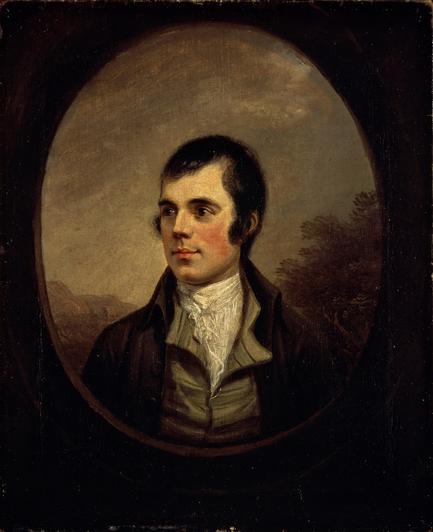
Alexander Nasmyth was the artist behind the iconic portrait of Robert Burns, the celebrated Scottish poet. Nasmyth’s portrait of Burns is not only a significant contribution to the portrayal of the poet, but it has also become a staple of Burns Suppers, adorning the walls of venues where these traditional events are held. The portrait captures the essence of Burns, adding to the cultural legacy of the renowned figure.
https://www.nationalgalleries.org/art-and-artists/1962/0https://chasingart.com/2023/11/30/alexander-nasmyth-edinburgh-castle/
#AlexanderNasmyth #EdinburghCastle #NationalGalleriesScotland #RobertBurns
Elisabeth (Bessie) MacNicol, a Scottish artist, studied at the Glasgow School of Art from 1887 to 1893. During this time, she had the opportunity to work alongside talented contemporaries such as the Macdonald sisters Margaret and Frances, Jessie Keppie, and Kate Cameron.
In 1893, MacNicol showcased her work at the prestigious Royal Academy in London, and later pursued further studies at the Académie Colarossi in Paris. From 1893 to 1904, she consistently contributed to the Glasgow Institute of Fine Arts exhibitions, gradually gaining recognition for her talent.
In 1896, MacNicol established her first studio at 175 St Vincent Street and held her solo exhibition at Stephen Gooden’s Art Rooms in Glasgow in 1899. Although she only occasionally exhibited at the Royal Scottish Academy, her reputation flourished as she showcased her work in various international locations such as Ghent, Munich, Vienna, Pittsburgh, and St Louis.
Self-Portrait 1894 by Elizabeth MacNicol, Public domain, via Wikimedia CommonsBessie MacNicol’s Artistic Evolution
In the late 1890s, Bessie MacNicol’s favoured subjects revolved around portraying young girls posing under trees, bathed in dappled sunlight. Through these works, she sought to encapsulate the youth and beauty of her subjects within the backdrop of nature and the changing seasons.
This thematic focus showcased MacNicol’s penchant for infusing her paintings with a sense of timeless elegance and the fleeting beauty of youth, creating a juxtaposition against the natural world. Her ability to capture the essence of youth and nature in harmonious settings contributed significantly to the allure and enduring appeal of her artistic oeuvre.
Under the Apple Tree, 1899, by Elisabeth (Bessie) MacNicol, Public domain, via Wikimedia CommonsTragically, on 4 June 1904, at the age of 34, Bessie MacNicol passed away in the late stages of a pregnancy due to eclampsia, leaving behind a promising career. Today she is known as one of The Glasgow Girls, among whom are also numbered Margaret MacDonald, Frances MacDonald, Jessie M. King, Jessie Wylie Newbery, Ann Macbeth, and Norah Neilson Gray.
These women made significant contributions to the Scottish art scene, advocating for the prominence of the “Glasgow Style” and leaving a lasting impact on the art world.
For more information on Elisabeth (Bessie) MacNicol, visit Art UK and National Galleries Scotland,
https://chasingart.com/2024/02/16/the-glasgow-girls-bessie-macnicol/
#BessieMacNicol #GLAM #NationalGalleriesScotland #TheGlasgowGirls


“The Storm” created by the Scottish artist William McTaggart depicts the powerful force of nature as a storm brews on the horizon.
William McTaggartThe Storm by William McTaggart depicts a thunderous sky, lashing wind, and turbulent sea through energetic brush work and bold color. The vulnerability and courageous struggle of man in the face of natural forces are suggested by the presence of a tiny fishing vessel at sea and the launching of a rescue boat from the shore. In the foreground, anxious families wait. The figures are fully integrated into the landscape.
William McTaggart was born in 1835 in the small village of Aros, near Campbeltown, in Kintyre, a western peninsula of Scotland. The son of a crofter, he lived and worked in Scotland throughout his life. His land and seascapes showcase his deep interest in nature and the connection between mankind and the natural world. His use of vibrant colours and energetic brushstrokes aligns with the techniques employed by Impressionist painters, while still remaining rooted in the unique Scottish artistic tradition.
Living near the coast allowed McTaggart to observe and capture the ever-changing moods of the sea and the dramatic skies that often accompanied them. The rugged landscape and the powerful forces of nature in Scotland served as inspiration for many of his landscape and seascape paintings, including “The Storm.”
Andrew Carnegie, the renowned industrialist, purchased William McTaggart’s painting “The Storm.”
Andrew Carnegie had a deep appreciation for art and was known for his extensive art collection. Acquiring William McTaggart’s masterpiece showcases Carnegie’s discerning taste and his support for talented artists. “The Storm” must have caught Carnegie’s attention with its captivating portrayal of nature’s power and the artist’s skillful technique.
In 1935, “The Storm” was presented to The National Galleries of Scotland by Andrew Carnegie’s widow, Louise Whitfield Carnegie.
For anyone interested in learning more about William McTaggart, Internet Archive has a biography of William McTaggart by James L. Caw. James Caw was a prominent figure in the Scottish art world. In 1907, he was appointed the Director of The National Gallery of Scotland (as it then was). Two years later in 1909, he married Anne Mary McTaggart, daughter of William McTaggart.
“It was my privilege to have lived upon terms of the closest intimacy with him for the last twenty years of his life, to have heard him speak of his past, to have watched him at work, to have seen and studied most of his pictures ; and, since his death, not a few of his friends and admirers have suggested that it was a duty incumbent upon me to make a record of what I knew.”
James L. Caw “William McTaggart – A Biography and an Appreication“
https://chasingart.com/2023/11/03/the-storm-by-william-mctaggart/
#AndrewCarnegie #NationalGalleriesScotland #Scotland #TheStorm #WilliamMcTaggart

At The Galleries - Lynn
Back to the end of July 2016, on the cusp of The Festival of that year.
Image in our web gallery here - https://www.henni.photo/Edinburgh/Street-Vignettes/i-hGsT37D/A
Our photo locations here - https://www.henni.photo/Photo-Locations-Map
#Edinburgh #NationalGalleriesScotland #Photo #Photography #BlackAndWhite


Photo by and copyright of Lynn Henni. A black and white photo of people sitting in a line on top of a rectangular, stone built, vent, legs dangling. They are beside the southern building of The National Gelleries Of Scotland at the foot of The Mound. Taken at the very end of July, on the cusp of The Edinburgh Festival, they appear to be visitors and are consulting phones and books. Edinburgh, Scotland.

'Mountain in the Snow', photographer unknown: https://www.nationalgalleries.org/art-and-artists/120714?search=snow&search_set_offset=5

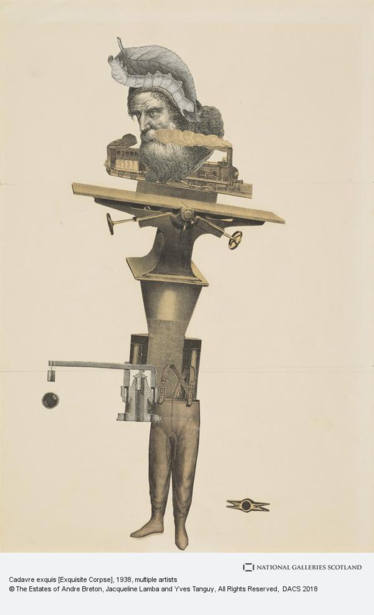
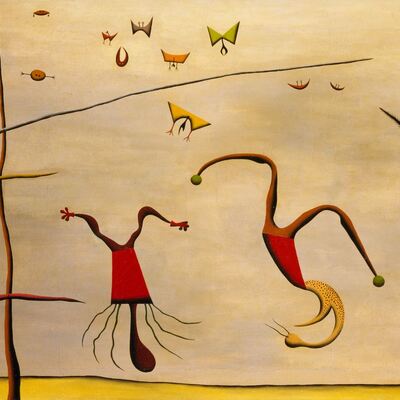
Two bike crashes in the past month and I’m feeling like this guy.
#AndreBreton #JacquelineLamba #Yves Tanguy #ExquisiteCorpse #NationalGalleriesScotland #biking https://i.pinimg.com/originals/78/be/de/78bedeba9a4ab7ad4e00728339141b91.png
 ChasingART
 HenniPhoto
 Saraphir Camille
 Barb Milne
 aeshnid