🛸🚀 Ah, yes, the "insane hack" that saved a 46-year-old space antique — because nothing screams cutting-edge technology like a software update from the 1970s! 🕰️🤦‍♂️ Clearly, NASA's next mission: teaching it to make coffee. ☕🔧
https://www.youtube.com/watch?v=p0K7u3B_8rY #spaceantique #insanehack #softwareupdate #NASAtechnology #techhumor #HackerNews #ngated
The First Interstellar Software Update - The Insane Hack That Saved Voyager 1

YouTube

At #AGU22? Don't miss #NASA activities by following @NASAExhibit!

If you're not at @theAGU event, you can still tune in to our hyperwall story at 3:25pm CT on how to use NASA's Eyes to follow the #CAPSTONE spacecraft & others around the Moon and in space: https://youtu.be/C9qSz70tI14
#NASATechnology

NASA Science Hyperwall Stories at the American Geophysical Union Fall Meeting 2022 – Tuesday, 12/13

YouTube
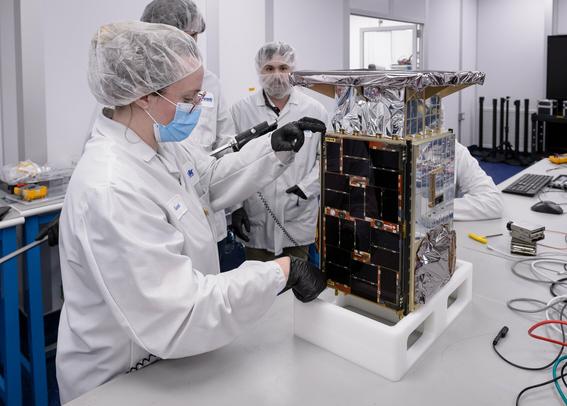
Targeted for launch aboard a @SpaceX Falcon 9 no earlier than Dec. 11, at 2:38 a.m. EST, our tiny Lunar Flashlight satellite will head to an orbit around the Moon where it will use lasers to light up dark craters to hunt for hidden water ice. Learn more: https://go.nasa.gov/3hhggys
#NASATechnology
NASA’s Lunar Flashlight SmallSat Readies for Launch

The small satellite will search for water ice in permanently shadowed craters at the Moon’s South Pole, using an orbit only one other spacecraft has employed.

NASA
A new round of awards to researchers at U.S. universities will support tech development in nuclear propulsion, space communications, atmospheric entry, advanced materials, and high-temperature radiators. Here are our 2022 Early Stage Innovation selections: https://go.nasa.gov/3B38ONR
#NASATechnology
NASA Awards to US Universities Bolster New Technology Research

NASA Awards to US Universities Bolster New Technology Research

NASA
Our Stereo Camera for Lunar Plume-Surface Studies (SCALPSS) has been delivered to @Firefly_Space for its Commercial Lunar Payload Services flight. The tiny camera will help study surface regolith activity beneath the lander as it touches down on the Moon: https://go.nasa.gov/3Ed7hXE
#NASATechnology
Tiny NASA Cameras to Watch Commercial Lander form Craters on Moon

This little black camera looks like something out of a spy movie — the kind of device one might use to snap discrete photos of confidential documents.

NASA
Our Moon-orbiting #CAPSTONE CubeSat is among Popular Science’s "Best of What's New" #BOWN22 greatest innovations of the year! Congrats to @NASAAmes, @AdvancedSpace, @TerranOrbital & other industry partners who achieved big things with this small satellite: https://go.nasa.gov/3Um2jwr
#NASATechnology
CAPSTONE Forges New Path for NASA’s Future Artemis Moon Missions

NASA's CAPSTONE spacecraft has completed final maneuvers to place it in its target orbit around the Moon, refining its path in the orbit it arrived to last week.

NASA
We awarded @ICON3DTech a #smallbiz contract to continue work on a construction system that could be used on the Moon and Mars! This technology is designed to use local resources to build infrastructure such as landing pads, habitats, roads, and more: https://go.nasa.gov/3FeRNmC
#NASATechnology
NASA, ICON Advance Lunar Construction Technology for Moon Missions

As NASA plans for long-term human exploration of the Moon under Artemis, new technologies are required to meet the unique challenges of living and working on another world.

NASA
The second set of International @Space_Station Roll Out Solar Arrays were delivered on Nov. 27. Once installed, they will be part of the plan to provide a 20-30% increase in power for station research and operations. Find out how iROSA tech got its start: https://go.nasa.gov/3DyCcvQ
#NASATechnology
Impact Story: Roll-Out Solar Arrays

Impact Story: Roll-Out Solar Arrays

NASA
This #SmallBusinessSaturday, we're sharing a few examples of #smallbiz innovators who worked with @nasa @sbirgov to develop tech for our missions while impacting life on Earth. From a sustainable protein alternative to compactable satellite antennas, read on to learn more.
#NASATechnology
For humans to live far from Earth, we'll need food easily produced with minimal resources. With STTR funds, @naturesfynd & @montanastate developed a bioreactor to cultivate fungus into an edible protein. The tech will soon be tested on the @Space_Station: https://go.nasa.gov/3Vw0VZ6
#NASATechnology
Low-Maintenance Bioreactor Cultivates Fungi for Sustainable Food Source in Space | NASA SBIR & STTR Program Homepage