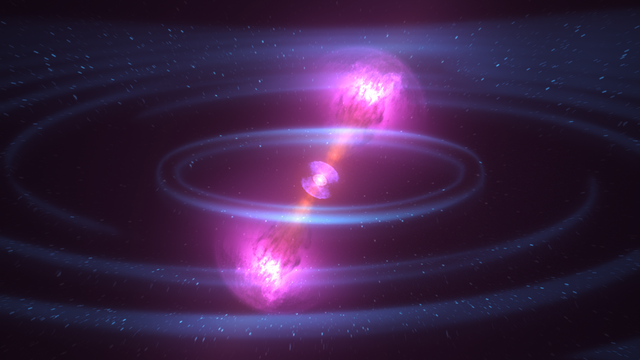
https://astrotube.obspm.fr/videos/watch/88ae041e-40f5-42f5-9a5d-a7265bb0baa4


The detection of transient phenomena such as Gamma-Ray Bursts (GRBs), Fast Radio Bursts (FRBs), stellar flares, novae, and supernovae, alongside novel cosmic messengers like high-energy neutrinos and gravitational waves, has transformed astrophysics in recent years. Maximizing the discovery potential of multi-messenger and multi-wavelength follow-up observations, as well as serendipitous detections, requires a tool that rapidly compiles and contextualizes relevant information for each new event. We present Astro-COLIBRI, an advanced platform designed to meet this challenge. Astro-COLIBRI integrates a public RESTful API, real-time databases, a cloud-based alert system, and user-friendly clients (a website and mobile apps for iOS and Android). It processes astronomical alerts from multiple streams in real time, filtering them based on user-defined criteria and placing them in their multi-wavelength and multi-messenger context. The platform offers intuitive data visualization, a quick summary of relevant event properties, and an assessment of observing conditions at numerous observatories worldwide. We here describe its architecture, data resources, and main functionalities. We highlight the automatic collection of photometric data from a variety of large scale optical surveys, a recently added feature that significantly improves the capabilities of the Astro-COLIBRI platform.
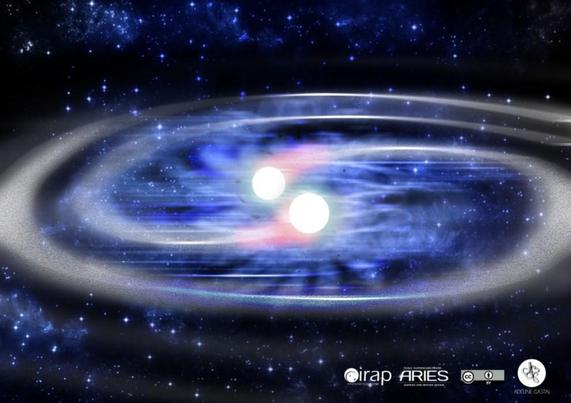
[#MultiMessenger Astrophysics] The very first colloquium of the #astrophysics Center for Multimessenger Studies in Europe (#ACME) is being held this week in Toulouse. It brings together numerous specialists in #GRB, #kilonovae, compact #binaries and more. These are the main transient and periodic sources of gravitational waves that travel through our #Universe, and which numerous experimental devices are attempting to intercept - from both ground and space.
More info: https://acme-grav-waves.sciencesconf.org/
An interdisciplinary research team, including scientists from @mpi_grav in Potsdam, has developed an innovative machine learning method. It makes it possible to precisely analyze gravitational waves from colliding neutron stars 💥 in a fraction of a second. ⏱️
The new algorithm DINGO-BNS could revolutionize multi-messenger astronomy. 🔭
📄 https://www.nature.com/articles/s41586-025-08593-z
#astrophysics #GravitationalWaves #astronomy #NeutronStars #MultiMessenger #MachineLearning
Observing binary neutron star mergers is high on the wish list of astronomers. These collisions of exotic, compact stellar remnants emit gravitational waves followed by light. In a study published today in Nature, an interdisciplinary team of researchers presents a novel machine learning method to analyze gravitational waves emitted from neutron star collisions almost instantaneously – even before the merger is fully observed.
Ein interdisziplinäres Team, darunter Forschende vom @mpi_grav in Potsdam, hat eine innovative maschinelle Lernmethode entwickelt. Sie ermöglicht es, Gravitationswellen von kollidierenden Neutronensternen 💥 in Sekundenbruchteilen ⏱️ präzise zu analysieren.
Der neue Algorithmus DINGO-BNS könnte die Multi-Messenger-Astronomie revolutionieren. 🔭
📄 https://www.nature.com/articles/s41586-025-08593-z
#Astrophysik #Gravitationswellen #Astronomie #Neutronensterne #MultiMessenger #MaschinellesLernen
Verschmelzungen von zwei Neutronensternen zu beobachten, steht ganz oben auf der Wunschliste von Astronom*innen. Diese Kollisionen von exotischen, kompakten Sternüberresten senden zuerst Gravitationswellen und dann Licht aus. In einer heute in Nature veröffentlichten Studie stellt ein interdisziplinäres Forschungsteam eine neuartige Methode maschinellen Lernens vor. Sie kann Gravitationswellen von Neutronensternkollisionen blitzschnell analysieren – noch bevor die Verschmelzung vollständig beobachtet wird.
[Multi-messenger #Astronomy] The first-ever #ACME (Astrophysics Centre for Multi-messenger studies in Europe) workshop will be held in Toulouse, France, from April 7 to 11. It will be dedicated to the detection, monitoring and analysis of #GravitationalWaves and transient events (#GRB, #kilonovae, compact binaries, etc).
The deadline for abstract submission is January 24, 2025.
Registration is still open ...