
Perhaps a "modernized" small-net / small-web version of XUL that incorporated lessons from spreadsheets —

Would let you "draw" the UI using the box-drawing characters, like from the DOS and Terminal eras.

And then, a small-net /small-web browser / app-runner could render these natively as mobile-phone UIs and desktop-computer UIs.

#GeminiProtocol #MercuryProtocol #SmallNet #SmallWeb #SmolNet #SmolWeb

Perhaps a "modernized" small-net / small-web version of XUL that incorporated lessons from spreadsheets —

• would provide a grid-first layout (while still allowing for other layouts)
• would support formulas/code in the same place data can go
• would support ways to allow the user to "draw" the UI

#GeminiProtocol #MercuryProtocol #SmallNet #SmallWeb #SmolNet #SmolWeb

What else could a "modernized" small-net / small-web app format learn from?

A LOT of non-programmers create applications using spreadsheets.

What could we learn from them?

#GeminiProtocol #MercuryProtocol #SmallNet #SmallWeb #SmolNet #SmolWeb

https://mastodon.social/@reiver/116458367287618358

Perhaps a "modernized" small-net / small-web version of XUL —

• would focus on intent
• would be declarative
• would have a simplified syntax (relative to XUL)
• would have high-level UI primitives
• would have reactive data bindings
• would aim for portability
• would be sandboxed by default
• would be adaptive by design

#GeminiProtocol #MercuryProtocol #SmallNet #SmallWeb #SmolNet #SmolWeb

Perhaps a "modernized" small-net / small-web version of XUL —

• would focus on intent
• would be declarative
• would have a simplified syntax (relative to XUL)
• would have high-level UI primitives
• would have reactive data bindings
• would aim for portability
• would be sandboxed by default
• would be adaptive by design

https://mastodon.social/@reiver/116458395826470481

#GeminiProtocol #MercuryProtocol #SmallNet #SmallWeb #SmolNet #SmolWeb
We've had different application formats over the decades. There may be things we could learn from them.

For example, decades ago there was XUL.

(XUL used to power Boxee, ChatZilla, Firefox, Komodo, Miro, Netscape, Songbird, Thunderbird, etc)

If we were to create a "modernized" small-net / small-web version of XUL, how might that look like?

#GeminiProtocol #MercuryProtocol #SmallNet #SmallWeb #SmolNet #SmolWeb

If the document formats of the small-net / small-web communities (currently) are GemText, Markdown, a sub-set of HTML, and text, then —

What might a small-net / small-web app format look like?

https://mastodon.social/@reiver/116458112950739729

#GeminiProtocol #MercuryProtocol #SmallNet #SmallWeb #SmolNet #SmolWeb

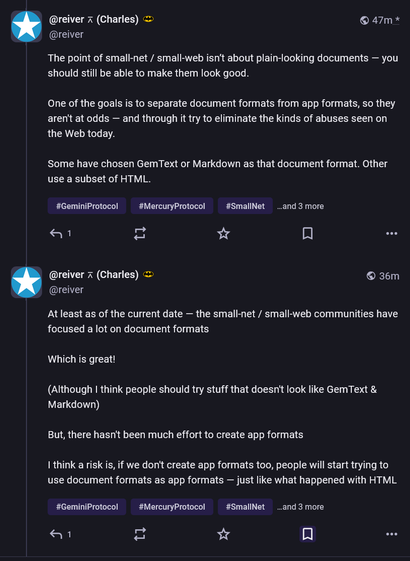
At least as of the current date — the small-net / small-web communities have focused a lot on document formats

Which is great!

(Although I think people should try stuff that doesn't look like GemText & Markdown)

But, there hasn't been much effort to create app formats

I think a risk is, if we don't create app formats too, people will start trying to use document formats as app formats — just like what happened with HTML

#GeminiProtocol #MercuryProtocol #SmallNet #SmallWeb #SmolNet #SmolWeb

The point of small-net / small-web isn’t about plain-looking documents — you should still be able to make them look good.

One of the goals is to separate document formats from app formats, so they aren't at odds — and through it try to eliminate the kinds of abuses seen on the Web today.

Some have chosen GemText or Markdown as that document format. Other use a subset of HTML.

#GeminiProtocol #MercuryProtocol #SmallNet #SmallWeb #SmolNet #SmolWeb

There are good reasons why HTML became the dominant front-end format in the late 1990s.

Before that, developers had to build separate native apps for platforms like DOS, Mac OS, MS Windows, NeWS, X Windows, etc

Not only was this expensive, it was tiring.

As the internet spread, HTML became the ubiquitous front-end format, eliminating the need for multiple versions

But, this put these 2 use-cases (doc vs app) at odds

#GeminiProtocol #MercuryProtocol #SmallNet #SmallWeb #SmolNet #SmolWeb