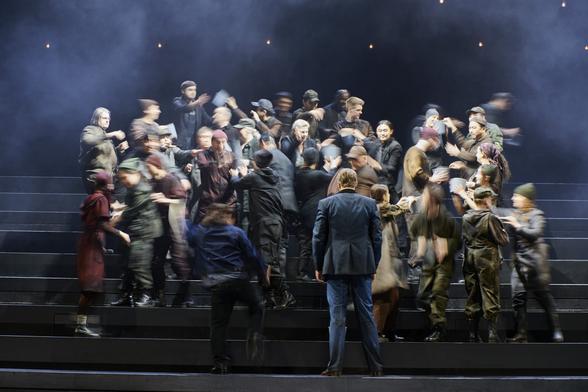
Clémence de Grandval’s Mazeppa: powerful opera without pedantry
During her lifetime, Clémence de Grandval was a celebrated composer, but after her death her music soon disappeared from the concert stage. The Palazzetto Bru Zane label now presents her opera Mazeppa, about Ukraine’s struggle for freedom. Once again in an exemplary, numbered edition with an extensive booklet in French and English. Who was Clémence de Grandval?
Clémence de Grandval was born in 1828 –fourteen years after Louise Farrenc and nine years after Clara Schumann– as Marie Félicie Clémence de Reiset, the youngest of four children in an aristocratic family. Her cradle stood at Château de la Cour du Bois near Saint-Rémy-des-Monts, about 200 kilometres west of Paris.
The château belonged to her mother, a prolific writer; her father was a career military officer, decorated with the rank of Officier de la Légion d’honneur. He was also a talented pianist, and their salon was frequented by artists, writers, and musicians. Among them the German composer Friedrich von Flotow, from whom Clémence received her first composition lessons.
From the very beginning, she aspired to a professional career in music and reportedly began composing symphonies as early as age ten. She received instruction from some of the greatest teachers; one of her voice coaches was Laure Cinti-Damoureau, the renowned Rossini soprano of her time. Later, she studied composition with Frédéric Chopin and Camille Saint-Saëns, with whom she became friends and who dedicated his Oratorio de Noël to her. Due to her aristocratic status, she published her compositions under various pseudonyms, among them Caroline Blangy and Clémence Valgrand.
Aristocrat
She regularly performed her own music in her parents’ Parisian salon and in the salons of musicians, thereby building a network at a young age and gaining some renown. In 1851, she performed as a pianist at the prestigious chamber music matinee hosted by double bassist Achille Gouffé. He himself played in her First and Second Septets for violin, oboe, bassoon, cello, double bass, and piano, an unusual instrumentation for the time.
A critic praised her ‘freshness of ideas, which is so often ruined by academic pedantry among our budding composers.’ Admiringly, he adds that she composed her first septet at the age of fifteen, but that it is in no way inferior to her second. She has nothing left to learn, ‘except the art of guarding against the pride that excessive praise might arouse in her’.
That same year, the Andante of a symphony is performed, which she had unsuccessfully submitted to the Société des Concerts du Conservatoire in 1849. The reason for the rejection? – She is an amateur and, moreover, wealthy enough to have her work performed at her own expense.
Hector Berlioz comes to her aid by including the Andante on the programme of the Grande Société Philharmonique de Paris, which he has just founded. ‘This ingeniously conceived and crafted, richly orchestrated piece managed to surprise and charm the connoisseurs alike,’ writes a reviewer. Only to then sneer that the music nevertheless exudes a ‘somewhat stiffly aristocratic’ atmosphere.
Lifelong struggle against prejudice
Prejudice would continue to dog Grandval throughout her career, as she struggled against a triple handicap: as a woman, she is expected to compose at most salon music for her own circle; as a composer not trained at the conservatory, she is not taken seriously; and as a member of the nobility, she is not supposed to present herself as a professional composer.
This last drawback is compounded when she marries Viscount Enlart de Grandval in 1851 and becomes a viscountess. It must have been a great source of gratification that her Trio de Salon for oboe, bassoon and piano and her Grande Sonate for violin and piano are published that very year.
Enlart de Grandval is a great lover of music and wholeheartedly supports her career, even taking on the role of secretary and impresario. Thanks to her privileged position, Clémence is able to devote herself entirely to composing. Partly on her husband’s advice, she decides to fill the gaps in her earlier training with Von Flotow. To this end she turns to Camille Saint-Saëns, who instructs her not to compose for two years. This seems rather drastic, but later she will more than make up for lost time: her oeuvre includes countless songs and chamber music pieces, orchestral and choral works, and no fewer than ten operas.
Paris Opera
In 1859, she presents a stage work for a small audience, featuring soloists from the Opéra de Paris. The press praises it as ‘highly remarkable’, but the title has remained unknown and the work has probably been lost. A year later, Jacques Offenbach conducts her operetta Le Sou de Lise, staged to great acclaim at the Théâtre des Bouffes-Parisiens under the pseudonym Caroline Blagny.
Her opera Les Fiancés de Rosa follows in 1863, in a production by the Théâtre Lyrique. Hector Berlioz praises it in the Journal des débats: ‘Her new opera is well written, shows no trace of hesitation, is generally consistent in style, and always tasteful.’
The subsequent year she generates enthusiasm in Baden-Baden with her comic opera La Comtesse Eva, presented under her own name. When the Opéra-Comique includes La Pénitente in its program in 1868, younger composers complain of ‘unfair competition’ – after all, she is an amateur. This opera meets with little success.
Grandval redeems herself with Piccolino, set to an Italian libretto. It premiers at the Théâtre-Italien in 1868, with the Austrian star soprano Gabrielle Kraus in the title role, and is a resounding success. The composer-critic Ernest Reyer, a cousin of Louise Farrenc, writes: ‘If there were many amateurs in Paris (I deliberately emphasize this word) who could write a score like Piccolino, the artists – or rather, the professionals – would have no choice but to close up shop and go play the chalumeau in the Grand Duchy of Gérolstein or on the island of Tulipatan.’ – Her envious young colleagues could put that in their pipe and smoke it.
Early successes
Grandval also writes a great deal of chamber music and songs, prompting Saint-Saëns to exclaim: ‘They would certainly be famous if their author had not, in the eyes of many, committed the unforgivable sin of being a woman.’ During this period, she ventures into symphonic and sacred music, too, domains even more impregnable to women. In 1867 she achieves her first success with the Mass for three soloists, choir, and large orchestra. It is performed at the Église de Saint-Eustache, just a stone’s throw from the Louvre.
When she presents her Stabat Mater in her own salon three years later, her reputation as a composer has been firmly established: ‘Everyone of any standing in the Parisian artistic world was there,’ writes Vincent d’Indy. Among the visitors are luminaries such as Daniel Auber, Georges Bizet, Léo Delibes, and Ambroise Thomas.
In 1872, the Stabat Mater is included in a list of works distributed to conservatories, choir schools, and libraries. Like the Mass, it quickly finds its way into the standard repertoire, with numerous performances by concert organizations and in large churches.
Her love for wind instruments remains strong, and in the 1870s and 1880s she composes extensively for woodwinds, particularly the oboe. This stems from her friendship with the oboist Georges Gillet, to whom she dedicate her Concerto for Oboe and Orchestra, Op. 7 in 1878. With this piece, she finally makes it to the stage of the Société des Concerts du Conservatoire, where it is performed twice.
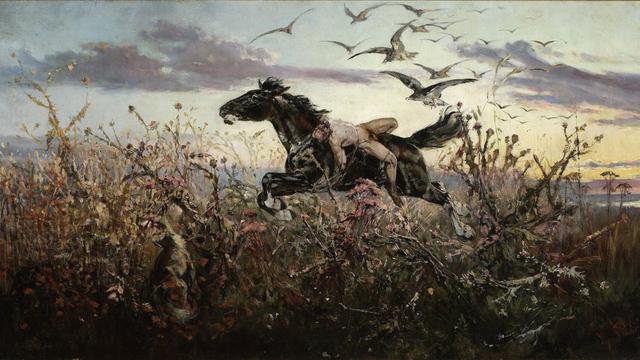
Mazeppa Painting by Pawliszak Waclaw 1866 (c) National Museum, Warsaw
Saint-Saëns includes it in his 1887 tour of Russia, while other orchestral works and sacred compositions are performed by renowned conductors and ensembles in the major concert halls of Paris. In 1880, she receives the Prix Rossini for La Fille de Jaïre, a ‘scène religieuse.’
Mazeppa: a popular theme in the nineteenth century
She then enthusiastically begins work on her opera Mazeppa, but in 1886 her husband dies. This is a devastating blow: ‘My life is shattered,’ she writes to Pauline Viardot. ‘The friend I have lost was deeply devoted to me, as no one else ever will be. I have a wonderful daughter, but children cannot fill the void left by your life partner.’ Enlart’s demise dampens her enthusiasm for work, but she resolves to persevere nonetheless and ‘not burden my loved ones with my mortal grief.’
In 1888, the Société Nationale presents the Prelude to the opera; four years later it has its world premiere – not in Paris, but at the Grand Théâtre in Bordeaux. It is an overwhelming success: ‘Anyone capable of producing a composition with such musical and dramatic expressiveness is truly a force to be reckoned with,’ declares the daily newspaper Le Soleil. Nevertheless, a performance in Paris never materializes.
In 1991, Ukraine breaks away from the Soviet Union and immediately proclaims Ivan Mazeppa (1639–1709) a national hero; he is seen as a fervent resistance fighter against Russian rule. Unfortunately, he ultimately loses this fight at the Battle of Poltava in 1709, where his army proves no match for the superior forces of Tsar Peter the Great. Now that Russia is once again threatening Ukraine’s sovereignty, Russian negotiators taunt that history will repeat itself.
Complex story
Mazeppa’s story is actually quite complex, but the theme of the fearless Cossack taking on a great power captured the imagination of the nineteenth century. Lord Byron dedicated his eponymous epic poem to it in 1819; Franz Liszt honoured Mazeppa with a symphonic poem in 1854, and thirty years later Peter Tchaikovsky wrote his opera Mazeppa. This, in turn, was inspired by Alexander Pushkin’s 1829 poem Poltava, in which Mazeppa appears as a dishonourable traitor to Tsar Peter and his Russian empire. – In Clémence de Grandval’s 1892 opera of the same name, Mazeppa actually betrays the Ukrainians.
All of these works follow the story, invented by Byron, of Mazeppa’s forbidden love affair with a Polish princess. Once caught, he is tied naked to a wild horse and driven out into the steppes. The stallion gallops on until it collapses in Ukraine, where Mazeppa is found by a woman who tends to his wounds and where he is appointed commander of the troops.
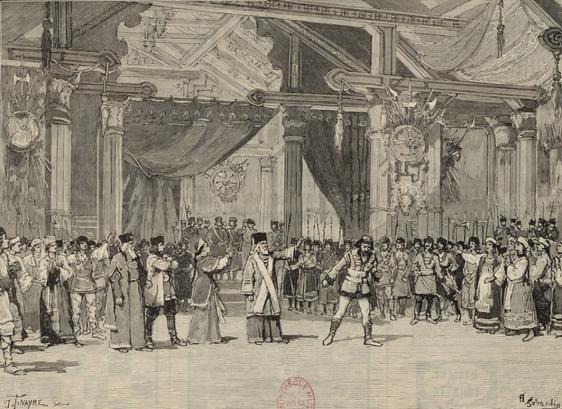
Engraving by Julien Tinayre (1859-1923) of Act 4 Mazeppa in Bordeaux
Charles Grandmougin and George Hartmann base their libretto for Grandval’s Mazeppa largely on Pushkin’s poem Poltava, but in their version, Mazeppa is found by Matrena, daughter of Cossack leader Vasili Kotchubey (a historical figure who lived from 1640 to 1708). He appoints Mazeppa in his place as commander of a campaign against Poland, despite fierce protests from his nephew, Colonel Iskra. Iskra distrusts Mazeppa and is secretly in love with Matrena.
When Mazeppa returns victorious from Poland, he is hailed as a hero by the people. But when Iskra reveals that he intends to hand Ukraine over to Sweden, the crowd turns against him. A messenger from the tsar pronounces a curse on Mazeppa for his treason, after which he wanders alone across the steppes in the fifth and final act. One day he encounters Matrena, who is dying. She recognizes him only with her last breath, with which she curses him for eternity.
Powerful music, compelling leitmotifs
The overture to Mazeppa is overwhelming: a resounding fanfare of trumpets, lightning-fast strings, swirling motifs from the woodwinds, and a dotted rhythm immediately conjure up images of a horse galloping feverishly across the steppes. Above all this turmoil, Grandval introduces a broad, drawn-out theme in the horns, which begins with a significant upward interval leap and then plunges back into the depths through major and minor seconds and a dramatic downward leap of a fourth.
This yearning motif is woven as a central thread throughout the opera, serving at times as a reminder of Mazeppa’s painful ride on the wild horse, and at other times as an ominous foreshadowing of his betrayal of the Ukrainians. In addition to this main motif, Grandval employs several other leitmotifs, with a rich alternation between bold, martial exclamations from the brass and melting, lyrical cantilenas from solo instruments, particularly woodwinds such as the clarinet and oboe.
When Matrena sees Mazeppa again at the end of the opera and curses him, a solitary English horn envelops her melancholic song in tender melodic lines, as if seeking to comfort her. It is striking that Grandval enriches Matrena’s vocal part here with graceful melismas; this is the first and only time she deviates from the syllabic text setting she employs throughout the rest of the opera. In doing so, she follows the French operatic tradition, in which intelligibility is paramount.
Outstanding performance
The orchestral score is highly colourful, featuring ominously rumbling low strings and startled, flaring motifs in the high registers of the flutes and saxophone (!). Grandval seamlessly transitions terrifying fortissimo tutti passages into restrained pianissimi, thereby vividly conveying the characters’ shifting moods. The choral passages are exceptionally atmospheric and are beautifully sung by the Chor des Bayerischen Rundfunks.
Under the baton of Mihhail Gerts, the Münchner Rundfunkorchester plays with passion and precision, proving itself the ideal accompanist for both choir and soloists. These are, without exception, outstanding, with dazzling performances by the Greek baritone Tassis Christoyannis as Mazeppa and the Australian soprano Nicole Car as Matrena.
With this release, Palazzetto Bru Zane has once again unearthed a masterpiece from the depths of history. The splendid performance underscores just how unjust it is that Clémence de Grandval was forgotten after her death in 1907. – The stage production by Opera Dortmund (March-May 2026) got positive reviews, with some critics comparing the music to that of Wagner.
– If you’re quick off the mark, you can still catch the final performance on 15 May. – It certainly seems worth a visit!
https://www.youtube.com/watch?v=RRry8W3PjQI
#ClémenceDeGrandval #Mazeppa #MünchnerRundfunkorchester #MihhailGerts #NicoleCar #PalazzettoBruZane #TassisChristoyannis barefootliam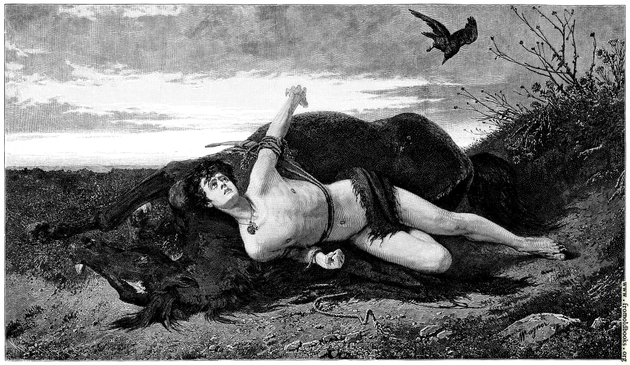
 Thea Derks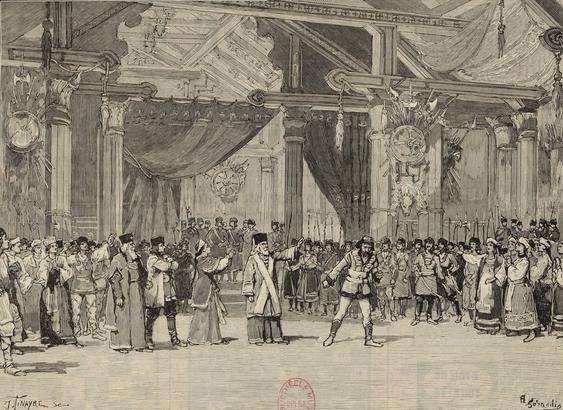
 Contemporary Classical - Thea Derks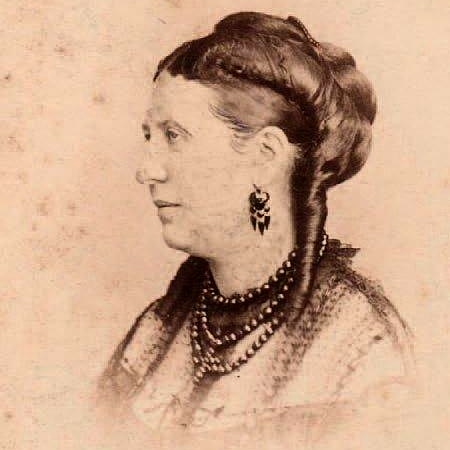
 DAS OPERNMAGAZIN