 Bryan King
The Salt and the Smolder
1,202 words, 6 minutes read time.
The “grocery store” lens hasn’t just obscured the truth—it has castrated it. It has turned the dangerous, tactical commands of a First-Century Revolutionary into a collection of pastel-colored suggestions for the weak. You’ve been taught that being the “Salt of the Earth” is about being a nice neighbor with a pleasant temperament. That is a lie. That is the talk of men who have never had to survive a night in the dirt.
In the real world—the one Jesus actually stood in—salt was a combatant. It was a chemical weapon used against the cold, the rot, and the dark. If you strip away the modern insulation and the automated comforts of your life, the metaphor stops being “flavorful” and starts being violent. It is time to look at the “Fire-Starter” reality of the Gospel with the eyes of a man who understands that if he isn’t providing the heat, he is just taking up space in a world that is freezing to death.
The Raw Mechanics of the Ancient Ignition
To get this, you have to get your hands dirty in the history. In the ancient Levant, wood was for kings and temples. The common man, the laborer, the man in the trenches, he didn’t have oak logs. He had dung cakes. He gathered animal waste, dried it in the sun, and piled it in an earthen mud oven. But here is the technical reality: dung smolders. It’s a low-grade fuel that chokes out more smoke than heat. It lacks the chemical “kick” required to bake the bread that keeps a family alive.
This is where the Salt comes in. It wasn’t in a shaker; it was in slabs. Men would place thick plates of rock salt at the base of the oven. When the smoldering dung hit that salt, it triggered a thermal-chemical reaction. The salt acted as a catalyst, forcing the waste to burn hotter, cleaner, and longer.
That is your job description. You are not the fuel, and you are not the oven. You are the catalyst. You are placed in a world that is fueled by “dung”—by mediocrity, by broken systems, by low-quality human nature. Your presence is meant to provoke a reaction. If you walk into a workplace or a home and the “fire” stays at a low, smoky smolder, you have failed. A man of God provides the chemical kick that turns a mess into a roar. You were designed to be the reason the heat goes up.
The Stench of the Inert: Why the “Safe” Man is Worthless
The tragedy of the modern “Christian man” is that he has become chemically inert. He sits in the oven, he looks like salt, he smells like the church, but he creates zero reaction. In the ancient world, after years of intense heat, a salt plate would eventually undergo a molecular change. It would lose its reactivity. It was still physically there, but it was “dead.” It no longer provoked the fire.
This is the “Savor” Jesus was talking about. He wasn’t talking about your personality; He was talking about your potency. A man who has lost his savor is a man who has lost his ability to make things uncomfortable for the dark. If your “faith” doesn’t sting, if it doesn’t provoke, if it doesn’t ignite the men around you, then you are a spiritual casualty. You are a cold rock sitting in a cold oven.
The “grocery store” lens tells you to stay “pure” by staying separate. The survival lens tells you that salt is only useful when it’s rubbed into the fuel. If you’re too “pious” to touch the dung, you’ll never see the fire. You’ve traded your masculine authority for a passive seat in the pews, and you’re wondering why your life feels like it’s smoldering out.
The Footpath Fate: No Mercy for the Useless
There is a brutal, hardboiled end for the tool that doesn’t work. In a survival culture, there is no sentimentality. When that salt plate became inert, it was a waste of space. It couldn’t go in the garden because it would poison the soil, and it couldn’t stay in the oven because it was just a cold obstacle.
Jesus was blunt: it is “good for nothing.” It gets thrown out into the street. It gets used to fill potholes in the footpath to be “trampled underfoot by men.”
Look at the world around you. The culture isn’t just ignoring the church; it is walking all over it. That isn’t because the world is “mean”; it’s because the salt has lost its sting. A man who won’t ignite the fire will eventually be used as gravel for someone else’s boots. If you aren’t a catalyst for God, you are just debris for the world. You have a choice: provide the heat that saves the house, or become the dirt that hardens the road.
Proximity and the Necessity of the “Rub”
You cannot start a fire from the sidelines. For the salt plate to work, it had to be at the very bottom, in the dark, under the weight of the fuel, in the middle of the heat. You have to get rubbed in.
Most men want to be “salt” from a distance. They want to tweet about the fire without ever feeling the smoke. But the Gospel is a contact sport. It requires you to bring your integrity and your “righteous anger” into direct contact with the rot of this world until something catches. You have to be willing to be the foundation of a fire that might consume you.
The “grocery store” faith is for the weak. The “survival” faith is for the men who realize that the world is freezing and they are the only ones with the chemical makeup to change the temperature. Get off the shelf. Get into the oven. Either ignite the mess around you tonight, or start getting used to the feeling of being walked on. The Master didn’t call you to be “nice”—He called you to be the reason the world finally feels the heat.
Call to Action
The oven is cold, and the world is smoldering in the gray smoke of its own rot. You can keep sitting on the shelf like a decorative jar of white powder, or you can finally get rubbed into the mess.
Stop pretending your “niceness” is a virtue when it’s actually just a lack of chemical potency. If you aren’t changing the temperature of your home, your workplace, and your city, you aren’t salt—you’re just debris. The Master didn’t call you to blend in; He called you to ignite.
Ignite the fire in your soul tonight. Stop being safe. Start being a catalyst. Get in the oven and burn, or get off the line and let a real man take your place.
SUPPORTSUBSCRIBECONTACT MED. Bryan King
Sources
- Salt, Dung, and Ovens: The Context of Matthew 5:13 – Journal of Biblical Literature, 1999
- Daily Life in Ancient Palestine – Library of Congress, 2005
- The Use of Salt in Ancient Near Eastern Ovens – Palestine Exploration Quarterly, 1980
- Archaeological Analysis of Earthen Ovens – Journal of Archaeological Science, 2015
- The Cultural Environment of the New Testament – Associates for Biblical Research, 2006
- Socio-Economic Life in the Roman East – Brill Publishing, 2002
- Domestic Technology in the Ancient Levant – PNAS, 2012
- Ancient Mediterranean Survival Strategies – Oxford Bibliographies, 2015
- The Material Culture of the Biblical World – Metropolitan Museum of Art, 1985
- Excavations of Domestic Ovens in Judea – Palestine Exploration Quarterly, 2016
- Social History of Roman Palestine – Cambridge University Press, 2010
- The Chemistry of Salt in Ancient Industry – Hebrew Union College Annual, 1982
- The Economy of Roman Palestine – Oxford University Press, 1991
- History of Salt Production and Usage – Encyclopedia Britannica, 2024
- How Salt Shaped Civilizations – History Channel, 2023
- Biblical Interpretation of Domestic Metaphors – Bible Translator Journal, 2018
- Fuel and Fire in the Ancient Near East – American Schools of Oriental Research, 1994
- Maritime and Domestic Life in First-Century Galilee – Archaeology Magazine, 2013
- The Sociology of the New Testament – Ashgate Publishing, 2004
- The Ancient Near East: A History – Routledge, 2015
Disclaimer:
The views and opinions expressed in this post are solely those of the author. The information provided is based on personal research, experience, and understanding of the subject matter at the time of writing. Readers should consult relevant experts or authorities for specific guidance related to their unique situations.
#activeFaith #ancientEarthenOvens #ancientLevantHistory #authenticFaith #BiblicalArchaeology #biblicalAuthority #biblicalEndurance #biblicalIntegrity #biblicalLabor #biblicalManhood #biblicalMetaphors #biblicalSaltMetaphor #BiblicalStrength #biblicalTacticalIntelligence #biblicalTeamBuilding #biblicalTruthForMen #biblicalWarrior #biblicalWisdom #catalystsForChrist #ChristianDiscipleship #ChristianEthics #ChristianLeadership #ChristianLifeForMen #christianMenSGuide #churchForMen #discipleshipStrategy #discipleshipTraining #dungCakesFuel #faithUnderPressure #fireStarterCatalyst #firstCenturySurvival #GospelGrit #gospelTruth #GreatCommission #grittyFaith #hardboiledTheology #historicalContextOfJesus #JudeanWildernessSurvival #kingdomMission #masculineChristianity #masculinePurpose #masculineSpirituality #Matthew513 #NewTestamentManhood #overcomingPassivity #realFaith #ruggedDiscipleship #saltAsACatalyst #saltLosingItsSavor #SaltOfTheEarthMeaning #spiritualHarvest #spiritualHeat #spiritualInfluence #spiritualMission #spiritualRot #spiritualWarfareForMen #thrownOutAndTrampled #transformativeFaith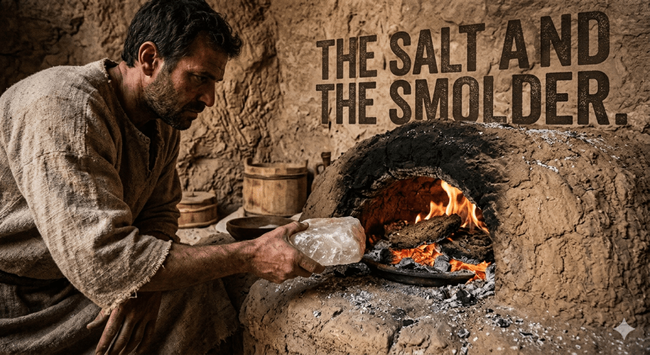
 Intentional Faith