 Dr Susi Arnott
 The Orkney News
The Feast Of All Souls
https://web.brid.gy/r/https://theorkneynews.scot/2025/11/06/the-feast-of-all-souls/

The Feast Of All Souls
https://web.brid.gy/r/https://theorkneynews.scot/2025/11/06/the-feast-of-all-souls/
Maeshowe Chambered Cairn was excavated by James Farrer and George Petrie.
James Farrer (1812 to 1879) was a Conservative Party politician in England who was elected three times as the Member of Parliament for South Durham, between 1847 and 1865.
He was a member of the Society of Antiquaries of Scotland, and his excavations included partial excavation of Orkney Brochs from 1853; Maeshowe in 1861; and the first excavation of Chedworth Roman Villa, from 1864 to 1866.
George Petrie (1818-1875) was a leading Orcadian antiquarian who excavated numerous archaeological sites in the mid 19th century, on some occasions with James Farrer. He worked as the Factor of the Graemeshall Estate and Sheriff Clerk of Kirkwall. Orkney sites he worked on included Maeshowe Neolithic tomb, Skara Brae, numerous Iron Age brochs (e.g. Lingro, Shapinsay, Burray), Bronze Age barrows, cists, and Viking graves.
This is James's personal account of his excavation of "the whole of the rubbish filling the chamber".
I include it partly because it's fun.
https://orkneyriddler.blogspot.com/2025/06/maeshowe-wonder-of-neolithic-world.html
#archaeology #Maeshowe #Orkney #Chambered #Cairn #neolithic #prehistoric
I could never quite believe that Neolithic people came to Orkney by boat.
As it is thought that they brought cattle and sheep with them, I could not envisage any animal, or any human, surviving a sea crossing of any British tidal waters in any prehistoric vessel.
Standard sources tie themselves in knots to persuade us that Neolithic people had boats that could carry beasts of both sexes that, once landed, would reproduce and help their tribe to survive on the unknown territory across the dangerous waters.
However, evidence has recently emerged that added another dimension to the problem. It was discovered that the Orkney Vole, a species that is unique to the archipelago, had been found by DNA analysis, to originate from northern Europe, and that it was not directly related to the common vole in Britain. (Thomas Cucchi et al)
This meant that the animal that arrived in Orkney did not pass through England, Wales or Scotland.
A vole arriving in Orkney, from Europe, without passing through Britain was a clue that all was not as it seems, and that in spite of the insistence of some that voles may have been carried as pets or food items, another possibility was probably more likely.
I therefore rather assumed that it must be necessary to question what places were passable around the coasts of Neolithic Britain, which areas were land, and which places were water, and when did land areas stop being land.
It is understood that much of the southern North Sea area was land at some point in the past. A piece of shallow sea called Dogger Bank has been named Doggerland as artefacts of 8000 years of age, and older, are frequently dredged up there. The rise in sea level which has occurred since the last ice age has clearly flooded lands here, but which lands, where, and when?
The obvious location, or so I thought, for a route to Orkney from Europe , that would be passable for small rodents, on foot, and avoiding England and Scotland, would be somewhere in the middle of the North Sea which, of course, is a bizarre idea.
Indeed, it was such a bizarre idea that I followed it, to see where it took me.
The result of my research can be seen in my blog:-
http://orkneyriddler.blogspot.com/2025/04/the-orkney-riddle.html
#Orkney #Neolithic #archaeology #prehistory #Brodgar #nessofbrodgar #Skara #skarabrae #barnhouse #knapofhowar #linksofnoltland #Noltland #cairns #Maeshowe
I have only visited Maeshowe once , 45 years ago. It's a bit awkward now, there is a visitor centre just down the way at Stenness village, and people are taken by minibus from there to control a hazardous crossing point near the monument .
The monuments greatest claim to fame seems to be the observation that the long entrance passage has been designed such that it is aligned with the setting sun on the day of the Winter Solstice. As the sun sets, its rays are said to radiate down the passage Illuminating the back wall of the great chamber. There remains great speculation regarding this belief, and much scholarly dispute is devoted to the discussion of sunsets and horizons here and elsewhere, on the Orkney landscape. Although it is true that the sun does light up the rear of the chamber at the solstice, some sources question whether this was purposeful or accidental.
The Royal Commission suggests that :“The great boulder in its triangular niche just inside the doorway on the left would have been drawn forwards with ropes to close the entrance.”, but as the butting face for the blocking stone is facing inwards, in my opinion it seems unlikely that an effective closure could be made from the outside. Strange though it may seem, it looks more likely that this closure would be better performed by people enclosed within the cairn.


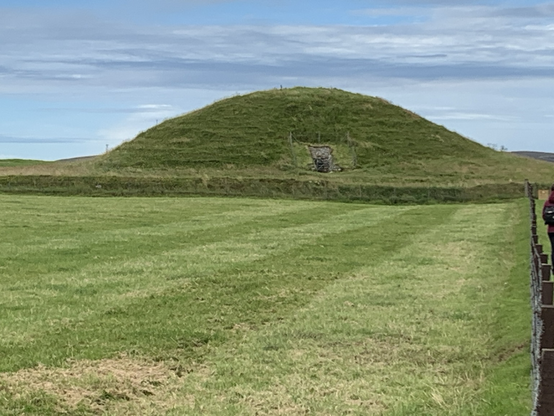
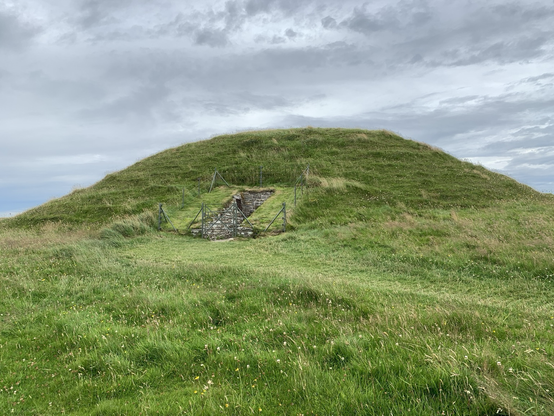
The other major monument in the Brodgar region of Orkney is the Maeshowe Chambered Cairn.
“More than any other prehistoric monument, the design and execution of Maeshowe epitomises the skill of Neolithic masons in Orkney, and the tomb is rightly considered to be one of the supreme achievements of prehistoric Europe. It is inevitable that such a huge mound should have been robbed long ago, and when it was opened in 1861 by James Farrer it was indeed empty of its original contents, apart from a fragment of human skull.
Its location, close to the great ceremonial complex of the Brodgar-Stenness circles, is presumably no accident.
The mound was built on a levelled circular platform, encircled by a low bank composed of earth scraped up from a shallow ditch on its inner side; the mound itself, 25m in diameter and 7m high, consists largely of clay and stones, but there is an inner core of stones casing and supporting the chamber. The outermost part of the entrance passage has been restored, but from the door checks inwards it is original. The great boulder in its triangular niche just inside the doorway on the left would have been drawn forwards with ropes to close the entrance. In keeping with the proportions of the tomb, the passage is quite spacious, although at a height of 1.4m it is not possible to walk upright.
The main chamber is about 4.5m square and was originally about the same height, with three side cells entered above ground-level; in each corner there is a buttress designed to help in supporting the weight of the corbelled roof. The masonry is superb, the slabs finely adjusted by underpinning or dressing to create a smooth face even where they are in fact oversailing one another towards the roof, and the tapering orthostats facing one side of each buttress not only create an impression of soaring vertical space but attractively interrupt the horizontal lines of the walls.
When Farrer dug into Maeshowe, he found that the chamber had already been broken into, as he did, from the top; from Orkneyinga Saga and from the runic inscriptions on the walls of the chamber, it is clear that it was entered on more than one occasion by Norsemen in the 12th century, to whom the mound was known as Orkhaugr. During the struggle between the rival earls Erlend and Harald for control of the earldom, Harald and some of his men sought shelter in Maeshowe from a snowstorm, but it was such a terrible experience that two of them went mad, ‘ which slowed them down badly’ says the saga, though they still reached their destination by nightfall. The following winter of 1153-4, crusaders gathered together ready for a trip to the Holy Land broke into the chamber and incised some of the runic inscriptions, and there were probably other occasions as well when runes were cut there. This is one of the largest extant collection of runic inscriptions carved in stone. There are about thirty inscriptions, including both ordinary runes and cryptographic twig runes, and there are also some beautifully executed carvings of a walrus, a serpent knot and a dragon or lion on the north-east buttress, all in typically vigorous Scandinavian style.” (RCAHMS Canmore)


 Orkney Riddler
 Aafke 🌹🍀🔻
 Astronomer Royal for Scotland | Catherine Heymans
 Robin Shantz