 Digital Mark λ ☕️ 8647
Protip: "Spring forward" means #lispygopher show is an hour later than you think, not an hour earlier.
I dunno, I just sorta coast along minute to minute and check the clock.
Protip: "Spring forward" means #lispygopher show is an hour later than you think, not an hour earlier.
I dunno, I just sorta coast along minute to minute and check the clock.
@screwlisp is having some site connectivity problems so asked me to remind everyone that we'll be on the anonradio forum at the top of the hour (a bit less than ten minutes hence) for those who like that kind of thing:
https://anonradio.net:8443/anonradio
He'll also be monitoring LambdaMOO at "telnet lambda.moo.mud.org 8888" for those who do that kind of thing. there are also emacs clients you should get if you're REALLY using telnet.
Topic for today, I'm told, may include the climate, the war, the oil price hikes, some rambles I've recently posted on CLIM, and the book by @cdegroot called The Genius of Lisp, which we'll also revisit again next week.
Mentioned in today's #lispygopher show, adventure books with computer programming puzzles:
https://archive.org/details/RetroGamingBooksFiction/MicroAdventureNo.1-SpaceAttack1984.pdf
You want all the Micro Adventure, Arcade Explorer, "A Magic Micro Adventure", and Time Lost books. The rest are mostly pick-a-path in videogame worlds with no coding.
#retrocomputing #books
FYI, I have finally published the actual source of my 2014 essay "Whither Original Thought" to my web site. It links to the audio from your radio show a month ago when I had read it aloud for the first time.
https://nhplace.com/kent/Writing/Whither-Original-Thought.html
#Philosophy #Programming #OriginalThought #literacy #education #thought #legitimacy #LispyGopher #invention #originality
This message is part of some prep you and I were doing for an upcoming show, but it also contains information that might have information that is of historical interest, so I'm going to send it in publicly viewable mode, even though it somewhat joins a private conversation already in progress and the context may not be entirely clear.
(I guess people can ask questions if something in here makes no sense out of context, or they can tune in when we talk on your show on what's tentatively slated to be May 13 when we talk about it on-air. Or they can submit questions to you/us privately in advance of that.)
This message will be several sections long.
1/n
At the start of your radio show this week, you mentioned the terms haiku/senryū/tanka. I had some comments on that.
I'm not some sort of expert on what these are. I just use the form and figure, in the way that an online poetry class, How Writers Write Poetry, that I took at the University of Iowa's International Writing Program offered, that each poem creates the terms on which it is to be judged. So it really doesn't matter a lot to me whether I'm precisely correct, so much as that I have my own sense of the form I want to say the things i want.
But I also try to at least be vaguely correct. So what follows here is my understanding but is not offered as an authoritative piece. People should feel free to offer corrections or critiques if they like, as long as they realize that I'm not in the first place saying I'm the best place to read about these things. There are some very good online descriptions that differ in subtle ways and I don't even care that they disagree because to me, that's not the point of poetry.
A haiku is a 5-7-5 syllable poem based on nature and seasons. There are a few other subtleties, and some controversy as to whether all project properly into English.
In particular, there is a thing called a kireji that has grammatical form in Japanese or Kanji, I presume representing it (and incidentally shared by Chinese). A kireji is described in Wikipedia as "is a word or phrase that creates a pause or break in the flow of a haiku". I'm unclear about whether this is a fixed set. But I know someone who thinks of it as a semicolon, connecting two full sentences in tight form. I myself just assume that, sans kireji, I should make line (the second 5 in 5-7-5) be a change of direction of some kind, including an irony, a contradiction, a commentary, or some other surprise element. The haiku form is a very short space in which to write anything, so it's important to me not to waste words on that, and merely to nice that line 3 is special
A senryu is the same structure but less about nature and more about things like the 'human foibles' you mentioned.
I have a special problem with knowing whether some of my poetry counts as proper haiku because supposedly it's about the seasons and should include a kigo (season word, which might include things like cherry blossoms associated with the season, not necessarily precisely the season). But climate change disturbs the structure and so the set of elements belonging in the set, not to mention it also "goes meta" and speaks of the mechanical process of how, why, or whether seasons are shifted, not just in-frame views of a season. ChatGPT was supportive of my staking a claim in this space, as it says others have done, but I'm never quit sure when to trust its judgment. I push forward mostly because I'm strong-willed. But I usually label with both terms to acknowledge potential controversy or just difficulty with lookup.
A tanka is a 5-7-5-7-7 poem of similar kind, and I ASSUME it traditionally is a haiku in content but mostly I write senryu so I only presume/force it to be more a modifier than a noun in order to have both tanka-haiku and tanka-senryu, though if you look it up they just say it's a noun.
Tankas are usually two tightly related yet grammatically independent thoughts, even I've read some places, written by different people for the 5-7-5 and the 7-7, where the 7-7 builds a different thought around the core thought of the 5-7-5 part, which I understand to be free-standing. One place I read suggested the 7-7 part was at least sometimes a response that came back from someone writing a haiku as correspondence.
I'm not going to cite extra references here because I'd have to look them up. Better you should do it not only because I am admittedly lazy, but also because in researching it (if you care, and you might legitimately not), you'll probably find some lovely essays by others on how to think about these art forms.
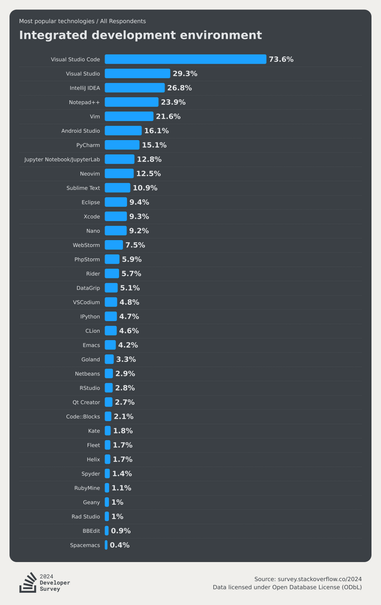
Editor market share via Stackoverflow:
https://survey.stackoverflow.co/2024/
VS Code 73.6%
…
Vim 21.6%
Neovim 12.5%
…
Nano 9.2% (dorks!)
Emacs 4.2%
Spacemacs 0.4%
ed, the standard text editor, is not reported, but we all know it should be #1.
Happy new year to all, but special good wishes to @screwtape for conjuring and maintaining this delightfully odd #LispyGopher social group.
cc @fstateaudio @hairylarry @nosrednayduj @me @rat @pkw @prahou @northernlights @SDF @mdhughes @Contrapunctus
 Kent Pitman
