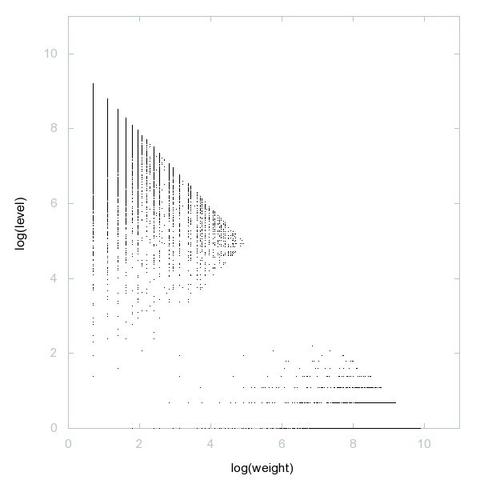
It’s Friday afternoon at the end of Week 2 here at Maynooth so I’ve now completed the 4th lecture of my 4th-year module Differential Equations and Complex Analysis. We’ve now in the section of Sturm-Liouville Theory. I’ve never taught this module before and, as always, teaching a new thing reminds me of all the things I had forgotten since I was a student. In this particular case, I still have the notes I took when I was studying this topic as an undergraduate. It’s scary to think the notes shown above were written by me 40 years ago!

Anyway, as I like to know something about the people behind the names, Sturm-Liouville Theory is named after Jacques Charles François Sturm (1803–1855)* and Joseph Liouville (1809–1882). Contrary to what I’d always assumed, Sturm was not German but was born in Geneva, which is now in Switzerland but which had been annexed by revolutionary France in 1798 so technically speaking he was born in France. Liouville was born in Saint-Omer, near Calais, which to my knowledge has never been part of Switzerland but has been part of the Spanish Netherlands.

*Given the dates, Sturm must have collaborated with Liouville after his earlier work with Drang

https://telescoper.blog/2024/10/04/sturm-and-liouville/

#Liouville #mathematics #OrdinaryDifferentialEquations #Sturm #SturmLiouvilleTheory #SturmUndDrang


Sturm–Liouville theory - Wikipedia

One day, one decomposition
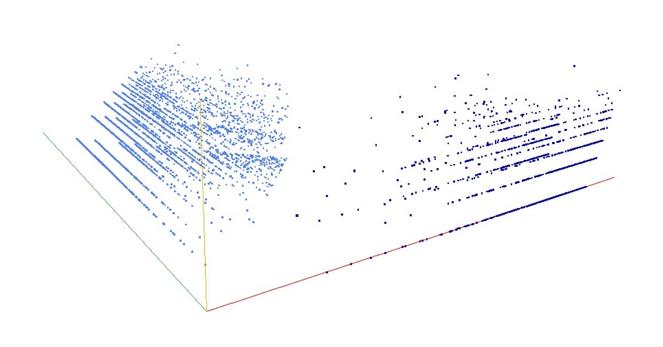
A028260: Numbers with an even number of prime divisors (counted with multiplicity); numbers k such that the Liouville function lambda(k) (A008836) is positive.

3D graph, threejs - webGL ➡️ https://decompwlj.com/3Dgraph/A028260.html
2D graph, first 500 terms ➡️ https://decompwlj.com/2Dgraph500terms/A028260.html

#decompwlj #maths #mathematics #sequence #OEIS #javascript #php #3D #numbers #prime #divisors #Liouville #graph #threejs #webGL

@dmm I see, thanks! To me it seems then that \( \sqrt{x^2+1} +x \) is the key to the observation. The first term more or less stays on and then the integral is a complicated way to hide the addition of x?

In that sense it sounds trivial but what is less simple is to consider #Galois theory, maybe somebody from #mathematics can pitch in?

Within #Galois theory getting the golden ratio is ok, it comes out from the quadratic equation. The integral is a limit of a Riemann sum and turns out to go outside of the expressive power of the the integrands and the log appears.

This integral appears a lot in classical electrodynamics at undergraduate level. It usually surprises students why there is a closed form.

My best answer is that solving an integral is a question of Galois theory or then more specifically in that case #Liouville theory.

#Liouville’s theorem is only strictly true for an infinitesimal region of phase space. For a very small but finite region, it may still give a good approximation to instantaneous change in volume, but over extended time periods the small errors can build up into large deviations.
- there is also a #quantum mechanical version of #Liouville’s theorem. That is why statistical mechanics can also be applied to quantum systems, this time identifying volume in #Hilbert space with the density of states.
#Liouville’s theorem. It is, quite simply, the reason that statistical mechanics works when applied to classical systems. It is the reason we can divide up the continuous phase space into tiny cells, call each cell a microstate, and then treat them as if they were discrete.
Such a doubly periodic function cannot be holomorphic, as it would then be a bounded entire function, and by #Liouville's theorem every such function must be constant
#Liouville's theorem justifies the use of canonically conjugate variables, such as positions and their conjugate momenta.
According to #Liouville's theorem, any bounded complex analytic function defined on the whole complex plane is constant. The corresponding statement for real analytic functions, with the complex plane replaced by the real line, is clearly false