 Max Horn
Habbich getz auch 1 Namensschild fürs #UM26 😊

1959
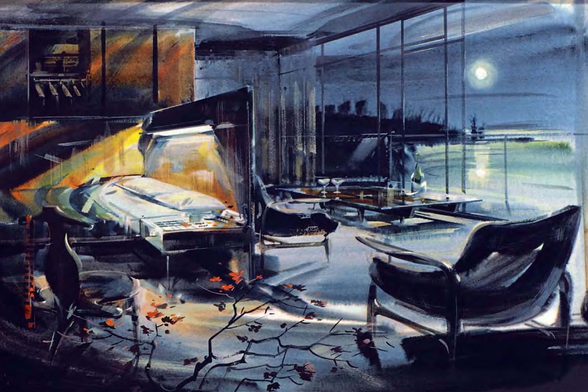
This artwork depicts an interior space at night, rendered in a style that is abstract yet evocative of realistic elements.
The scene is divided into three distinct sections, each representing a different area within the room: the bedroom, bathroom, and living/dining area.
The artist has used muted colors with subtle hints of warmth through the use of light sources and possibly a fireplace or candles.
The art style leans towards impressionism, characterized by loose brushstrokes that capture the essence rather than the precise details.
https://nocontext.loener.nl/fullpage/04-April1959-Page-054.png
#photography #illustration #madman #nocontext #sfw #abstract #interior #night #bedroom #bathroom #livingroom #diningarea #warmth #lightsources #fireplace #candles #impressionism #loosebrushstrokes #mutedcolors
🧲 Now in npj Computational Materials: 'Attosecond magnetization dynamics in non-magnetic materials driven by intense femtosecond lasers' - a study by Ofer Neufeld and members of our Theory Department. They show that fast electron dynamics in bismuthumane (BiH) can be converted to #attosecond magnetism and predict a magnetic response at record speed. Such processes could be important for future memory storage devices.

Irradiating solids with ultrashort laser pulses is known to initiate femtosecond timescale magnetization dynamics. However, sub-femtosecond spin dynamics have not yet been observed or predicted. Here, we explore ultrafast light-driven spin dynamics in a highly nonresonant strong-field regime. Through state-of-the-art ab initio calculations, we predict that a nonmagnetic material can transiently transform into a magnetic one via dynamical extremely nonlinear spin-flipping processes, which occur on attosecond timescales and are mediated by cascaded multi-photon and spin–orbit interactions. These are nonperturbative nonresonant analogs to the inverse Faraday effect, allowing the magnetization to evolve in very high harmonics of the laser frequency (e.g. here up to the 42nd, oscillating at ~100 attoseconds), and providing control over the speed of magnetization by tuning the laser power and wavelength. Remarkably, we show that even for linearly polarized driving, where one does not intuitively expect the onset of an induced magnetization, the magnetization transiently oscillates as the system interacts with light. This response is enabled by transverse light-driven currents in the solid, and typically occurs on timescales of ~500 attoseconds (with the slower femtosecond response suppressed). An experimental setup capable of measuring these dynamics through pump–probe transient absorption spectroscopy is simulated. Our results pave the way for attosecond regimes of manipulation of magnetism.
 No Context Pictures
 MPSD
MPSD