 IMDEA Nanociencia
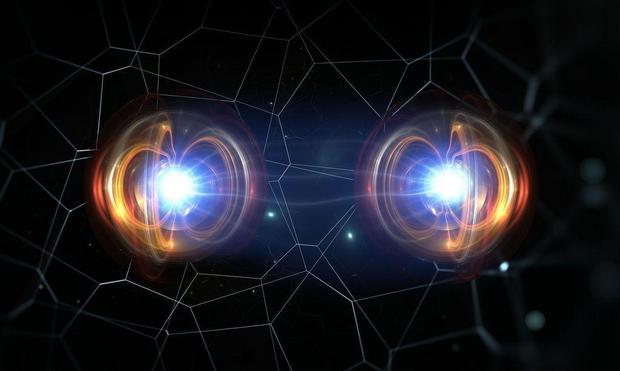
On #WorldQuantumDay we revisit this pioneering research by Prof. Fernando Martín, published in Nature: controlling #quantum #entanglement at the expense of coherence using #attosecond pulses.
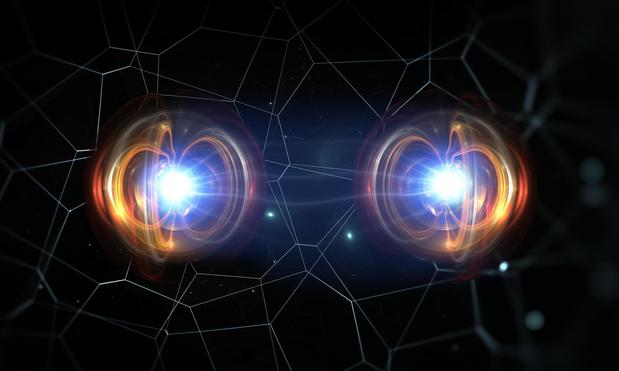
On #WorldQuantumDay we revisit this pioneering research by Prof. Fernando Martín, published in Nature: controlling #quantum #entanglement at the expense of coherence using #attosecond pulses.
Today in Nature: Coherence and quantum entanglement controlled by #attosecond pulses.
Researchers at UAM, MBI and IMDEA Nano tune the degree of entanglement at the cost of quantum coherence.
+info https://nanociencia.imdea.org/home-en/news/item/researchers-tune-quantum-entanglement-and-coherence-using-attosecond-laser-pulses #IMDEAnanoPublications
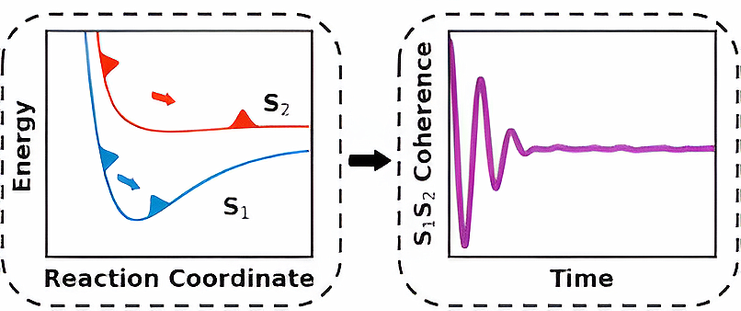
New computational method captures molecular dynamics after ultrafast excitation.
Researchers capture how electrons and nuclei interact after #attosecond light excitation in a numerically inexpensive way.
#IMDEAnanoPublications @tomATTOsecond
Our postdoc has spent his time, while the lab building has been closed, exploring some ideas around strong field physics. It is generally discussed in semi-classical terms, however he is considering a model using quantum "squeezed" light. Contributions also from a couple of my supervisors. It has been submitted for publication, with a link to the preprint below.
"...
Crucially, we show that the collapse of holographic contrast is not a loss of information but
a metrological gain.
...
This fundamental trade-off between structural imaging fidelity and
statistical sensitivity establishes the framework for Attosecond Quantum Tomography: an in-situ,
reference-free protocol
...
Our results
identify strong-field ionization as a nonlinear quantum transducer, bridging attosecond electron
dynamics with quantum information science"
https://arxiv.org/abs/2602.13667v1
#physics #strong-field #attosecond #quantum

Bridging quantum optics and strong-field physics provides a pathway to explore how quantum light shapes extreme nonlinear light-matter interactions. However, direct characterization of non-classical light at damage-threshold intensities remains an open question. Here, we theoretically investigate the impact of photon-number fluctuations of squeezed light on strong-field photoelectron holography using a quantum-optical strong-field approximation. We identify a mechanism, ponderomotive dephasing, whereby the inherent quantum fluctuations of the driving field dictate the stability of the electron's semiclassical action. While amplitude-squeezed light stabilizes the action to enhance holographic contrast, phase-squeezed light amplifies photon-number noise, causing a rapid collapse of fringe visibility. This quantum-optical sensitivity follows a steep quartic wavelength scaling, rendering mid-infrared drivers uniquely sensitive to the field's underlying quantum nature. Crucially, we show that the collapse of holographic contrast is not a loss of information but a metrological gain. By evaluating the Classical Fisher Information, we identify a "dark-port" mechanism in the tunneling tail that enables the estimation of field quadrature noise beyond the Standard Quantum Limit. This fundamental trade-off between structural imaging fidelity and statistical sensitivity establishes the framework for Attosecond Quantum Tomography: an in-situ, reference-free protocol to reconstruct the Wigner distribution of intense quantum light. Our results identify strong-field ionization as a nonlinear quantum transducer, bridging attosecond electron dynamics with quantum information science.
Researchers at @EuropeanXFEL have created a state of #matter as it occurs in the interior of #planets or during #inertial confinement #fusion. They also open up a way to measure extremely short phenomena #attosecond #physics
https://www.xfel.eu/news_and_events/news/index_eng.html?openDirectAnchor=2426&two_columns=0

Researchers at @EuropeanXFEL have created a state of #matter as it occurs in the interior of #planets or during #inertial confinement #fusion. They also open up a way to measure extremely short phenomena #attosecond #physics
https://www.xfel.eu/news_and_events/news/index_eng.html?openDirectAnchor=2426&two_columns=0

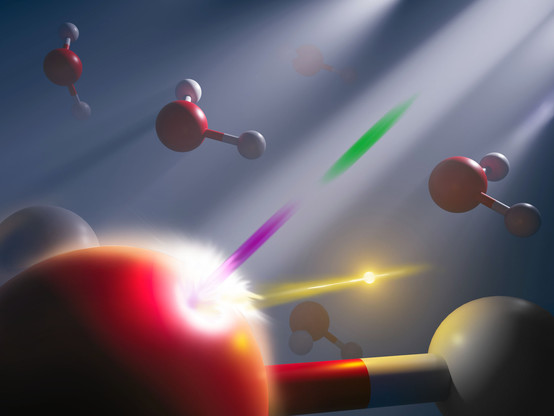
Tiny, tinier & tiniest ?
(Something in the water)
https://www.anl.gov/article/firstever-atomic-freezeframe-of-liquid-water

 Anthony David
 IL Photonics
 Science News
 idw
idw Peter Riley
 Alan Boyle
 Markus Osterhoff