Die Sendung „Forschung aktuell“ im Deutschlandfunk hat am Freitag auch über 10 Jahre Astronomie mit Gravitationswellen berichtet.

Für den Beitrag „Ein sensationelles Beben durch Raum und Zeit“ sprach Frank Grotelüschen mit Forschenden am @mpi_grav in Potsdam und Hannover. Es geht um die erste Entdeckung, die wichtigsten Erkenntnisse des vergangenen Jahrzehnts und die Zukunft mit neuen Detektoren wie dem Einstein-Teleskop und LISA.

🎧 https://www.deutschlandfunk.de/ein-beben-durch-raum-und-zeit-10-jahre-gravitationswellen-100.html

#Gravitationswellen #Deutschlandfunk #Wissenschaft #EinsteinTeleskop #LISAMission #10YearsGW

Gravitationswellen - Ein sensationelles Beben durch Raum und Zeit

Wenn Raum und Zeit beben: Vor zehn Jahre schnappten zwei US-Detektoren die erste Gravitationswelle auf, nachdem zwei Schwarze Löcher kollabiert waren.

Deutschlandfunk
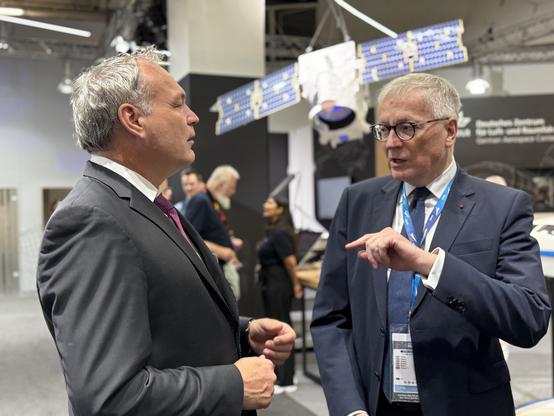
🚁🛩️ Zweiter Messetag auf der #ParisAirShow2025 geht auf das Ende zu 🛩️🚁 Mit der Vertragsunterzeichnung zwischen OHB und @thalesaleniaspace.bsky.social ist die #LISA-Mission, ein Observatorium zum Nachweis von #Gravitationswellen einen guten Schritt vorangekommen.

Today, the European Space Agency (ESA) and OHB System AG sealed their agreement to build ESA’s Laser Interferometer Space Antenna, @LISA

ℹ️ https://www.lisamission.org/industry/

“We are delighted that the European Space Agency has now chosen the industrial partner who will take on the manufacturing of LISA, marking another major step towards launch”, says Dr. Jonathan Gair, chair of the LISA Consortium council and group leader at @mpi_grav in Potsdam.

#GravitationalWaves #SpaceIndustry #LISAMission

Industry

Industry LISA prime industrial partner selected: Construction of ESA’s ambitious LISA Mission begins June 17, 2025 Today, the European Space Agency (ESA) and OHB System AG sealed their agreement to build ESA’s Laser Interferometer Space Antenna, LISA. A bold scientific enterprise, the triple-spacecraft mission will be the first space-based observatory to study gravitational waves: ripples … <p class="link-more"><a href="https://www.lisamission.org/industry/" class="more-link">Continue reading<span class="screen-reader-text"> "Industry"</span></a></p>

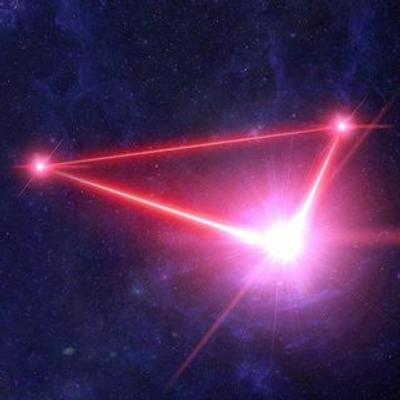
👇 Exciting news for the @LISA gravitational-wave space observatory! 🚀

The @mpi_grav and OHB Systems AG have signed a contract for the further development and production of the LISA phasemeter. It’s the key instrument for LISA’s gravitational-wave observations.

➡️ https://www.aei.mpg.de/1254455/entscheidender-fortschritt-fuer-lisa-das-gravitationswellen-observatorium-im-weltall

The ESA mission, scheduled for launch in 2035, will provide unprecedented insights into the Universe!

Picture: OHB

#LISAMission #GravitationalWaves

👇 Spannende Neuigkeiten für @LISA, das Gravitationswellen-Observatorium im All! 🚀

Das @mpi_grav und die OHB Systems AG haben einen Vertrag über die Weiterentwicklung und Fertigung des Phasenmeters für LISA geschlossen. Es ist das Schlüsselinstrument für LISAs Beobachtungen von Gravitationswellen.

➡️ https://www.aei.mpg.de/1247332/entscheidender-fortschritt-fuer-lisa-das-gravitationswellen-observatorium-im-weltall

Die ESA-Mission, die 2035 starten soll, wird uns ganz neue Einblicke ins Universum geben!

Bild: OHB

#LISAMission #Gravitationswellen

🚀 LISA, GRACE und NGGM neuem Podcast 🎧

In der ersten Folge des ganz neuen Podcasts „Chip Happens“ geht es auch um die Satellitenmissionen @LISA, GRACE und NGGM, die Gravitationswellen beobachten sollen bzw. jetzt schon Klima-Indikatoren global überwachen.

Gerhard Heinzel vom @mpi_grav bringt euch (etwa ab der Mitte des Podcasts) auf den neuesten Stand.

🎧 https://open.spotify.com/episode/3L3YQqOjFZ0zyrZ3Amnjr4

#ChipHappens #Raumfahrt #Satelliten #LISAMission #Gravitationswellen #Klima #Laser #Podcast

#LISACommunityTalks

The #LISACommunity recently hosted a talk by Senwen Deng on a paper by Senwen Deng, Stanislav Babak, Maude Le Jeune, Sylvain Marsat, Éric Plagnol, Andrea Sartirana: "Modular global-fit pipeline for LISA data analysis", linked here 👉 https://arxiv.org/abs/2501.10277

Here's a summary of the paper:

"The #LISAMission data band is expected to be dominated by gravitational wave signals emitted by a plethora of astrophysical sources. Signals of the Galactic white dwarf Binaries are long-lived, overlapping in time and their unresolved residual forms a confusion noise. Massive Black Hole Binary signals are loud and broadband, hindering the estimation of the noise property, the knowledge of which is key to the detection and parameter estimation for the gravitational wave signals. We came up with a modular two-stage iterative pipeline prototype to disentangle the intertwined signals and to infer the parameters for the different signal sources and the noise level. We demonstrated its capability by applying it to simulated LISA dataset known as "Sangria", where we managed to recover the injected parameters at the simulation with faithfulness."

Modular global-fit pipeline for LISA data analysis

We anticipate that the data acquired by the Laser Interferometer Space Antenna (LISA) will be dominated by the gravitational wave signals from several astrophysical populations. The analysis of these data is a new challenge and is the main focus of this paper. Numerous gravitational wave signals overlap in the time and/or frequency domain, and the possible correlation between them has to be taken into account during their detection and characterization. In this work, we present a method to address the LISA data analysis challenge; it is flexible and scalable for a number of sources and across several populations. Its performance is demonstrated on the simulated data LDC2a.

arXiv.org

The new @LIGO Magazine is out and available online!

➡️ https://ligo.org/wp-content/uploads/2025/03/LIGO-magazine-issue26.pdf [pdf]

This time…

… with an article by Elise Sänger, PhD student at @mpi_grav in Potsdam, on the formation of the LIGO-Virgo-KAGRA Climate & Sustainability Committee (page 16)

@harte_echtzeit, a scientist during the day and a musician during nights, on his gravitational-wave inspired music which he also presented during our 2024 Open Day at GEO600 (page 20)

… an update from @LISA on the full-scale telescope prototype revealed by NASA (page 24)

… and a lot more great reading from the science community.

#LIGOMagazine #GravitationalWaves #LISAMission

New @DAAD_worldwide “science in a nutshell” video about @LISA!

Got four minutes to spare? Why not use them to listen to Marie-Sophie Hartig explain how @LISA will observe the gravitational-wave Universe?

➡️ https://inv.nadeko.net/watch?v=ObK0-COD9Zk [Invidious]

➡️ https://www.youtube.com/watch?v=ObK0-COD9Zk [YouTube]

#GravitationalWaves #LISAMission #astronomy #BlackHoles #Outreach #SciComm #Science #Physics #Astrophysics

Probing the history of the universe through gravitational waves – Dr Marie-Sophie Hartig

#DAADScienceInANutshell Dr Marie-Sophie Hartig is part of a groundbreaking project between ESA, NASA and an international consortium of researchers: LISA, the first space-based observatory dedicated to studying gravitational waves. Detecting and decoding these ripples in space-time will enable us to probe the history of our universe. _____ Besuch uns auf https://www.daad.de/ Oder auf unseren Social Media-Kanälen: Bluesky – https://www.bsky.app/profile/daadworldwide.bsky.social Threads – https://www.threads.net/@daad_worldwide Facebook – https://www.facebook.com/DAAD.Worldwide Instagram – https://www.instagram.com/daad_worldwide LinkedIn – https://www.linkedin.com/school/daad-worldwide

DAAD Worldwide | Invidious
Just a year ago LISA passed a major review with flying colours: The whole concept - from the definition of the overall mission and operations to the space hardware to be built - stood up to the intense scrutiny of ESA´s reviewers. ESA confirmed that LISA is sufficiently mature and mission development could proceed as planned. The sky's (not) the limit🚀
#lisamission #LISACommunity #gwspace #europeanspaceagency #nasa