Army of John Hunyadi and Matthias Corvinus

Recruitment and organization

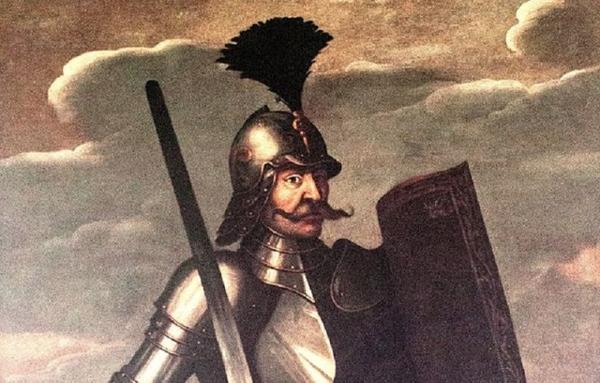
John Hunyadi

Both Hunyadis utilized army which was a combination of mercenaries and feudal banderia (banners – Exercitus Banderialis). Occassionally the army would be supplemented by Exercitus Generalis – a general call to arms, which would basically mean everyone capable of bearing arms. This Exercitus Generalis may be the source of a media trope of feudal armies composed primarily of untrained, unequipped peasants – but in reality, such armies were an exception, not the rule. Exercitus Generalis itself was in existence since 14th century, but it was called for the last time in 1439. by king Albrecht. He gave up and dismissed people to their homes after two weeks. Primary way of recruiting troops was, since 1435., banderial system. Banderia – which could vary in strength from less than a hundred to more than a thousand men – were raised and maintained by the king, bishops and magnates. While this system theoretically allowed the kingdom to maintain large number of professional soldiers, in practice the owners of banderia were not motivated for war until they themselves were in danger. Banderial system thus was incapable of stopping the Ottoman expansion, and was only really effective in constant civil wars.

John Hunyadi had fought against Hussites as a youth, specifically under king Sigismund near Prag in 1420. and Visegrad in 1421. Hussites were citizens and peasants who rebelled against Church and high nobility. They were poorly equipped and could not withstand the impact of a charge of heavy cavalry. Therefore, they adopted approach of eastern nomads, using wagons to defend the camp. While these were ordinary peasant wagons, they later built specialized battlewagons with artillery. Near the enemy wagons would move in multiple columns, allowing them to quickly form a square when necessary. Women, children, cattle and horses would be placed in the middle of the camp, which wold be additionally fortified with earthen rampart if time allowed. Such a fort could only be attacked on foot. Many experienced commanders were left after the end of Hussite wars, and Hunyadi took them into his service.

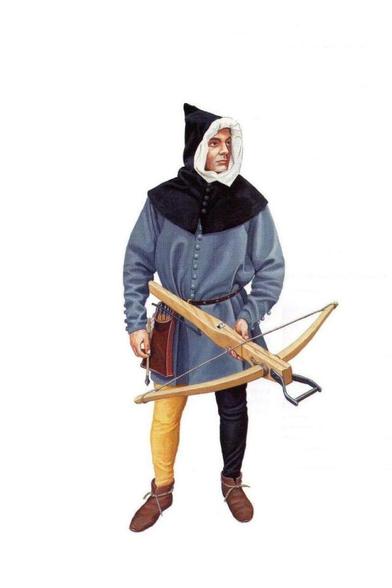
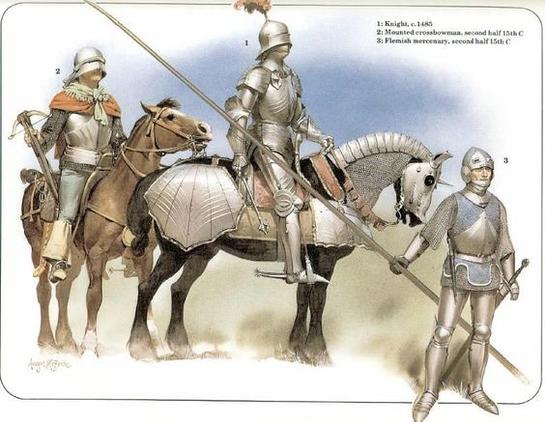
Hunyadi utilized heavy infantry equipped with half-plate and polearms, and Czech and German mercenaries equipped with pavises and either crossbows or hand cannons. Light infantry was formed from poor peasants and citizens, and armed with composite bow and either a sabre or a sword; their task was to engage Turkish light infantry, retreating behind the wagons or heavy infantry as necessary. Main striking arm was heavy cavalry. For heavy cavalry Hunyadi utilized predominantly German or Italian mercenaries, who were organized into lances (Gleve). Each lance consisted of a knight, a less-armoured serjeant (also called a coustillier – one who finishes a defeated opponent) and one or more mounted crossbowmen. Crossbowmen supported their knight by loosing bolts at nearby enemies before retreating for a short time to reload the crossbow. This system did not exist in Croatian-Hungarian kingdom, hence the need for king Sigismund to explicitly order (in 1396.) that each knight has to bring two mounted crossbowmen (thus making two heavy/shock cavalrymen and two mounted crossbowmen per lance). Light cavalry protected other troops from Ottoman light missile cavalry (Akincis).

Hungarian-Croatian army was very cavalry-heavy. Kaiser und Konig Sigismund in his reforms in 1432. predicted raising 80 000 cavalry in whole country, of which 12 000 just in Croatia. At least a portion were light cavalry, armed with a sword, bow or crossbow, and a lance, and armoured either lightly or not at all. Considering the population of 4 000 000 would give military as 2% of population, it would appear that reforms did not predict raising any infantry at all. Sekeljs were nomads divided into 12 tribes giving 400 cavalrymen each – a total of 2 400 cavalry. This cavalry was equipped only with a bow, saber, lance and a shield. Saxons, which were settled in Transylvania, gave 1 600 soldiers to the king. Their equipment was much like that of Germans in the West, and their cities had advanced metalworking, armour and cannon production.

Hunyadi strained against the limits of feudal military organization. He started war against Ottomans with smaller armies composed of 10 000 – 15 000 mercenaries and his own soldiers. Core of this army were few thousand veterans who were highly reliable, motivated and determined. Feudal system had disadvantage in its inability to train large coherent forces: only individual banderia could really train together, but banderia themselves only came together in case of major conflict where multiple magnates came together. At best, 2 000 – 3 000 men could be formed into a coherent body of troops, much less than was the case with ancient Rome or else Byzantine Empire – or indeed Ottoman Empire, which had inherited Byzantine military model. As wars against Ottomans escalated, Hunyadi’s armies were larger, but he also climbed the state hierarchy. When he went to war in 1448., Hunyadi had to secure his position in the kingdom with several thousand loyal troops before leaving on campaign. And since he waged the war with army of the kingdom, and not just his private army, his nominal subordinates were often large magnates and other powerful nobility with its own interests. This might have been a reason why infantry – usually one of key elements of Hunyadi’s battle tactics – was mostly ignored at Varna and Kosovo, being few in number and likely structured for sieges as opposed to open battles.

Matthias Corvinus

General organization

Main innovation of the new king was the standing professional army. Armies he led were very cavalry-heavy. When it comes to banderial army, he introduced provincial banderies. These could be kept under arms for three months every year, and used both within and without the kingdom. Each noble had to give one soldier. Nobles themselves had to raise their banderies to defend the kingdom, but were not required to participate outside its borders.

Matthias had no problem raising medium to large armies for the time. Szilagy had 8 000 men in Belgrade in 1458. and attempted to help Serb despot Jelena. Matthias himself defeated an Ottoman army in Srijem large enough that 5 000 Turks died just trying to run away across Sava, after which Mihail Szilagy took 3 000 men from Kovin to Belgrade. Hungarian army of 3 000 was defeated near Kormend by Austrian troops 2 000 strong in 1459. In 1461. Matthias sent 4 000 cavalry and 1 200 infantry to help Albrecht.

By 1463. Matthias Corvinus already had a standing army of 5 000 infantry and 2 000 cavalry. He also requested nobles to raise one cavalryman per 10 houses – previous standard was one per 20 houses – thus giving (assuming family size of 5, as is standard assumption) army size as 2% of population. Prelates and barons had to send him 12 000 cavalry. If kingdom had population of 4 000 000 – 5 000 000, then Matthias’ army could have numbered 80 000 – 100 000 troops, similar to what Sigismund thought to raise (compare to 40 000 – 60 000 or 1,2% of population in 1454.). Such a number certainly could be reached if conquered Moravia and Sillesia as well as allied Moldavia and Wallachia were counted. Matthias Corvinus himself may have had up to 30 000 troops from his own estates. As noted, Matthias crossed Sava on 11th September 1464. with 17 000 cavalry, 6 000 infantry and 7 000 crusaders. This again shows cavalry-heavy nature of Hungarian armies in the time. In 1468. Matthias fielded an army of 22 000 men, 2 000 wagons and 50 cannons, and in 1469. took an army of 10 000 men. In 1474. he had 10 000 men and 900 war wagons in a field army, and later raised an army of 60 000 – 70 000 men and 100 ships. Black Army in 1487. had 20 000 cavalry and 8 000 infantry.

Standing army of king Matthias – the “Black Army” – originally had 6 000 mercenaries. Full army of kingdom included banderial troops as well as Moladvian and Wallachian dukes; thus an army overall could have been 148 000 – 163 000 according to some sources. Venetian ambassador specifically stated that the army had 3 000 battle(?) wagons, 30 bombards, 30 long cannons, 24 two-wheeled wagons with 2 cannons each, 12 great bombarding wagons with 6 cannons each, 8 wall-breaching bombards, 8 wall-destroyer machines and 10 great bombards. As for army, ambassador counted 6 000 heavy Silesian-Moravian cavalry, 10 000 infantrymen, 10 000 Hungarian heavy cavalry, 4 000 crossbowmen with pavises, 16 000 Szekely mounted archers, 16 000 Szekely footmen, 400 riflemen, 80 artillery masters, 10 000 soldiers of noblemen of Transylvania, 2 000 Wallachians of Transylvania, 12 000 soldiers of voivode of Transylvania, 20 000 infantrymen and artillerymen, 8 000 riders of Moldavia, 30 000 footmen. Total: 144 480 men, of which around 106 000 were of the kingdom. Army had heavy and light infantry (of which 20% had gunpowder weapons), heavy and light cavalry, artillery and navy. An Italian report places navy at 364 ships, with 2 600 sailors and 10 000 soldiers. Of these 10 000 soldiers, 1 700 were men-at-arms, 1 200 infantry with pavises, and remainder crossbowmen and handgunners. Among ships, 16 were galleys with four great bombards and 300 gunmen each. Of 364 vessels of the navy, there were 330 actual ships and additional 34 sloops at Belgrade. Each sloop had 18 oars and 18 soldiers with a rifle and two artillerymen. Bombards on large ships could fire a ball weighting 300 lbs. This military force required over a million florints per year, thus forcing Matthias to constantly ask for extraordinary taxes. But a lot of money was also spent on supporting the art, and in his time first printing works appeared in Hungary and Croatia.

Black Army

Black Army was the core of Matthias’ army. It was a standing army formed first from former Czech Hussites. It gained its nickname most likely from one of its commanders, “Black” John Haugwitz. While theories exist that soldiers of Black Army painted their armour black, this is unlikely – black armour did not appear in mass until 16th century. Images where armour does look black are likely ones which utilized silver-based silver colour, which due to oxidization would become black – this is also the reason why flag of Matthias Corvinus is sometimes shown with red-and-black instead of actual red-and-white colour pattern.

Standing army was required, as feudal army of the kingdom depended primarily on large magnates, which were – mildly put – unreliable. Hussites had utilized battle wagon tactics to counter otherwise nearly-unstoppable charge of feudal heavy cavalry. Combination of battle wagons and infantry armed with firearms and protected by pavises proved a powerful defensive tactic. John Hunyadi and Matthias Corvinus also formed light cavalry as a separate combat arm, significantly improving mobility and scouting capacity of the army, while also significantly reducing relative combat power of Ottomans whose tactics were based heavily on utilization of light cavalry.

Matthias Corvinus improved on his father’s model by forming regular logistical support and also regularly paying soldiers. In the end, Matthias’ standing army will reach strength of 30 000 men, 2 000 wagons, 100 cannons and 200 ships on Danube and Sava. This is almost the same as what entire Hungary was able to field for Battle of Mohacs in 1526. (25 000 – 30 000 soldiers, 5 000 carts and 85 cannons). And while original Black Army was made up of foreign mercenaries, by 1480. it consisted mainly of native troops. Among troops of Black Army, one in five carried harquebus, which was extremely high proportion of gunpowder small arms for the time.

Strategy

John Hunyadi

Hunyadi’s army was comprised primarily of mercenaries. This heavily influenced his choice of an agressive, offensive strategy. Losses of mercenaries did no harm to kingdom itself, and by transferring war to enemy’s land, Hunyadi prevented them from harming his own kingdom. This also forced Ottomans to defend instead of attacking. Ottoman military was structured around jihad, and contained a significant number of soldiers with no lands or incomes, whose only “wages” were whatever they acquired in war. This meant that the Ottoman Empire depended on permanent consquest and expansion for proper functioning; yet Hunyadi turned the situation on its head. Hunyadi also used this strategy against Counts of Celje; only when he devastated Slovenia – then part of Holy Roman Empire – did they becalm themselves. Hunyadi likewise forced Friedrich III to abandon his designs on Hungary by devastating parts of Austria. His losses did no damage to the kingdom as his soldiers were mecenaries.

Matthias Corvinus

Matthias Corvinus likewise preferred to go on the offensive. In this however he was significantly constrained by his many enemies within the kingdoms. He was also too occupied by affairs of central Europe. Matthias failed to assist either Serbia of Stjepan Tomašević or Bosnia of Stjepan Tomaš. Only after the latter fell did he take serious steps for defense against Ottoman threat. This however was not wholly his fault. Friedrich III. Hapsburg was actively seeking crown of Hungary between 1459. and 1463., and again in 1474. and 1484. – 1490., as did Polish prince from 1472. to 1474. As early as February 1459., he made a declaration in which he called Friedrich a parasite who is seeking to exterminate Hungarians and their language; thus Matthias called people to arms – showing that a form of (ethnic?) nationalism existed at least this early. Matthias was also aware that resources of Hungarian-Croatian kingdom were limited, and sought to increase them by expanding his rule to Austrian lands.

His success however was in his ability to focus on one opponent at the time. When that was not possible, he was usually still able to keep his enemies divided, physically if not in war aims, and to defeat the weakest enemy first.

Weapons and equipment

Pavise Carriers (Clipeati)

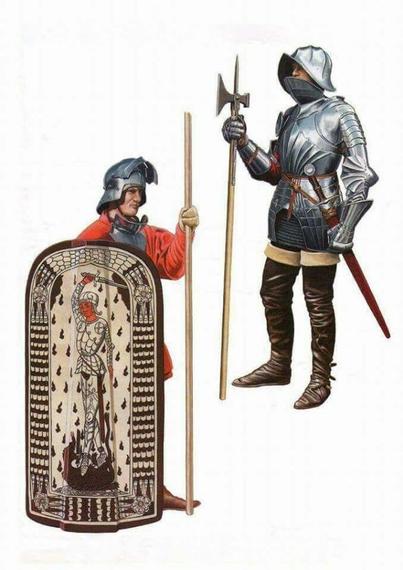
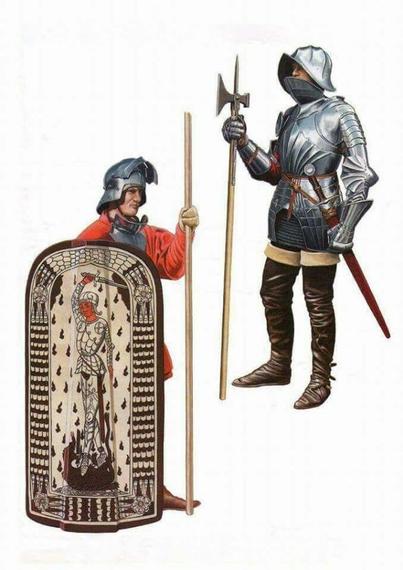
Clipeati are well armoured infantry armed with a polearm and paired with a servant who carried a large pavise shield and equipped with light armour – or just a helmet – and likely armed with a long spear or pike for repelling cavalry attacks. Pavise shield was rather large. A pavise shield used by army of Matthias Corvinus cca 1485. was 115 cm tall, 61 cm wide and weighted 10 kg. This particular shield however was lost or destroyed during battles for Budapest in 1945. Shields could be larger – 125 cm and 11 – 12 kg.

Clipeati in Matthias’ service formed a solid shield wall which other elements of infantry could fight from. This might be tactic similar to that of Hussites, who used man portable mantlets to create a second line of defence within their Tabors.

Heavy Infantry (Armati)

Armati were heavy armoured infantry which fought alongside clipeati, and had same equipment. They could fight in support of / within battle wagons or behind clipeati. Armati were armed with two-handed weapons – two examples being a poleaxe (or, rather, polehammer) and a spear. Polehammer was a two-handed weapon with a warhammer head – specifically, a head which consisted of a hook for piercing plate, a long square spike for stabbing between plates, and a warhammer. Another common weapon was short (1,8 m) spear with a very long single-bladed hewing head – that is, spearhed designed for both stabbing and cutting. Backup weapons were a one-handed or hand-and-a-half longsword and a dagger.

Infantry armour was lighter and cheaper in make than that of heavy cavalry, as latter was expected to stop impact of heavy spear. Helmet was typically sallet without visor, with faceplate attached to breastplate. Because of this, soldier could easily open and close vision slot simply by raising and lowering his head. Infantrymen usually did not have leg armour: partly for greater mobility in close combat, partly perhaps for financial resouns, and partly because – in army of John Hunyadi and Matthias Corvinus at least – first ranks had their legs protected by pavise wall.

Some may have carried hand-held pavises. These shields were much smaller than “static” pavises used by crossbowmen for protection, perhaps around the size of a heater shield. Pavise of Matthias Corvinus shows two horizontal straps top and bottom, and loose strap in the middle. It is likely that soldier would use the shield with hand gripping one of the handles near ends, with large strap being then tightened over forearm.

Light infantry

Often mentioned, but their equipment is unknown. Crossbowmen were definitely counted among light infantry, as they are mentioned nowhere else. However, tactics as described above also indicate a significant presence of melee-armed light infantry.

Crossbowmen used pavise shields as a protection when reloading crossbows. These shields could be equipped with two straps and carried as a backpack, in which case crossbowman would reload crossbow with back turned towards the enemy before turning around. By time of Matthias Corvinus however much larger pavise shields were utilized, requiring a dedicated shield-bearer. Heavy crossbows with steel bows could reach distances greater than 300 meters (compare with 250 – 300 meter range for English longbow), and were drawn with mechanical devices. These crossbows could even pierce plate, as an example of a helmet pierced from both sides by a crossbow bolt shows. Windlass crossbows however were usually only used in forts, while in the field crossbows were loaded with one-handed teethed mechanism or else with “goat leg”. With such devices, rate of fire was around two bolts per minute. Light crossbows with wooden bows, often used by city militias, were drawn manually with two hands, and had range of 110 meters with heavy bolt and 130 meters with light bolt.

Pushkars used first firearms (whose name – pushka – used here comes from Slavic word “pušiti” – “to smoke”). But these early pushkas (handguns) were not effective weapons in open field battles and required protection, such as provided by a wagonburg. Matthias Corvinus had 2 000 pushkars in 1475. Pushkars also used pavise shields for protection in a manner similar to crossbowmen. Hand cannons were used as early as Hussite wars, and had lethal range of 50 meters. At distance of cca 10 meters, hand cannon’s ball could pierce even plate armour, something no other ranged infantry weapon could do unless it hit a weak spot. Hand cannons were also very easy to learn, and had rate of fire of 10 – 15 shots per hour.

Up until Hunyadi, archers were the mainstay of Hungarian infantry. They represented poorer elements of various levies, and tradition of mounted archery in Hungary made inevitable the appearance of foot archers as well. During Louis the Great foot archers carried sabres and composite bows. Janos Hunyadi relied on Transylvanian and Szekely foot archers.

In Black Army itself, every 4th soldier had a gun – with 8 000 infantry, this would suggest that all pushkars were part of the Black Army.

Saxons

Saxons were a significant German population settled in Transylvania, whose migration there started in 1150. Largest settlement was around town of Sibiu (Hermannstadt), situated on one of few easily navigable routes through Carpathian mountains to the Black Sea. Thus it was a major trading town and defensive stronghold. Like Szekelis (see in cavalry section), Saxons were granted practical autonomy in exchange for special tax and military obligations. These obligations included supplying 500 warriors for internal defence and 100 warriors for foreign service. Aside from area around Sibiu, there were two more Saxon districts, centered around Brasov (also on a route through Carpathian mountains) and Kyralia – Rodna – Bistrita. These also enjoyed rights similar to those given to Sibiu. In 1430., Saxon military obligation was 1 600 men. Their troops were likely similar to those of Germany proper – knights, spearmen, crossbowmen, and in later period handgunners.

Mounted crossbowmen

Mounted crossbowmen were rarely used in the West, and so are not well represented in Western military literature. What mounted crossbowmen do appear in Western accounts are exclusively mounted infantry: that is, they used horses for transport but fought afoot. John Hunyadi and Matthias Corvinus however used them as part of their offensive cavalry arm. This employment is most similar to that of 10th century Byzantine missile cataphracts (which will be described in one of later articles), or later combined-arms units, where a wedge or column would be formed with heavy melee cavalry in outer ranks, and inner ranks formed of heavy missile cavalry. In combat, crossbowmen would likely “soften” enemy ranks with missile barrage before reloading and targeting enemy men-at-arms’ horses when close combat unfolded.

Heavy cavalry

  • Knight armed and mounted, ready for battle. Hand-colored woodcut of a 19th-century illustration

Hungarian-Croatian heavy cavalry (nehec lovassag) of second half of 15th century was army’s primary striking force. It was recruited from major and middle nobility, as well as foreign mercenaries. Cavalry utilized gothic plate armour. Weak point of armour was helmet (sallet) which sat directly on top of head, and thus every strike fell directly on head (and neck). But it also had significant advantage in that it allowed easy head movement and thus easy visibility, and also impeded hearing much less than a fully enclosed helmet attached to armour. Armour for rider weighted 26 kg. Heavy lance was helped by arrest mounted on armour; this and deep saddle allowed rider to transfer much more of force (around 1 ton) to target.

Main weapon was heavy lance around 4 meters long. Only very rich warriors could afford full horse barding; much more common was armour for head only, which was not rare. Full barding had weight of 33 kg. With armoured rider and saddle horse will have carried around 140 kg, which meant that such a horse had to weight at least 560 kg. Heavy cavalry was main striking force, and Hungarian and Croatian armies of the time were both mostly cavalry. Hungary had major advantage in its horses, which were some of the best in Europe.

Hungarian knights were different from their Western counterparts in multiple ways. Emperor Sigismund made a specific order for the Nicopolis campaign of 1396 that Knights should be accompanied by two mounted archers, showing that they did not normally come with combat support group, unlike their Western counterparts. Hungarian nobles however were much superior to their Western counterparts in temperament. There are no examples of Hungarian heavy cavalry displaying the impetuous recklessness of their Western (especially French) counterparts, which is likely a consequence of Hungarian experience in fighting against horse archers (from Mongols to Turks).

Also present were mercenary knights from Hungary and Western Europe. These were disciplined professionals, and were organized in lances consisting of a knight and three to five less well equipped retainers. Hungarian mercenaries appear during Luis’ reign, with knights in King’s household recruiting 50 – 80 men-at-arms, and each man-at-arms also supplying a support group of 2 – 3 mounted crossbowmen. Mercenaries came mostly from southern Germany, Bohemia, Hungary itself and Balkans.

Light cavalry

As only rich nobility could afford full plate armour, many if not majority of cavalry were light cavalry. In order of battle, first rows consisted of heavy cavalry with progressively lighter cavalry as one moved towards the rear ranks. Typical equipment was light infantry spear serving as lance, sword, sallet helmet and shield. Armour could be mail, coat of plates, brigandine, gambeson, or nothing.

Light cavalry also employed missile weapons (bow and crossbow). Mounted crossbowmen were usually placed behind heavy cavalry and supported it with missile fire. Light horsemen also acted as skirmishers and counter-skirmishers, in order to clear away Turkish light cavalry (Akinji skirmishers in particular). These were mostly foreign specialists and mercenaries, or Tatars from within Hungary; native Hungarian cavalry appears to have been incapable of acting in this role. Light cavalry also harassed enemy flanks, lines of supply and reinforcements entering the battlefield.

Many light cavalrymen were from Wallachia and Moldavia, or else Transylvania – with Rumanian (Roman) refugees in particular being an important source of cavalry. Each heavy cavalryman had to bring two light cavalrymen for missile support.

Hussars

Hussars were very numerous in Matthias’ service – according to some sources he could have raised 20 000 of them. Generally one Hussar was recruited for every 20 peasants. Hussars had originated after Serbia had fallen under Ottoman rule in 1427. With Turkish raiders and also bandits penetrating the borders, border districts recruited their own cavalry to counter them. Hussars were thus elemental in countering Turkish Akincis, be it their raids or in scouting role. By time of John Hunyadi’s Long Campaign, units of Rac horsemen played significant part in the campaign. Number of hussars rose dramatically after Serbia was formally absorbed into Ottoman Empire in 1459., sending a wave of refugees into Hungary.

Typical armament is heavy lance, sabre and half-circular shield, as well as recurve bow. Of protection, they often wore none, but could have a helmet and mail armour. Shield could also be so-called “Hungarian shield”. They acted as raiders, and during wars against Poland, they took cities of Poznanj and Crarow. Hussars also completely destroyed Polish logistics, which led to their adoption by Poles.

Szekely

Szekelys were separate ethnic group from Magyars, possibly descendant from Huns, and were largest Hungarian speaking group in Transylvania. Szekely lands were largely ethnically homogenous, forming a block of some 12 000 square kilometers in south of Transylvania. Lands were divided into seven districts (szeks). As they were outside the Hungarian law, even Voivode of Transylvania had no authority inside their borders, and administration fell to the Count of Szeleky, who was also often Voivode of Transylvania as well. From 1462., two offices were combined on a permanent basis.

Szekely remained semi-nomadic people who lived from horse and cattle breeding, and were thus regarded as some of the finest light horsemen available to the King of Hungary. Their only obligation was to supply troops for military service, and their value as light horsemen allowed them to maintain their lifestyle. Szekely were divided into six tribes, of four branches each. Each branch was obligated to provide Hungarian Crown 100 horsemen for military service, for 2 400 horsemen total. This professional force was further supplemented by militia obliged to serve 30 days. This militia consisted of those that serve with three other mounted men, individual horsemen, and infantry.

Venetian reports however state that Matthias’ army of 1470. had 16 000 Szekely horsemen, which may indicate recruitment of Szekely mercenaries beyond traditional feudal obligations.

Bombardiers

Bombardiers were specialists who manned bombards (cannons). Bombards were cannons with very short barrel. In second half of 15th century bombards were equipped with a wheeled carriage as well as primitive barrel elevation mechanism. When at position, cannon was protected by a wooden pallisade with a door which could be opened to allow firing. Range was 200 – 300 paces.

Battle Tactics

John Hunyadi

West had heavy cavalry – knights – unstoppable in a charge. Ottoman sipahis could not withstand their charge, and were thus usually placed behind the infantry. Ottoman infantry was placed in the center and deployed unusually deep. As feudal cavalry was usually not capable of cycling the charge (charge-retreat-charge), their charge would drown in the mass of infatry, rendering them static and easy prey for sipahis. Once knights were eliminated, Christian infantry was easily taken care of.

John Hunyadi solved this problem by utilizing a segmented battle line. Normal Western tactic of the time called for heavy cavalry to be placed in the front to deliver a charge all across the line, with infantry behind the cavalry to mop up. Results of such tactic when utilized against Ottomans were already described in the previous paragraph. Instead of doing this, Hunyadi placed infantry in the center. Flanks and the rear of the infantry were protected by battle wagons, and cavalry was placed on the flanks. This forced Ottomans to either be encircled or else face Western heavy cavalry with their own sipahis, either of which was a bad idea. When sipahis started to weaken, Hunyadi would support flank which made more progress with his own heavy cavalry reserve.

In 1443. – 1444., Ottoman army had little in terms of field artillery. This meant that they were incapable of effectively dealing with Hungarian Wagenburg tactics. In their first encounter with such force in September 1442., at Ialomita against Hunyadi, Ottoman army was decisively defeated as their cavalry could not penetrate wagons protecting Hunyadi’s flanks. In 1443., battle wagons again proved an insurmountable obstacle to Ottoman cavalry, and the only way to defeat them was by siege.

Matthias Corvinus

Matthias Corvinus also used tactics similar to John Hunyadi, and he took his father’s mercenaries into his service. It is precisely his father’s mercenaries that formed the core of Matthias’ standing army. However, tactics seem to have evolved with time, becoming more defensive.

In 1480., Matthias Corvinus described his army’s tactics as follows: “…some are light infantry, others heavily armoured, and some are clipeati, which receive double wage as they have servants. Also counted are experts gunners, but they are not as effective as other infantry; they are best behind pavises at beginning of the battle or during sieges. Our rule is that a fifth of infantry are pushkars [note: infantry armed with first matchlock muskets]. …We hold heavy infantry to be immovable wall, and they will die all to one at place they are standing on. If opportunity shows itself, light infantry will break out and attack, but if their attack loses momentum or if they are heavily pressed, they will retreat behind heavy infantry. …All infantrymen and pushkars are surrounded by armatis and clipeatis as a fort. Pavises seem as a fort, behind which light infantry is protected as if behind the walls, from which they attack in proper moment.”. This indicates tactics essentially same as those of Italian mercenary armies.

Another text, likely written also by Matthias, describes tactics of light infantry as such: “…Main task of both lines is protection of third line of pushkars and fourth line of light infantry armed with bows, spears and axes…”, “…during the attack they would approach enemy lines protected by fire of musketeers [note: likely pushkars, archers and crossbowmen], and once enemy attack had been broken, light infantry would come forth to hand-to-hand combat…”.

Thus tactics of infantry can be reconstructed in phases as follows:

  • Clipeati are in first row (servant with shield and spear and clipeati). Behind them are crossbowmen or puskars, and in the rear heavy infantry.
  • When enemy reaches range, shield-bearers and clipeati kneel. Crossbowmen (or puskars) fire over their heads, walking in circle much like 17th century musketeers: first row releases a salvo, and then goes to rear to reload, while second row steps forward to fire.
  • Enemy has closed in; this means that crossbowmen pull back, and armati step forward to reinforce the defense of pavise wall.
  • At this point, cavalry would make a sortie to catch the enemy in the rear. Pavise wall might have been supplemented by battle wagons.

    harci szekerek=war wagons; ágyúk= cannons; könnyű lov.= light cavalry; nehéz lov.= heavy cavalry; nehéz gyalogság = heavy infantry; könnyű gyalogság = light infantry, puskás gyalogság = infantry with rifles; poggyász szekerek = luggage wagons; the three dots = the line of armored infantry with shields;

    Conclusions

    As it can be seen, John Hunyadi and Matthias Corvinus had built up a highly professional, versatile and adaptible force capable of meeting any challenge – be it from Western feudal states or Ottoman Empire. It would not be amiss to consider Hungarian army between 1440. and 1490. the most sophisticated and powerful military force in Europe.

    However, unlike Ottoman army, Hungarian army of the time had little in terms of structural adaptability. Much like Byzantine Komnenian and Paleologian armies, it depended directly on capabilities of the leader. This is seen in battle of Mohacs. Despite the disbandment of Matthias’ standing army, Hungary of Jagellon times still in fact maintained significant military capability. Army of 25 000 – 30 000 men, fielded at Mohacs, was not much smaller than armies of John Hunyadi, though it was only half the size of largest armies led by Matthias Corvinus. This army however displayed clear lack of tactical sophistication which had characterized armies of John Hunyadi and Matthias Corvinus. While Ottoman army had increased in sophistication by that time, Hungarian did reverse – and so it was medieval feudal army which faced modern Ottoman army at Mohacs.

    #army #armyOrganization #battleTactics #equipment #JohnHunyadi #MatthiasCorvinus #militaryOrganization #organization #recruitment #weapons
    Campaigns of John Hunyadi

    Introduction

    Kingdom of Hungary and Croatia had provided a continuous defense of Western Europe against Ottoman expansion from Battle of Nicopolis in 1396. until Battle of Mohacs in 1526. During this time, external assistance was received only infrequently. With Franco-Burgundian military incompetence causing a disaster at Nicopolis, and Western Europe busy with its own matters, Hungary was alone with its vassals in fighting against the Ottoman threat. This had multiple causes. First, European powers were busy fighting each other. England and France were fighting a Hundred Years War, while Germany was disunited and incapable of proper action. Italy was much like Germany, and Italian maritime city-states of Venice and Genoa were as likely to assist Ottomans as they were to fight against them. Any action against Ottomans required settling disparate interests and arranging for peace; but such a peace was diplomatically almost impossible to achieve. Neither frequent messages of peace nor Ottoman conquests could induce Western princes to abandon their wars. Second, West Europeans were too frightened by Turks to go against them. Images of Ottoman cruelty – both real, exaggerated and imagined – coupled with ther (real) military capability and efficiency invited images of disaster, and turned away in fear those who otherwise might have gone against them. As was their usual response to problems arising in Eastern and Central Europe, Western Europe adopted “head in the sand” management policy. Third reason for lack of response was simply that Hungarians were too successful in containing the Turkish threat. While Turkish raids did penetrate into Slovenia, especially during the latter part of the period discussed here, Hungary was the primary target of the raids, and it was – for the most part – able to defend itself well. Hungarian army adapted many Ottoman methods, providing a flexible and capable force matched only by Ottoman army itself. In fact, as will be seen from the following, Hungarian army was largely on the offensive during first part of the period discussed here, entering Ottoman territory and fighting battles there. In 1442., Ottomans were forced to surrender Vidin and Wallachia to Hungary. Even when Ottomans won at Varna in 1442. and Kosovo in 1448., they were unable to capitalize on these victories, at least against Hungary itself – but Constantinople, Serbia and Albania all fell to them in following years. Hungary itself remained strong until its nobility gutted its military capability post 1490., leading to fall of Belgrade in 1521. and defeat at Mohacs in 1526. In 1529., Suleiman beseiged Vienna.

    History and battles

    John Hunyadi

    John (Janos) Hunyadi was born in 1387., as the oldest son of a Hungarized Romanian Wallach Woyk Morosin. Woyk and his two brothers bought a city of Hunyad, receiving surname Hunyadi after the city. John Hunyadi came to court of king Sigismund as a boy while preparing for knighthood. From 1420., John Hunyadi fights against Hussites in Czech lands. After campaign against Ottomans near Smederevo in 1437., king Albrecht I gave John Hunyadi banship over Severin, the most exposted area of Hungary. During civil war of 1440. John Hunyadi supported Wladislaus III. Jagellon (hrv. Vladislav I. Varnenčik) alongside Nikola Iločki, likely due to Polish king’s promise of help in defense against Ottomans. In the same year (1440.), Ivan Talovac, commander of Knights of St.John in Croatia, defeated Ottoman assault against Belgrade.

    Belgrade 1441.

    Ottomans did not give up, however, and came back the next year. John Hunyadi attempted to push back Ottoman forces which were active south of Belgrade, but was forced to retreat in face of unexpectedly large numbers. He was forced into battle after his retreat to Transylvania got cut off by Bey of Semendria. John Hunyadi in this battle abandoned traditional battle order where knights were in the front, opting instead to place heavy infantry in the center, with crossbowmen and light infantry at its flanks. At flanks of infantry were placed heavy cavalry with mounted crossbowmen in support, and light cavalry archers were placed as skirmishers in front of heavy cavalry. Reserve composed of heavy cavalry was placed behind infantry. Battle was decided by the decisive charge of heavy cavalry reserve.

    Alba Iulia & Sibiu 1442.

    Mezid-beg, beglerbeg of Rumelia, entered Transylvania in early March of 1442. with an army of 16 000 – 20 000 men, besieging Sibiu – a Saxon-populated town in Carpathians. Hunyadi found himself in a bind – having dismissed his veterans after liberating Serbia, he could not recall them in time. Instead, he declared a general mobilization (exercitus generalis – all males capable of bearing arms) with a mobilization point in Alba Iulia. Mesid-beg sent a detachment of his army, which broke Hunyadi’s army with a charge, upon which Hunyadi retreated to Alba Iulia. Few days later however Hunyadi’s own army arrived at Alba Iulia, along with Szekels and Saxons under Anton Trautenberg, and Wallachian army under Vlad Drakul.

    Two armies met each other somewhere near Sibiu on 22. April 1442. Both had infantry in the center, but Ottomans had second line of infantry behind the first row. Ottoman cavalry was deployed at wings and also as a central reserve. Hunyadi deployed infantry in a single line, with wagons reinforcing the flanks. At the flanks, beyond the wagons, was cavalry, with additional cavalry in reserve. Christian troops were the ones to attack, and in combat one of commanders of infantry in Hunyadi’s center was killed, causing some degree of disorder. Turks used this for a general assault, but one of wings of Ottoman army was destroyed by counterattack by Christian heavy cavalry and battlewagons. Some Christian detachments may also have penetrated into rear of Ottoman army. Ottomans then routed, and during the pursuit Wallachians captured and executed Mezidbeg and Mezidbeg’s son.

    Vasaq 1442.

    Murat II. decided to avenge this defeat, and raised an army which according to some sources may have had as many as 80 000 men. Army was led by Sehabadin-pasa, new beglerbeg of Rumelia. Army had Jannisaries as well as six banners of Anatolian begs and sandzakbegs. First target was Wallachia. Unable to face this force in the open field, Vlad Dracul retreated to Carpathain mountains to wait for Hunyadi, who arrived in early September. Sehabedin sent a portion of the army to devastate Wallachia, while most of the army went after Dracula along Iaomite river valley. Hunyadi and Dracula faced the Ottoman army on 6th September 1442. near Vasaq, in a narrow valley surrounded by hills. Thuroczy described the terrain as “iron gates”, which is why older literature sometimes incorrectly states that battle happened at Iron Gates on Danube. Hunyadi had 15 000 men, at least some of them drafted citizens and peasants.

    Hunyadi again deployed his army with infantry in the center, with battle wagons protecting the flanks and the rear of infantry. Cavalry was placed at the wings outside the wagons. Hunyadi started battle by sending forward infantry and wagons to attack the Ottoman center. Battle lasted until nightfall when Ottomans finally broke. Sehabadin himself escaped, but Ottomans had lost 20 000 dead men, 200 flags and 5 000 horses and camels. Hunyadi abandoned the pursuit across Danube, instead sending his forces to clear Wallachia from Ottomans. Ottoman army was destroyed in a series of small battles, and the survivors were killed by peasants, so very few managed to get back to the Ottoman territory.

    Campaign of 1443. – 1444.

    In summer of 1443. news arrived to Budim that sultan Murat II was defeated in combat against rebels in Karmania. While war preparations had started in 1442., these news hastened them. Hunyadi bought supplies from cities – wagons, gunpowder and cannons – and also hired some 10 000 – 12 000 mercenaries with money he collected from his own incomes and also donation by Serbian despot Đurađ Branković. After reinforcing the army with royal and noble baneries. Christian army of 35 000 men and 600 battle wagons left Belgrade in September 1443.. Lateness of the campaign start took Ottomans by surprise, and they were unable to mount an effective response. Ishak, bey of Semendria, was defeated while attempting to block Hunyadi’s advance at river Morava. Hunyadi was soon joined by Mircea, son of Vlad Drakul.

    Hunyadi with 12 000 (mostly Transylvanian and Serbian) cavalry ranged ahead of the army, reaching and burning down Niš. Nearby he encountered and destroyed an army of beglerbeg of Rumelia, with Turks losing 9 flags, 2 000 dead and 4 000 captured. Remnants of the Ottoman army were massacred by local peasants during retreat.

    After learning of Hunyadi’s campaign, Murat made peace with Emir of Karmania, and started gathering army near Adrianople while also setting up a blockade of mountain passes leading to Adrianople and Constantinople. Meanwhile Christian army had taken Pirot and Sofia, and went to Plovdiv. Attempts to break through mountain passes failed. This failure, combined with strong winter and loss of a great number of horses incited Christian forces to return home. Sultan Murat did not dare attack Hunyadi directly, and instead attacked and scattered smaller Serb army of despot Branković, which was retreating home through pass of Kunovica. Immediately after Serb defeat, Hunyadi’s cavalry destroyed Ottoman advance guard, capturing Mahmud Celebi, Grand Vezier’s brother. After this defeat, Murat agreed to peace and allowed Hunyadi to return back to Hungary unimpeded.

    Overall campaign was a success, having spent four months on Ottoman territory, penetrating 300 kilometers deep and fighting seven large battles. Army returned home and disbanded in January 1444.

    Varna 1444.

    At council in Budim in April 1444. cardinal Julian Cesarini declared foundation of an anti-Ottoman alliance. King Wladislaus was offered support by Pope, Phillip the Good of Burgundy, Venice and Genova. At these news, sultan Murat II. offered peace, which was agreed on 13th July 1444. But after Byzantine emperor John VIII. Paleologous notified Wladislaus that majority of Ottoman army was in Anatolia, and papal legate Cardinal Julio Cesarini promised that Venetian and Papal fleet will cut crossing over Bosphorus and Dardanelli, king decided to break the peace; promise of support from Bulgaria, Albania and Byzantium also helped tip the scales. Wladislaus raised an army of 16 000 men and crossed Danube at Belgrade on 20th September 1444, conquering Orshava in the process. Army had no infantry other than few hundred Czech handcannoneers and around 100 wagons with crews (plus 2 000 supply wagons). Presence of battle wagons, which would find passing mountains difficult, directed army along Danube to Varna. Kladovo, Florentin and Vidin were conquered along the way.

    Nicopolis was conquered, and many Bulgarians joined the army. Also at Nicopolis, Vlad Dracul joined the army with 4 000 cavalry, and attempted to persuade the king to abandon the campaign after seeing how weak the army was, warning him that sultan takes more men with him when going hunting. But Wladislaus – possibly under influence of Cardinal Cesarini – persisted. While marching through Thracia, Hungarian army came across a river where Ottomans had hidden 28 new galeati in order to destroy Hungary and Croatia under the guise of the peace treaty. Army then camped around Shumen and captured it after a three-day siege – largest battle of the campaign until Varna itself. This was followed by capture of Madara and Venchan. Petrich was reached on 7th November and captured on 9th. It is there that Wladislaus received news that Murat had crossed Bosphorus. This was made possible by Venetian navy which carried Ottoman troops across Bosphorus for price of one gold coin per man and two gold coins per horse, though some sources blame Genoese. Army reached Black Sea coast at Varna on 9th November. Next morning, they had sea behind them and Murat with 50 000 men in front of them – and possibly more, as many (if not most) sources give numbers ranging from 60 000 to 80 000.

    Before battle, Ottomans lit torches and started to sing, an old Turkic tradition intended to show their number and inspire awe in the enemy. In Christian camp, council was convened, which quickly realized rather unfavourable situation of the army. Varna and Black Sea lay to the east, and there was no promised fleet; to the south was Beslav Lake, to the north Franya Heights and to the west Turks. Battle was thus unavoidable. Guliano Cesarini proposed defending from within wagon fort, but John Hunyadi – aware that Christian army was within enemy territory and now with no hope of resupply – argued that the best course of action is open assault against the enemy.

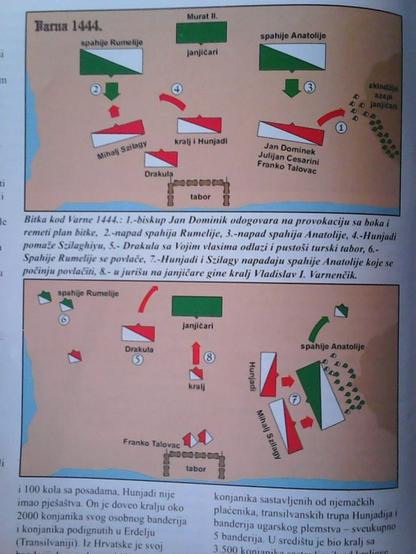
    Bonifaus described the Christian battle order as a half-circle stretching from Devin (or Beslav?) lake to wooded hills, with a width of around a thousand paces. Left wing was held by Mihail Szilagy with 5 000 Hungarian cavalry, in the center was the king with 3 500 cavalry and Hunyadi, while the right wing was commanded by bishop Jan Dominek (likely also 5 000 strong). Reserve was composed of Wallachians under Vlad Dracul. What infantry there was (maybe 2 000, if estimate on strength of right wing is correct) was sent along with battlewagons (100 wagons – 500 crew?) to reinforce the wagenburg camp with 2 000 transport wagons erected on the shore and defended only by drivers. Nevyan Mitev claims that left with had 5 banners and 4 000 people in total, center had either 2 000 or 3 500 men.

    Sultan also divided his army into three groups. Right wing was held by 15 000 – 20 000 sipahis of Rumelia, center was held by sultan with 10 000 Janissaries and Rumelian infantry, and left wing was held by 15 000 sipahis of Anatolia (40 000 – 45 000 total). Wooded hills on Christian right were infested with akinci light cavalry and azap infantry. Janissaries had erected barricades and dug a ditch in front of their positions in the center. Nevyan Mitev puts left wing at 20 000 plus 10 000 hidden in forrest, right wing at 10 000 sipahis, and center at 10 000 janissaries (50 000 total).

    Husar 10 / 2008

    Ottoman attack begun by a provocation from a Frangen Hills forrest, which successfully baited bishop Jan Dominek on the right wing into attack on forrest. This left Christian right wing surrounded and center open to attack. Sipahis at the same time attacked Christian left wing under Szilagy, pushing it back. Hunyadi led Batori’s troops from center there, attacking sipahis into flank and driving them back; parts of Hungarian forces went looting. While this went on, Dominek’s right wing was wiped out by a deluge of sipahis of Anatolia; bishop and his personal troops managed to retreat to wagenburg on the coast. Hunyadi, having broken Ottoman right wing, now turned his attention to the opposite side. Sipahis of Anatolia started to break under his attack, while Wallachian troops found a gap in Ottoman lines and snuck through it, plundering Ottoman camp before heading home. Hungarian army had thus neutralized 35 000 of enemy troops, and sultan Murad was considering running away from battle.

    King Wladislaus had not participated in the fighting thus far. Having grown afraid that Hunyadi will take all the accolades for the victory, he launched a completely unnecessary and illogical head-on attack on Janissaries. Attacking 10 000 Janissaries in fortified position with only 500 heavy cavalry could not succeed. Wladislaus was dragged off his horse and beheaded. Having seen this, certain divisions of Christian army started to retreat, and retreat soon turned into rout. Ottomans did not pursue as their losses were too great; Murad apparently stated “may Allah never grant me another such victory”. Overall, Crusaders appear to have lost 8 000 – 10 000 men, while Ottomans lost 20 000 – 30 000.

    Reasons for Ottoman victory are several. They had much larger army, fought on a terrain that was well-familiar to them, were on strategic defensive whereas Crusaders were in enemy country with no hope of resupply, had much more unified and disciplined command whereas Crusader army was disorganized. King Wladislaus was impetious and threw away his life and chances of victory when victory was within grasp. Also, because of Venetian (and Genoese?) treason, 2/3 of Ottoman army managed to cross the straits – until that point, Ottomans only had 20 000 troops in the Balkans, which if not reinforced would have gotten crushed by Janos Hunyadi despite all the factors noted previously.

    War of 1446.

    King Wladislaus and ban (viceroy) Matko Talovac had died in the same year 1444. While Croatian Parliament talked endlessly about declaring a new viceroy, dukes of Celje Friedrich and Ulrich declared themselves bans of Slavonia and started taking possessions of Talovac brothers. By the end of 1445. there was an open war between them and third brother Ivan Talovac, with Celje dukes taking numerous lands in Slavonia. This rather annoyed Croatian and Hungarian nobility, and Hunyadi raised an army by the beginning of 1446. In early April 1446., Hunyadi took an army of 15 000 men against Celje dukes; with him was his nephew Mihail Szekely. He retreived Đurđevac (taken by Celje dukes from Talovacs), and fights around Varaždin, Virovitica, Bistrica, Križevci, Čakovec, Legrad. Szekely managed to reach Celje itself, failling to take it but devastating the countryside. Emperor Friedrich III called an army, and dukes of Celje also raised an army under captain Ivan Vitovec. Armies of Vitovec and Hunyadi met near Rača, but there was no fighting as conflict was solved by talk. Dukes of Celje returned possessions of Vrana Priorate, but kept the honour of viceroys of Slavonia and other possessions they had taken, excepting Legrad, Čakovec and Đurđevac which were taken by Hunyadi. Hunyadi also placed his nephew Mihail Szekely for Vrana prior.

    In mid-1446., Croatian-Hungarian parliament in Pest chose Janos Hunyadi as governor of the kingdom, as Ladislaus Postumus was not yet of age. However, part of nobility gathered around Ulrich of Celje, openly resisting the new governor. Parliament also decided to ransom the Crown of St.Stephen from Friedrich III., given to him by Queen Elizabeth during civil war of 1444. But Friedrich III. rejected the offer, hoping to gain the throne. Hunyadi thus raised an army of 20 000 men and started devastating Austria, while Friedrich ran away to Wienna calling for help from Germany. Papal legate negotiated the peace which brought nothing.

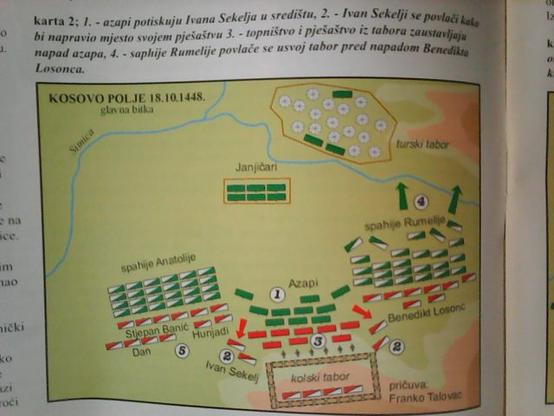
    Blackbird’s Field (Kosovo Polje) 1448.

    Since early summer of 1448., sultan Murat II. was warring, at urging of Venetians, against Hunyadi’s ally Skenderbeg. Hunyadi saw this as a good opportunity to invade Ottoman Empire and destroy Ottoman army in concord with Skenderbeg. Aim was to liberate Macedonia and southern Serbia, and thus split Ottoman Europe in two. By early September, Hunyadi had collected an army 24 000 strong, consisting of feudal banderies and mercenaries. Army also had artillery as well as wagons, of which a portion were definitely battle wagons. In early September 1448. army gathered near Kovin on Danube where Hunyadi unsuccessfully attempted to recruit despot of Serbia for the campaign. By 27th June, Wallachian voivoda Dan had join the army with 8 000 men, as had Czech gunners and German crusaders (Teutonic knights, who may have come from Severin banate). In last days of September, Hunyadi moved south, likely through Morava valley, intending to march at Niš and then on Adrianople. Despot Đurađ forbade interference with Hunyadi’s army, but neither was inactive. Hunyadi allowed his army to plunder Serbia as if it were an enemy country in retaliation to despot’s assistance to Ottomans during Varna campaign of 1444., when despot stood aside and may even have blocked the passage of Skenderbeg’s troops. Đurađ meanwhile sent reports of Hunyadi’s strength and movements straight to the Sultan. Sultan immediately broke off from attacking Skenderbeg’s cities and marched against Hunyadi to protect Adrianople. Skenderbeg started preparing to join Hunyadi – in particular, negotiating with Venetians – but he did not arrive at battlefield in time.

    At Niš Hunyadi changed his plans, moving through Toplice valley towards Kosovo field, arriving at 17th October 1448., placing wagon camp at hills at left coast of Sitnice river. Ottoman camp, on the opposite coast near Priština, was clearly visible from there. Same day there were minor cavalry skirmishers between Hunyadi’s and sultan’s scouts and outriders. Ottoman army numbered some 50 000 – 60 000 men as seen from Ottoman sources; various Western sources give its strength from 50 000 to (clearly exaggerated) several hundred thousand men. As at Varna in 1444., Sultan brought court sipahis, provincial sipahis and janissaries. Weakest element of Ottoman army were light infantry azaps, several thousand in number. Light cavalry was not separated but was rather deployed alongside sipahis.

    Day One

    Husar 11 / 2008

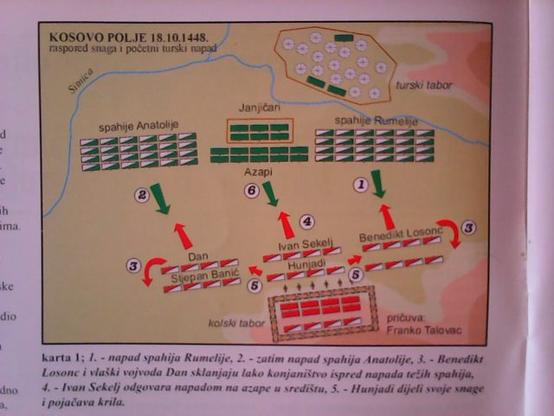
    At Friday on October 18th, armies went out to battlefield. Hunyadi deployed his cavalry in the plain outside the camp, while infantry was left in the camp. Center of the battle order was held by Janos Szekely with heavy cavalry (banderial and mercenary). Behind him was Hunyadi with his elite banderium of heavy cavalry, German mercenaries, and several banderies of Hungarian feudal and bishopial cavalry; possibly also Teuton and Hospitaller knights. Right wing was held by Benedict Losonczi. In first rows were several thousand light cavalry, mostly Szekelys, while behind them was heavy cavalry. Left wing was held by Wallachian voivoda Dan with light cavalry, and behind him was Stjepan Banić with feudal heavy cavalry. Reserve was made up by Croatian feudal troops under Franko Talovac; as an oftentimes-decisive part of the battle order, reserve will have been formed by high-quality troops.

    Hunyadi’s main force was comprised of 15 000 troops in three divisions. Hunyadi may have expected Ottomans to attack with cavalry and leave infantry in the reserve, but if so, he was wrong. Sultan deployed his forces in standard Ottoman manner, placing sipahis on the wings, Azap infantry in the center, and Jannissaries in the center behind the Azaps, within the earthwork fortifications. Light cavalry was deployed behind sipahis. Ottoman decision to attack with sipahis first, on their left wing, forced Benedict Losonc to withdraw light cavalry in order to clear the way for his heavy cavalry, disordering his forces. Same situation happened on the Christian left. Hunyadi split his reserve to reinforce the wings, and Ottoman infantry attacked the weakened Christian center. Szekely’s cavalry swept away first rows of opposing infantry, but he was forced to retreat under pressure and leave Ottoman infantry to Christian infantry which had left the camp. Azap attack was broken by artillery fire followed by infantry charge.

    Husar 11 / 2008

    While battle on Hunyadi’s left wing was in balance, his reinforcements produced results on the right wing, and sipahis of Rumelia were forced back. After six hours of combat with no results, Ottoman forces pulled back to the camp; Christians, exhausted, also pulled back. After battle, Christian forces attempted a night attack against Janissari encampment, which was thrown back after achieving some initial successes.

    Day Two

    Husar 11 / 2008

    Sultan opted for the same disposition as the day previously, but separated a contignent of horsement of Thessaly from Sipahis of Rumelia, sending them secretly to bypass Christian left wing. At the same time, Ottoman deserters brought news to Hunyadi that sultan will seek decision on left wing with Sipahis fo Anatolia (facing Christian right), so Hunyadi reinforced that wing with troops of John Szekely and Croatian troops of Frank Talovac. In the center was Hunyadi’s heavy infantry reinforced by artillery and Hunyadi’s personal banderies, while right wing was held by Benedict Losonc. Combat started on Christian right wing, and spread along the front. Best results was achieved by Hunyadi’s infantry in the center, ¾ of which were missile troops armed with crossbows and some hand cannons. Ranged fire from infantry and artillery forced back azapis, after which Hunyadi’s cavalry charged Janissaries. With Ottoman center at serious disadvantage, sultan called from camp everything capable of bearing arms, barely stabilizing the situation there.

    Husar 11 / 2008

    After some hour or two of fighting, cavalry of Thessaly appeared behind Wallachian voivoda Dan, who was thus encircled. Between this and death of John Szekely, Christian left wing fell apart. Voivoda Dan surrendered with 6 000 men, but Christian left wing and center managed to retreat in order, while right wing fell back in chaos. Among losses were Frank Talovac, Stjepan Banić, Toma Seč and Emerik Marczall. During night, Hunyadi retreated with cavalry, leaving infantry in its camp to its fate, possibly to cover his retreat.

    After battle

    Hunyadi escaped to Serbia, where he managed – alone and on foot – to reach Kladovo on Danube, where he was recognized and brought to despot. Nobles of Hungary and Croatia managed to negotiate his release, despite Hunyadi’s many enemies working against him after the defeat. Hunyadi was released in late 1448. after agreeing to return Đurađ Branković his possessions in Hungary. As kingdom was in chaos, Hunyadi negotiated peace with sultan. Despot was to be middle-man, but his propsals – seven-year peace, Wallachia and Serbia paying only half of tribute to Sultan while Bosnia paid full tribute – were not accepted, possibly due to interference by despot Branković himself. As despot had already, several times, interfered with Hunyadi’s efforts to defeat the sultan, Hunyadi raised an army and in beginning of 1450. took all of despot’s possessions in Hungary. Despot then quickly agreed to release Ladislaus and abandon his previous demands, especially since Murat II. was succeeded by his even worse son, Mehmet II. Hunyadi also calmed down in face of the new threat, and peace was agreed on in 1451., with despot offering a hand of his young granddauther Elizabeth, daughter of Ulrich of Celje, to Hunyadi’s younger son Matthias.

    Interlude

    Ladislaus Postumus, then 13 years old, managed to free himself from tutorship of king Friedrich III., replacing it with looser care of his cousin and ban of Slavonia Ulrich of Celje. Ulrich himself was well aware of number and power of Hunyadi’s supporters and so did what he could to avoid conflict with him. Thus Ulrich convinced the king to shower the governor of the kingdom with rich gifts and to leave him his position, as well as giving him new titles of supreme captain and the governor of royal incomes. Hunyadi’s 20-year-old son Ladislaus was named a ban of Dalmatia and Slavonia. King did similarly with governor of Czechia Juraj Podjebradski (George of Podjebrad), but not with governor of Austrian lands Ulrich Eizinger. Ulrich of Celje had likely concluded that the last one was weakest and thus decided to eliminate him first while avoiding giving insult to Hunyadi and Podjebradski.

    Meanwhile, Constantinople was taken by the encroaching Ottomans on 29th May 1453. With this disappeared for centuries the strongest defense of Europe against eastern invaders. In early 1454., with king absent in Vienna, a council was called in Budim to discuss defence of the kingdom against Ottoman threat. After eleven days, 16 conclusions were reached, of which most significant are:

    • Comission of nobles was formed to investigate how many royal banderies could be raised and maintained from crown incomes.
    • Council called for raising of 35 banderies. Each province had to make a census of village habitats (sessio colonalis) and on each hundred, raise four cavalrymen and two infantry archers. Assuming 5 people per house (not including horses), this would imply 1,2% population in military, and total military strength of 40 000 – 60 000 for Hungarian-Croatian kingdom.
    • All high and low nobility has to go to campaign. Royal cities and other privileged places, such as Kingdom of Slavonia which usually did not pay for royal chamber, have to raise troops. Nobles who leave the muster / assembly camp will lose their property, and commoners will be punished with death.

    Hunyadi started gathering the army immediately after the council. He placed his headquarters in Nagypaly on 28th March 1454., towards border with Serbia and Turkey where threat was coming from. In late March despot Đurađ Branković had fled to Hungary with his family and treasure, and in early April sultan Mehmet II. broke into Serbia with a huge army which included 300 siege engines. Largest part of the army was sent against Smederevo, which was defended by a contingent 6 000 strong.

    Hunyadi followed events in Serbia through spies and reports from refugees. When Ottoman army separated into several smaller armies, he decided to strike with a cavalry-only force which crossed Danube near Kovin. Hunyadi himself took most of the army towards Belgrade, while his cavalry detachment ambushed Isabeg’s camp which was destroyed. Learning of Isabeg’s defeat, sultan changed course towards Smederevo and attacked it with cannons. Hunyadi then crossed Danube near Belgrade and contnued towards Smederevo; learning of Hunyadi’s movements, sultan lifted the siege of Smederevo and retreated to Sofia. Sultan left Firuzbeg near Kruševac with an army of 32 000 men, which Hunyadi destroyed, capturing Firuzbeg and many other Ottoman nobility. There was no battle, as Turkish army was surprised by Hunyadi’s arrival and fled; they were then chased down by Hunyadi’s light cavalry and slaughtered. This indicates that Hunyadi’s light cavalry was under separate commands, able to act on its own. Hunyadi then retreated to Hungary in order to prepare for inevitable Ottoman assault against Belgrade.

    Siege of Belgrade 1456.

    Next year sultan returned to Serbia in order to avenge defeat at Kruševo. Instead of going directly for Belgrade, sultan attacked Novo Brdo (New Hill), which guarded despot’s mines of gold and silver – mines which provided him with yearly income of 120 000 ducats. City fell after 40 days of siege, on 1st June 1455. Meanwhile Hunyadi butted heads with Ulrich of Celje, who had continued with his theft of possessions in Croatia, and had even declared himself the ban (viceroy) of Dalmatia, Croatia and whole of Slavonia. He also managed to convince the king that Hunyadi wants to take the crown, right when Turks were nearing the gates. At the same time, Friedrich III. And Ladislaus were at the verge of war over possessions in Austria. Despot of Serbia Đurađ Branković thus does not manage to get any help from Hungary, and instead returns to Serbia and signs a peace which turns half his country over to the Ottoman Empire. Only the new pope, Callixtus III., did something about the Ottoman threat, preaching a Crusade while collecting money for war. But England and France had only just finished their own squabble, and other countries were also unwilling to help.

    News about sultan’s preparations for war reached Budim from Dubrovnik in early 1456. A council was called in late January 1456., at which John Hunyadi and Ulrich of Celje declared a truce. Nobility also accepted the duty of collecting money for war, at one forint per each serf house.At 6th of April news arrived from Dubrovnik that sultan had amassed a large army and set out towards Belgrade. Next day Hunyadi also set out for Belgrade. Kings spent another month in Budim, and then he and Ulrich ran away to Vienna. Learning of this, nobility promptly forgot about conclusions of the council and accepted “head in the sand” management policy, hiding in their castles. Defence of the kingdom remained on shoulders of John Hunyadi, cardinal Juan Carvajal and John of Capistrano, who had to organize and finance defence with their own resources. At Hunyadi’s request, Carvajal returned to Budim to organize logistical support for the crusader army. Hunyadi meanwhile collected some troops – no more than 20 000 – placing them in Belgrade under command of Mihail Szilagy. Crusader armies also started arriving to Hungary under John of Capistrano, composed mostly ordinary citizens and peasants armed with axes and farming tools – some 30 000 in total. Only professional soldiers were some 100 Germans and 300 Poles, as well as cavalry banderium of John Korogy.

    Hunyadi must have known about heavy Ottoman cannons which destroyed the walls of Constantinople – these were the product of Central European arms industry, and sultan had utilized German, Italian and Saxon miners and artillerymen. Mihail Szilagy started first works on reinforcing the Belgrade in spring of 1455. Ditches were dug around the city and covered with branches and sulphur. Earth from digging the ditches was used to reinforce the lower portions of the walls from the outside. Walls of Constantinople had been covered with a mix of lime and broken brick which reduced the effectiveness of cannons, and similar approach may also have been used at Belgrade.

    Sultan arrived at Belgrade in early July with an army of 120 000 men and 300 cannons, as well as Danube fleet of 70 large and 200 smaller ships. From land he surrounded the city with ditches and pallisades manned by infantry and artillery, and upriver on Danube he placed a barricade of chained ships, thus preventing any resupply. After the siege positions were finished, Ottoman artillery opened fire on the city. Sultan himself swore that he will take Belgrade in 15 days and have dinner in Budim in two months. Garrison of Belgrade, commanded by John Hunyadi’s brother-in-law Michael Szilagyi, numbered 7 000 soldiers and 40 ships.

    In the meant ime Hunyadi with his army and Capistrano with crusaders arrived at Petrovaradin and Slankamen at Danube. First order of business was breaking Ottoman blockade of Danube. Hunyadi in Slankamen collected some 200 boats, which he filled with handpicked troops. On 14th of July he went down the river and broke the Turkish blockade after five hours of combat, reinforcing Belgrade with fresh troops, food and ammunition, and took command in the city. Ottoman army – possibly receiving news of a relief force – launched a full-scale assault on the city on 21st of July. Attack lasted from five in the afternoon until afternoon in the next day. Defenders managed to withstand the attack, partly thanks to ditch-and-pallisade they had built behind the largely collapsed walls. Following that success crusaders streamed out of the city and attacked exhausted Turks in the ditches, where they managed to disable a large number of cannons. Seeing this Hunyadi followed with his soldiers to prevent crusaders from being needlessly butchered. The attack swept away Smail-aga, and even sultan was wounded; Christian troops were only forced back in the evening when 6 000 Ottoman cavalry arrived to help the city. Sultan had had enough however, and during the night from 22nd to 23rd of July, he packed up the camp and left for Sofia. Later, despot Branković would write that the Ottomans had lost 24 000 men in the attack on the city and as many during their march to Sofia “because they slaughtered each other”. Ottomans left behind their entire siege train and many rifles; defenders of the city, “no more a fortress but an open field”, had also suffered significant losses. Hunyadi himself died on 11th August 1456. of a disease which broke out after the battle. Same disease also claimed John of Capistrano. Sultan Mehmed the Conqueror sent a letter to Hungary in which he expressed mourning for such a worthy adversary.

    #AlbaIuliaSibiu1442 #battles #Belgrade1441 #Belgrade1456 #campaigns #JohnHunyadi #Kosovo1448 #Varna1444 #Vasaq1442