Registration is open for the Jupyter AI Developer Summit in San Francisco and London, May 27–28.

Contributors from across the AI-in-notebooks community will gather to design shared building blocks for AI in Jupyter, through hands-on demos, collaborative discussions, and focused sprints. Sessions run in parallel across US and EU, with time overlap built in for cross-timezone collaboration.

If you're working on AI in notebooks, this is where the framework gets built. Register: https://jupyterfoundation.org/event/jupyter-ai-developer-summits/

#Jupyter #AIEngineering #OpenSource #InteractiveComputing

George Washington University has joined the Jupyter Foundation as an Associate Member!

Formalizing a relationship that began when GW deployed JupyterHub in 2017.

To mark the occasion, GW OSPO Faculty Director Lorena A. Barba keynoted at OSCON 2026, covering JupyterLite's browser-native computing and the new configurable AI personas in Jupyter AI v3.

Read the announcement: https://ospo.gwu.edu/george-washington-university-joins-jupyter-foundation
#Jupyter #JupyterFoundation #OpenSource #InteractiveComputing #OpenScie"

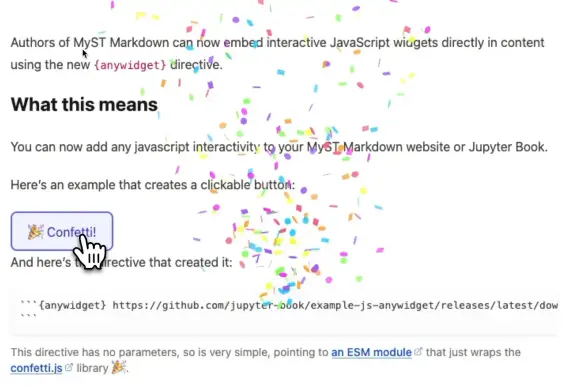
MyST Markdown now supports interactive JavaScript widgets with the new {𝗮𝗻𝘆𝘄𝗶𝗱𝗴𝗲𝘁} directive.

The directive uses the same 𝗿𝗲𝗻𝗱𝗲𝗿({ 𝗺𝗼𝗱𝗲𝗹, 𝗲𝗹 }) interface as anywidget in Jupyter notebooks, so existing widget authors can reuse their work directly in books and articles. mystmd bundles your ESM and CSS modules at build time, and the feature works without any Jupyter kernel.

The implementation started at SciPy 2024 and has been upstreamed into mystmd and Jupyter Book 2.

Read more: https:
#Jupyter #MyST #JupyterBook #OpenSource #InteractiveComputing #DataScience

https://blog.jupyter.org/the-myst-anywidget-directive-daa55c348ab2

JupyterLite enables notebooks to run entirely in the browser without server infrastructure.

Learn more: https://blog.jupyter.org/jupyterlite-officially-joins-project-jupyter-77df24c8db80

#Jupyter #JupyterLite #OpenSource #InteractiveComputing #DataScience