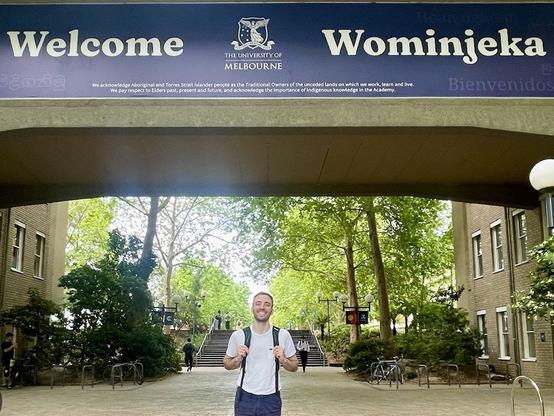
🌍 How does delaying net-zero emissions impact temperature #extremes? 🌡️ #IMPRS_student Eduardo Alastrué de Asenjo is seeking answers at the University of Melbourne during a 2-month research stay with lecturer Andrew King. Edu is expanding his research with new tools & societal perspectives. "Visiting #Melbourne allows me to access a unique set of future net-zero Earth system simulations and start exciting collaborations", says Edu. Read about the simulations he is using: https://esd.copernicus.org/articles/15/1353/2024/
Exploring climate stabilisation at different global warming levels in ACCESS-ESM-1.5

Abstract. Under the Paris Agreement, signatory nations aim to keep global warming well below 2 °C above pre-industrial levels and preferably below 1.5 °C. This implicitly requires achieving net-zero or net-negative greenhouse gas emissions to ensure long-term global temperature stabilisation or reduction. Despite this requirement, there have been few analyses of stabilised climates, and there is a lack of model experiments to address our need for understanding the implications of the Paris Agreement. Here, we describe a new set of experiments using the Australian Community Climate and Earth System Simulator Earth system model (ACCESS-ESM-1.5) that enables the analysis of climate evolution under net-zero emissions, and we present initial results. Seven 1000-year-long simulations were run with global temperatures stabilising at levels in line with the Paris Agreement and at a range of higher global warming levels (GWLs). We provide an overview of the experimental design and use these simulations to demonstrate the consequences of delayed attainment of global net-zero carbon dioxide emissions. We show that there are substantial differences between transient and stabilising climate states and differences in stabilisation between GWLs. As the climate stabilises under net-zero emissions, we identify significant and robust changes in temperature and precipitation patterns including continued Southern Ocean warming and changes in regional precipitation trends. Changes under net-zero emissions differ greatly between regions, including contrasting trajectories of sea ice extent between the Arctic and Antarctic. We also examine the El Niño–Southern Oscillation (ENSO) and find evidence of reduced amplitude and frequency of ENSO events under climate stabilisation relative to projections under transient warming. An analysis at specific GWLs shows that significant regional changes continue for centuries after emission cessation and that these changes are stronger at higher GWLs. Our findings suggest substantial long-term climate changes are possible even under net-zero emission pathways. These simulations are available for use in the community and will hopefully motivate further experiments and analyses based on other Earth system models.
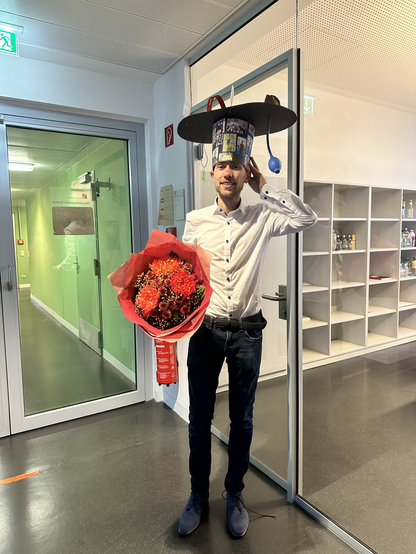
👏 Congratulations to our IMPRS-ESM candidate Moritz Günther for his outstanding success!💐🥳🥂 Today, Moritz defended his #PhD thesis entitled “Asymmetries between the climate responses to CO2 and stratospheric aerosol forcing”! We are also really excited that Moritz has started a 4-year postdoctoral position in the German-Israeli Max Planck-Weizmann Programme, which starts at #MPIM in the #Climate Dynamics department of Sarah Kang. ➡️ https://mpimet.mpg.de/en/communication/news/moritz-guenther-starts-postdoctoral-position-in-the-german-israeli-max-planck-weizmann-programme @maxplanckgesellschaft #IMPRS_student
Moritz Günther starts postdoctoral position in the German-Israeli Max Planck-Weizmann Programme

The Max Planck Institute for Meteorology (MPI-M) is pleased to announce that Moritz Günther has started a 4-year postdoctoral position in the German-Israeli Max Planck-Weizmann Postdoctoral Programme. Together with Prof. Sarah Kang, Head of the Climate Dynamics Department and Director at MPI-M, and Prof. Yohai Kaspi, Department of Geophysical Fluid Dynamics at the Weizmann Institute of Science in Tel Aviv, Israel, he will spend the next four years as a postdoc investigating how land-sea contrasts influence tropical sea surface temperature.

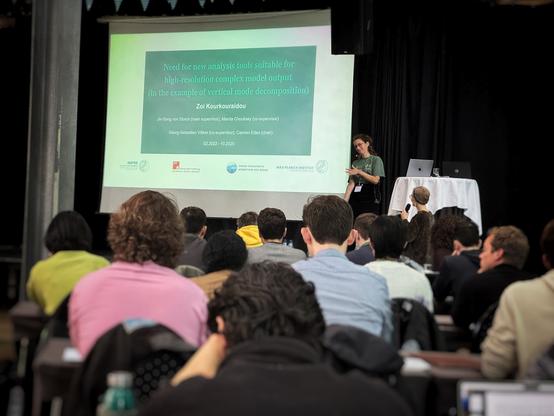
🌍 We are in the middle of the IMPRS-ESM Retreat 2024 in Fintel, Lower Saxony. This interdisciplinary gathering of top scientists and our emerging doctoral researchers focuses on the latest #research and promotes collaboration between #MPIM and other institutes.

Inspiring times with valuable insights and engaging conversations!

#science #climate #PhD #IMPRS_Student #unihh @maxplanckgesellschaft @hereon

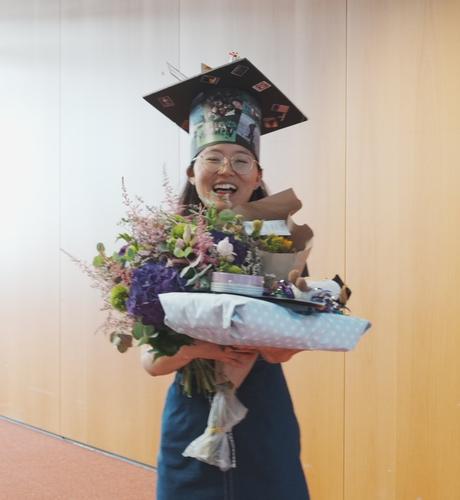
Congratulations to our #IMPRS_student Hongdou Fan! 💐🥳🥂 Last week, Hongdou successfully defended her doctoral thesis entitled „Subdecadal Variability and Predictability of the Subarctic Atlantic Ocean“. 🎓🌍 Well done!
#PhdHat #phd #DissertationDefense #IMPRS