 Deezer Research
We are at #ICASSP2024 to present a paper by Gabriel Meseguer-Brocal, Dorian Desblancs and Romain Hennequin on Self-supervized methods for Music Tagging


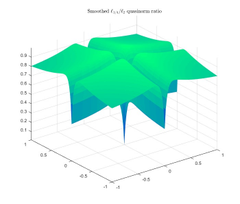
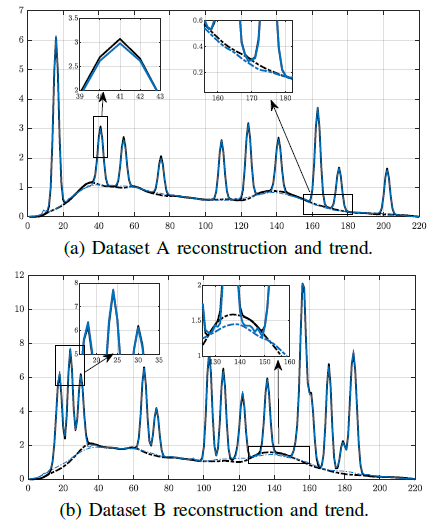


Denoising, detrending, deconvolution: usual restoration tasks, traditionally decoupled. Coupled formulations entail complex ill-posed inverse problems. We propose PENDANTSS for joint trend removal and blind deconvolution of sparse peak-like signals. It blends a parsimonious prior with the hypothesis that smooth trend and noise can somewhat be separated by low-pass filtering. We combine the generalized quasi-norm ratio Smoothed One-Over-Two/Smoothed <inline-formula xmlns:mml="http://www.w3.org/1998/Math/MathML" xmlns:xlink="http://www.w3.org/1999/xlink"><tex-math notation="LaTeX">$p$</tex-math></inline-formula> -Over- <inline-formula xmlns:mml="http://www.w3.org/1998/Math/MathML" xmlns:xlink="http://www.w3.org/1999/xlink"><tex-math notation="LaTeX">$q$</tex-math></inline-formula> (SOOT/SPOQ) sparse penalties <inline-formula xmlns:mml="http://www.w3.org/1998/Math/MathML" xmlns:xlink="http://www.w3.org/1999/xlink"><tex-math notation="LaTeX">$\ell _{p}/\ell _{q}$</tex-math></inline-formula> with the Baseline Estimation And Denoising with Sparsity (BEADS) ternary-assisted source separation algorithm. This results in a both convergent and efficient tool, with a novel Trust-Region block alternating variable metric forward-backward approach. It outperforms comparable methods, when applied to typically peaked analytical chemistry signals. Reproducible code is provided.
 halcy
halcy 

 Laurent Duval