New #openaccess publication #SciPost #Physics

A Lorentz-equivariant transformer for all of the LHC

Johann Brehmer, Víctor Bresó, Pim de Haan, Tilman Plehn, Huilin Qu, Jonas Spinner, Jesse Thaler
SciPost Phys. 19, 108 (2025)
https://scipost.org/SciPostPhys.19.4.108
#CuspAI @uniheidelberg #CERN #MIT #IAIFI
#NextGenerationEU

New #openaccess publication #SciPost #Physics Core

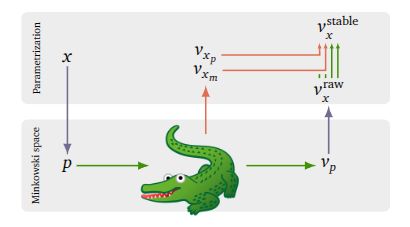
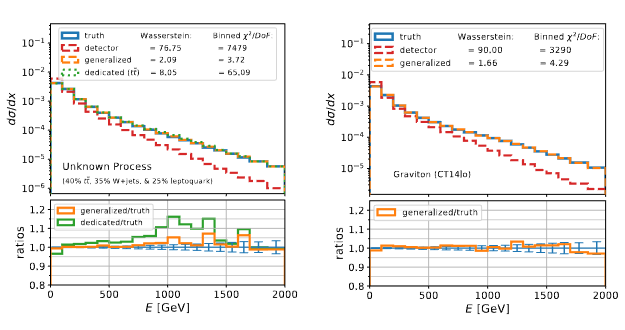
Towards universal unfolding of detector effects in high-energy physics using denoising diffusion probabilistic models

Camila Pazos, Shuchin Aeron, Pierre-Hugues Beauchemin, Vincent Croft, Zhengyan Huan, Martin Klassen, Taritree Wongjirad
SciPost Phys. Core 8, 064 (2025)
https://scipost.org/SciPostPhysCore.8.4.064

#TuftsUniversity #IAIFI #UL

New #openaccess publication #SciPost #Physics

Learning the simplicity of scattering amplitudes

Clifford Cheung, Aurélien Dersy, Matthew D. Schwartz
SciPost Phys. 18, 040 (2025)
https://scipost.org/SciPostPhys.18.2.040

#Walter_Burke #Harvard #IAIFI

SciPost: SciPost Phys. 18, 040 (2025) - Learning the simplicity of scattering amplitudes

SciPost Journals Publication Detail SciPost Phys. 18, 040 (2025) Learning the simplicity of scattering amplitudes

New #openaccess publication #SciPost #Physics

Open string stub as an auxiliary string field

Harold Erbin, Atakan Hilmi Firat
SciPost Phys. 17, 044 (2024)
https://scipost.org/SciPostPhys.17.2.044

#ParisSaclayUniversity #MIT #IAIFI
#HORIZON2020

SciPost: SciPost Phys. 17, 044 (2024) - Open string stub as an auxiliary string field

SciPost Journals Publication Detail SciPost Phys. 17, 044 (2024) Open string stub as an auxiliary string field

New #openaccess publication #SciPost #Physics

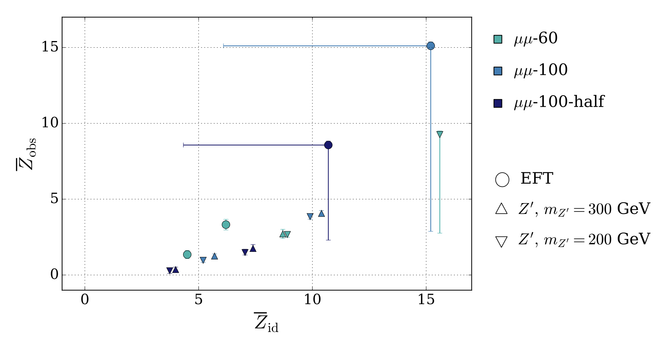
Goodness of fit by Neyman-Pearson testing

Gaia Grosso, Marco Letizia, Maurizio Pierini, Andrea Wulzer
SciPost Phys. 16, 123 (2024)
https://scipost.org/SciPostPhys.16.5.123

#IAIFI #INFN Padova #CERN #Harvard #UNIPD #MIT #UniGe #IFAE

SciPost: SciPost Phys. 16, 123 (2024) - Goodness of fit by Neyman-Pearson testing

SciPost Journals Publication Detail SciPost Phys. 16, 123 (2024) Goodness of fit by Neyman-Pearson testing

New #openaccess publication #SciPost #Physics

EPiC-GAN: Equivariant point cloud generation for particle jets

Erik Buhmann, Gregor Kasieczka, Jesse Thaler
SciPost Phys. 15, 130 (2023)
https://scipost.org/SciPostPhys.15.4.130

#UH
#CDCS
#MIT
#IAIFI
#BMBF
#DFG
#FriedrichNaumannStiftung
#NSF
#DOE

SciPost: SciPost Phys. 15, 130 (2023) - EPiC-GAN: Equivariant point cloud generation for particle jets

SciPost Journals Publication Detail SciPost Phys. 15, 130 (2023) EPiC-GAN: Equivariant point cloud generation for particle jets

Next was a great talk by @jascha on learned optimizers at #IAIFI. This work is going after the important problem of moving away from hand-designed optimizers in deep learning, and Sohl-Dickstein shows some promising results here https://www.youtube.com/watch?v=FrqLLRpAdL0 (4/11)
IAIFI Summer Workshop 2023 - Jascha Sohl Dickstein

YouTube

📢New paper (finally...) out today📢 'EPiC-GAN: Equivariant Point Cloud Generation for Particle Jets' with Erik (#UniHamburg too) and Jesse (#IAIFI)

A short summary below, full paper at https://arxiv.org/abs/2301.08128

One useful way to represent data from particle physics collisions is a point cloud: each collision event is a cloud of points & each point has a position in space (the position of the specific sensor or particle) and some additional features attached (for example the energy)

EPiC-GAN: Equivariant Point Cloud Generation for Particle Jets

With the vast data-collecting capabilities of current and future high-energy collider experiments, there is an increasing demand for computationally efficient simulations. Generative machine learning models enable fast event generation, yet so far these approaches are largely constrained to fixed data structures and rigid detector geometries. In this paper, we introduce EPiC-GAN - equivariant point cloud generative adversarial network - which can produce point clouds of variable multiplicity. This flexible framework is based on deep sets and is well suited for simulating sprays of particles called jets. The generator and discriminator utilize multiple EPiC layers with an interpretable global latent vector. Crucially, the EPiC layers do not rely on pairwise information sharing between particles, which leads to a significant speed-up over graph- and transformer-based approaches with more complex relation diagrams. We demonstrate that EPiC-GAN scales well to large particle multiplicities and achieves high generation fidelity on benchmark jet generation tasks.

arXiv.org