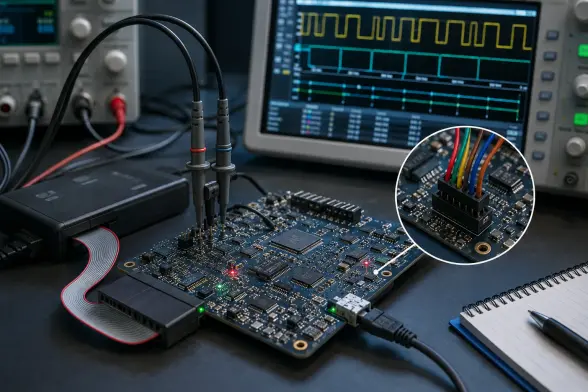
Learn how to debug Dynamic Address Assignment failures in I3C systems with practical tips on timing, firmware, hardware, and bus analysis.

#mymobprice #I3C #EmbeddedSystems #HardwareDebugging #ElectronicsEngineering #FirmwareDevelopment

https://mymobprice.com/debug-dynamic-address-assignment-failures-in-i3c/

Debug Dynamic Address Assignment Failures in I3C

Learn how to debug Dynamic Address Assignment failures in I3C systems with practical tips on timing, firmware, hardware, and bus analysis.

MyMobPrice
Nuvoton NuMicro M3331 Cortex-M33 MCU features built-in ARGB LED controller, optional USB 2.0 OTG interface

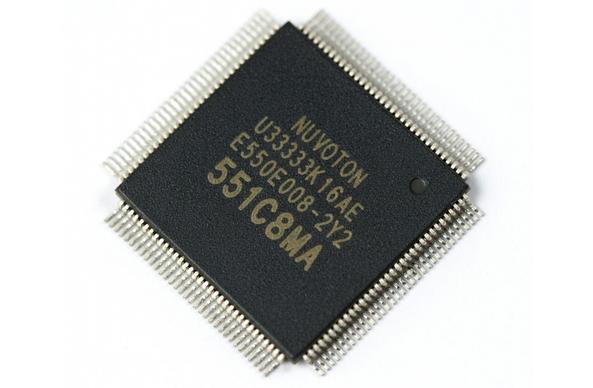
Nuvoton's new NuMicro M3331 is a series of 32-bit Arm Cortex-M33 MCUs clocked at 180 MHz that integrate an ARGB LED controller, a DSP instruction set, a single-precision FPU, and TrustZone security for smart factories, renewable energy systems, and consumer devices. In the past, we have written about other Cortex-M33 MCUs like the STM32U3B5/C5, Texas Instruments MSPM33C321A,  Nordic Semi’s nRF54LM20A, and various others, but the Nuvoton M3331 series specifically features a built-in Enhanced LED Light Strip Interface (ELLSI) and up to 10 standard LLSI channels. This allows the MCU to natively support gaming ARGB Gen1 and Gen2 LED control protocols, completely offloading the CPU to run fluid, dynamic LED effects. It comes in two variants, the M3333 series and the M3334 series, with the latter adding a high-speed USB 2.0 OTG controller with an integrated PHY. NuMicro M3331 specifications: MCU core – Arm Cortex-M33 32-bit CPU @ 180 MHz with single-precision

CNX Software - Embedded Systems News
Waveshare ESP32-P4 + ESP32-C6 PoE development board targets HMI and IoT applications

Waveshare has recently launched ESP32-P4-WIFI6-POE-ETH, a compact development board with Wi-Fi 6, Bluetooth 5 (LE), OTG, Ethernet, and PoE support, for various HMI and IoT applications. The board supports 100Mbps Ethernet with PoE, MIPI-CSI, MIPI-DSI, USB 2.0 OTG, audio codec + amplifier, microphone, MicroSD card slot, and 40-pin GPIO expansion. Other peripherals include I2S, I2C, SPI, UART, PWM, MCPWM, RMT, ADC, and TWAI, alongside security features like secure boot, flash encryption, crypto accelerators, TRNG, and privilege separation. These features make it suitable for HMI terminals, smart panels, multimedia control interfaces, local edge AI, and IoT gateways. Waveshare ESP32-P4-WIFI6-POE-ETH specifications: Wireless module - ESP32-P4-Core Microcontroller – ESP32-P4NRW32 MCU Dual-core RISC-V microcontroller @ 400 MHz with AI instructions extension and single-precision FPU Single-RISC-V LP (Low-power) MCU core @ up to 40 MHz GPU – 2D Pixel Processing Accelerator (PPA) VPU – H.264 and JPEG codecs support Memory – 768 KB HP L2MEM,

CNX Software - Embedded Systems News

ST launches 800 MHz STM32V8 Arm Cortex-M85 high-performance MCU manufactured with 18nm FD-SOI process

https://fed.brid.gy/r/https://www.cnx-software.com/2025/11/19/st-stm32v8-arm-cortex-m85-800-mhz-high-performance-mcu-18nm-fd-soi-process/

ST launches 800 MHz STM32V8 Arm Cortex-M85 high-performance MCU manufactured with 18nm FD-SOI process

ST has just launched its most powerful STM32 microcontroller so far, with the STM32V8 family, the first equipped with a Cortex-M85 core (clocked at up to 800 MHz) and manufactured with an 18nm FD-SOI process. It's a non-pin compatible update to the STM32H7 family that delivers up to 5,072 CoreMarks, greatly improves Edge AI performance thanks to Arm Helium and MVE, integrates up to 4MB eNVM (Embedded NVM), operates up to 140°C, and adds PCM (phase-change memory) radiation immunity. Two main parts have been launched in different configurations and packages: STM32V863 and STM32V873. STM32V863/873 specifications: Core – 32-bit Arm Cortex-M85 CPU @ up to 800MHz with Arm Helium, Arm MVE, TrustZone...; up to 5,072 CoreMarks Multimedia accelerators - Chrom-ART 2D GPU, and JPEG hardware accelerator Memory/Storage 1.5 MB system SRAM with ECC (partial) 8 KB backup RAM 192 KB zero-wait state TCM Up to 512 KB TCM with ECC Up

CNX Software - Embedded Systems News
#I3C Subsystem Appears Ready For Possible Inclusion Into Linux 4.20~5.0
http://www.tuxmachines.org/node/116702
I3C Subsystem Appears Ready For Possible Inclusion Into Linux 4.20~5.0 | Tux Machines