 Omar Antolín
Elmendorf's theorem is a pathway to many abilities some consider to be equivariant.
 Ryan
Ryan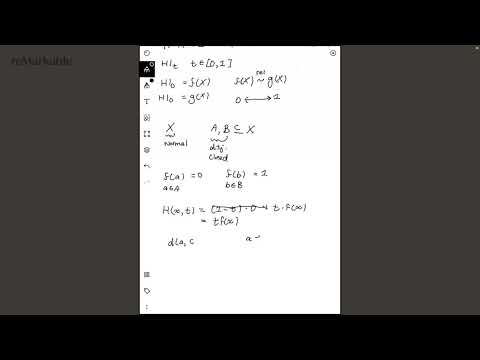
Urysohn's Lemma and Homotopy
 claude
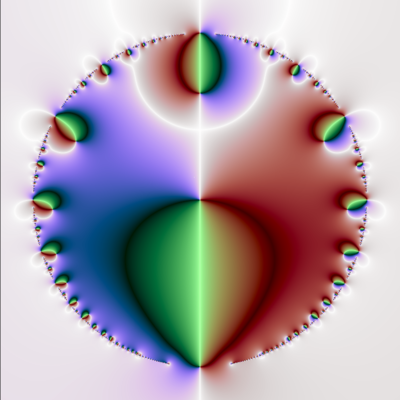
trying out homotopy methods (construct an ordinary differential equation to interpolate from root at iteration k to two roots at iteration k+1) to solve f_c^n(0) = z for z non-zero; where f_c(w) = w^2+c and f^n denotes n-fold composition. a paper I found describes it for z zero, wasn't too much algebra work to adapt to my use case.
image shows paths between roots to iteration 12 or so, for z = i.
hoping eventually to use it to accelerate zooming into nebulabrot aka buddhabrot, nothing to show for that yet though. not finished debugging the root finder yet.
the idea is to find little balls around the roots that when iterated will hit the viewing area around z (ideally ball contains some boundary of mandelbrot set => some parts of the ball are near (pre)periodic points and will hit the viewing area many times).
will use derivatives to work out how big each ball should be, and distance estimate to check if ball contains boundary.
the tough part is that balls may overlap.
this approach is deterministic. afaik most buddhabrot zoomers use stochastic methods like metropolis-hastings.
reference:
https://ir.lib.uwo.ca/etd/4028/ https://uwo.scholaris.ca/server/api/core/bitstreams/2cf58b26-c757-48e1-833c-bda6c70a1e18/content
"A comparison of solution methods for Mandelbrot-like polynomials"
Eunice Y. S. Chan, MSc thesis, The University of Western Ontario
New #preprint; this one's kind of beefy.
#mathematics w/ applications to: #physics #biology #control ... and more!
 Oscar Cunningham
Can you define a 'simplicial set of small simplicial sets' by defining Δⁿ → Simp to be the set of small simplicial sets over Δⁿ, i.e. A → Δⁿ?
Would we then have that the maps B → Simp were in correspondence with the simplicial sets over B, for all B?
 Refurio Anachro
Chris Staecker does humorous videos about calculation machines, but he also does research on digital #homotopy! Wait, what's that?!
A rather simple example for a digital space is just a digital image. We'll also need a digital sphere, and that's going to be the vertices of an octahedron. We want to do homotopy stuff, so we'll look at maps from any image to such an octahedron.
We're all used to looking at images, and since it's also where the fun happens, we'll color all the vertices of the octahedron in different colors, and pull those back to the image. So we can see where any pixel position gets mapped to by looking at its color.
Homotopy is a subject of topology, and that involves stretching. It also involves continuitiy, or a notion of neighbourhood. Both of these must be transported to our digital space and sphere.
Well, two vertices on an octahedron are neighbours if they are connected by an edge, or, put differently, they are not neighbours if they are opposite of each other. Now, when should we consider pixels on an image to be neghbours? Chris proposes that pixels, drawn as little squares, are considered to be neighbours if they share a vertex. Or an edge, which means that they share two vertices. So, any pixel in the middle of an image has eight neighbours!
1/3
 ⎯ΘωΘ⟶
⎯ΘωΘ⟶I have neglected this channel, sorry lol. If you follow me you will probably find this interesting: https://arxiv.org/abs/2307.00442

Homotopy theories of $(\infty, \infty)$-categories as universal fixed points with respect to enrichment
We show that both the $\infty$-category of $(\infty, \infty)$-categories with inductively defined equivalences, and with coinductively defined equivalences, satisfy universal properties with respect to weak enrichment in the sense of Gepner and Haugseng. In particular, we prove that $(\infty, \infty)$-categories with coinductive equivalences form a terminal object in the $\infty$-category of fixed points for enrichment, and that $(\infty, \infty)$-categories with inductive equivalences form an initial object in the subcategory of locally presentable fixed points. To do so, we develop an analogue of Adámek's construction of free endofunctor algebras in the $\infty$-categorical setting. We prove that $(\infty, \infty)$-categories with coinductive equivalences form a terminal coalgebra with respect to weak enrichment, and $(\infty, \infty)$-categories with inductive equivalences form an initial algebra with respect to weak enrichment.
 Corbin
Today I got to have the full #intuitionist #constructivist #maths experience.
First, somebody half-jokes that if one is a constructivist, then one's friends won't talk to them anymore.
Then, somebody else says that #constructivism is a deviant counterculture.
At this point, like a fool, I link Bauer's "five stages" paper: https://www.ams.org/journals/bull/2017-54-03/S0273-0979-2016-01556-4/S0273-0979-2016-01556-4.pdf
But alas, somebody actually reads the paper, and they think that the whole paper is a joke. They have two concrete questions, which I answer using relevant examples.
This was all in the context of #homotopy #TypeTheory, for what it's worth.
 HoldMyType
not all equality was proven using reflexivity. My understanding of the matter is that is has to do with the placement of the forall (x : A) quantifier. It is permissible to move one of the x's to the top level (based path induction), but not both. (This is somewhat obscured by the reuse of variable names.) There is also a geometric intuition, which is that when both or one endpoints of the path are free (inner-quantification), then I can contract the path into nothingness. But I have a difficult time mapping this onto any sort of rigorous argument.
http://blog.ezyang.com/2013/06/homotopy-type-theory-chapter-one/
#homotopy folks any clue on it?
http://blog.ezyang.com/2013/06/homotopy-type-theory-chapter-one/
#homotopy folks any clue on it?
 RanaldClouston
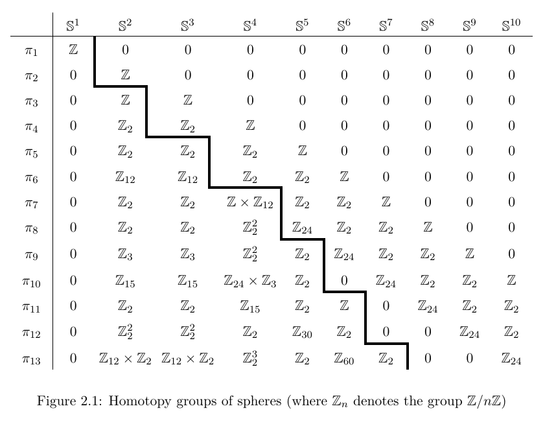
On this week's #blog , a bit late as I work around the start of teaching this semester, I write about the fascinating PhD thesis, 'On the homotopy groups of spheres in homotopy type theory' https://updatedscholar.blogspot.com/2023/02/discussing-on-homotopy-groups-of.html #Hott #TypeTheory #Homotopy