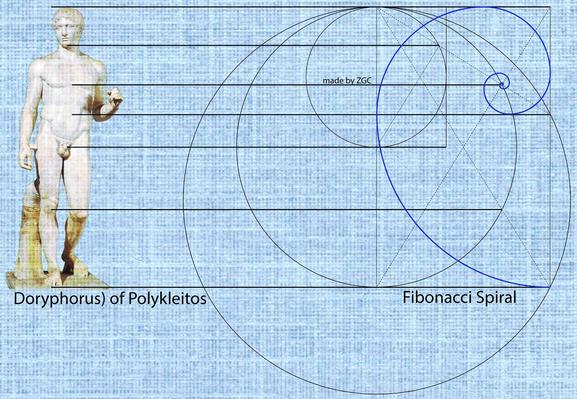
The idea that the ‘golden’ ratio — $1.61803\ldots:1$ — has applications in visual art and architecture does not go back any further than the 2nd edition (1799–1802) of Jean-Étienne Montucla's (1725–99) (generally superb) ‘Histoire des Mathématiques’, in which he made the **incorrect** statement that Luca Pacioli's (c.1447–1517) book ‘Divina Proportione’ included illustrations of the ratio's application to architecture and font design.

This was shortly after the earliest known appearance of the term ‘golden section’ in Johann Samuel Traugott Gehler’s (1751–95) general scientific dictionary ‘Physikalisches Wörterbuch’.

The golden ratio was then taken up by Adolph Zeising (1810–76) as the basis for a system of aesthetic proportion in his book ‘New Theory of the Proportions of the Human Body’ (1854), where he argued — apparently to his own satisfaction — that his system agreed with the proportions of many masterpieces of art.

The psychologist Gustav Fechner (1801–87) made a much-misreported experiment in which people were asked to choose the most aesthetically pleasing of various rectangles (shown in the attached image). The most popular choice was the 34 ∶ 21 rectangle, whose proportions approximate the golden ratio. Fechner's conclusion was only that **a range of rectangles**, including the golden ratio rectangle, were considered most pleasing.

1/3

#GoldenRatio #GoldenSection #DivineProportion #HistMath #aesthetics #Zeising #Fechner

Luca Pacioli’s (c.1445–1517) book ‘Divina proportione’ (written 1496–8, published 1509) is famous in the history of mathematical beauty, but mostly for the wrong reasons.

The term ‘divine proportion’ refers to Euclid's ‘extreme and mean ratio’, known since the late 18th century as the ‘golden ratio’: $1.61803\ldots:1$.

Pacioli's use of the term ‘divine’ **was not based upon aesthetic appreciation**.

Rather, he made a mystical identification of certain properties of the ratio with attributes of God. E.g., the incommensurability of the ratio = the indefinability and ineffability of God.

But Pacioli aesthetically admired the five regular polyhedra — the platonic solids — and the archimedean solids that he knew. In the dedication of ‘Divina proportione’ he wrote that hoped that his patron would see ‘their most sweet harmony’. He linked the aesthetic value of the solids to that of the sphere, from which he saw them as deriving. He seems to have placed special value on the ‘most noble’ dodecahedron.

In his portrait (attached), a dodecahedron sits on top of one of his books as a symbol of mathematical success. His diagram is part of the construction of the tetrahedron. A glass rhombicuboctahedron hangs behind him.

1/3

[Each day of February, I am posting a short interesting story/image/fact/anecdote related to the aesthetics of mathematics.]

#GoldenRatio #DivineProportion #MathematicalBeauty #MathArt #polyhedron #RegularSolid #PlatonicSolid

I'm really excited to put together my 1 + √5 : 2 scale model of the Golden Snitch!

#phi
#DivineProportion
\[a+b/a=a/b\]