 Contemporary Classical - Thea Derks
Unsuk Chin: ‘I want to entice the listener into a cosmological fantasy land’
Unsuk Chin (Seoul, 1961) is at the centre of this season’s radio concert series NTRZaterdagMatinee in the Amsterdam Concertgebouw. On Saturday 13 January the Dutch Radio Philharmonic Orchestra will play the Dutch premiere of Alaraph ‘Ritus des Herzschlags‘ (Ritual of a heartbeat).
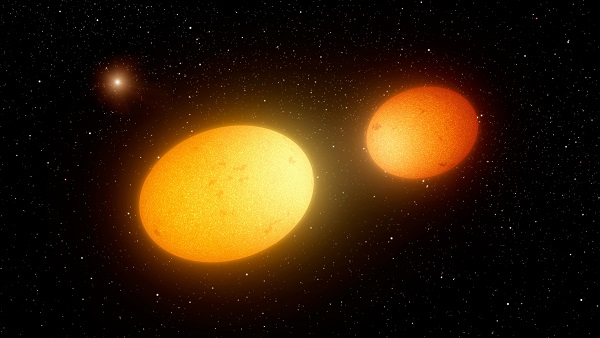
Artist’s conception of two heartbeat stars and a companion star (c) NASA/JPL-CaltechThis is the third concert featuring music by Chin. In September te young Korean pianist Sunwook Kim was the soloist in her Piano Concerto, a month later her witty, street-theatre-inspired ensemble piece Gougalōn was performed by Asko|Schönberg, and Chin’s widely acclaimed opera Alice in Wonderland will conclude the series in June.
Chin is certainly no stranger to the NTRZaterdagMatinee. She first appeared as a guest in 2004 with her Double Concerto for piano, percussion and ensemble. In the years that followed, several solo concerts were on the roster, and in 2019 her large-scale Le chant des enfants des étoiles for orchestra, mixed choir and children’s choir had its Dutch premiere.
Like her new piece, this is about stars and cosmic phenomena. After its premiere in 2016 a critic wrote that ‘from the opening bars, the music draws you into the unfathomable abyss of the cosmos, as if you were taking a spacewalk in the infinite universe.’Another critic deemed its dynamics ‘akin to Stravinsky’.
Primal power
Alaraph is the name of one of the so-called heartbeat stars. According to a Wikipedia entry quoted by Chin, these are ‘pulsating variable binary star systems in eccentric orbits with vibrations caused by tidal forces’. The name ‘heartbeat’ is derived from the fact that when their brightness is mapped over time, the light curve is similar to what a heartbeat looks like on an electrocardiogram. Abracadabra to the average layman, but Chin was so fascinated that she decided to devote her new composition to it.
Her interest in science and cosmology has its roots in her childhood, she explains: ‘The initial impetus dates from when, as a child, I began to wonder about dreams, an encounter with another world where very different laws of physics prevail. Dreams, like music, are phenomena that flow through time but at the same time are frozen, like a sculpture, in a small moment of timelessness.’
‘All this made me suspect that what we perceive in our daily lives is only a fraction of reality. To explore these questions further, I became curious about cosmology and physics. What fascinates me so much in the heartbeat stars is their primal power and haunting rhythmicity.’
Musical material demands percussion
Chin lives up to her reputation as a wizard of sound colour. As a listener, Alaraph irrevocably sucks you into a universe of mysterious sounds, in which percussion plays a central role. Six musicians play an immense number of percussion instruments, ranging from cymbals, drums, timpani and gongs to thunder sheets, piano strings, whips and woodblocks. Tuned instruments such as glockenspiel, marimba or xylophone were deliberately left out.
Asked for the reason behind this, she explains: ‘I didn’t so much make this decision myself, the musical material simply demanded it. Moreover, I wanted to write something completely different from all my other orchestral works. For instance, I use gongs, timpani and piano not for their pitch, but to generate special timbres.’
The score teems with unusual sound effects, such as the indeterminate murmur of cymbals resonating on timpani, the chattering sounds of twigs hitting a bass drum or the scraping sound of plastic rulers stroking low piano strings.
One swaying current
The piece opens with a short bright rattle of a ‘bamboo tree’ that changes the tone colour of the ensuing gong strike. After this, a slow-moving mass of sound unfolds with a static and ritualistic character. Beneath the surface swarm stacks of rhythmic pulses, ranging from extremely slow to extremely fast. Glissandi in both strings and horns – with or without mutes – intensify the atmosphere of otherworldliness and deprive you of any sense of grip.
The whole is one breathing organism, in which there are barely any recognisable melodies or rhythms. You are carried along on a swaying current into the dark universe, with short motifs flaring up like falling stars. An accordion evokes the vibrations of the Alaraph with bright, ever-recurring tremoli. The piece ends with a five-fold pianissimo, as if the music continues to float forever in the infinite universe.
The premiere in Basel in September 2023 was acclaimed by both audience and critics. ‘The pulsating vibrations of the Alaraph are not only heard in the percussion but also in the pizzicati of basses and celli’, wrote the Aargauer Zeitung. The critic of Das Opernmagazin was so overwhelmed he simply noted that Alaraph is ‘a sort of sound installation’.
You can judge for yourself during the live broadcast of the Dutch premiere on 13 January on NPO Klassiek (starting at 2.15 pm).

 Daniel Fischer
 In the Dark