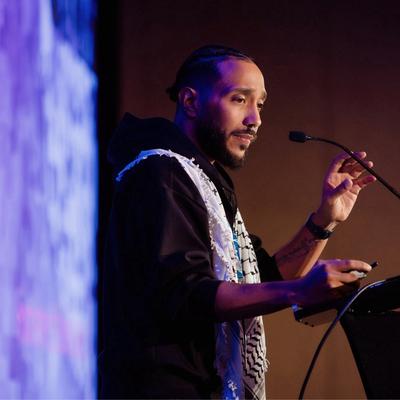
My latest article, “Ballroom as Speculative Care: Black Queer Kinship and Health Beyond Recognition” has just been published in L’Esprit créateur’s Future Worlds of Health special issue. I’m really proud of this one!

It’s open access, and you can read it here: https://dx.doi.org/10.1353/esp.2025.a985872

#BlackStudies #HealthHumanities #SocialWork #Ballroom #Kiki #AcademicFedi
Project MUSE -- Verification required!

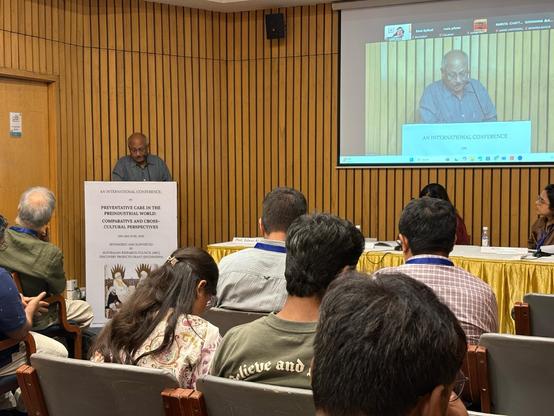
Recordings of all sessions in our conference last month, "Preventative Care in the Preindustrial World: Comparative and Cross-Cultural Perspectives", are now available. See our blog post for more information:

https://premodernhealthscaping.hcommons.org/?p=1479

#unani #histmed #mughal #healthhumanities #publichealth

One of our researchers, Megan Cassidy-Welch, has published a short piece on the health of pilgrims - please share!

https://theconversation.com/fruit-and-veg-exercise-frequent-bloodletting-and-more-tips-on-staying-healthy-from-medieval-travellers-244638

#histmed #pilgrim #healthhumanities

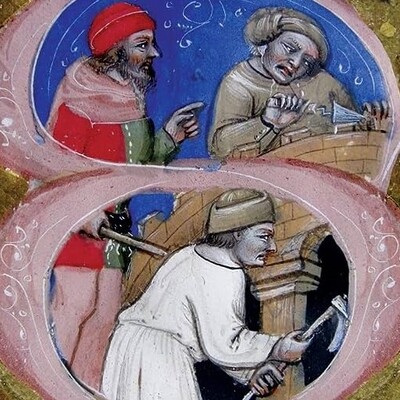
Fruit and veg, exercise, frequent bloodletting and more tips on staying healthy from medieval travellers

Travellers have always faced health hazards when far from home. Here’s what medieval people believed would keep them healthy.

The Conversation

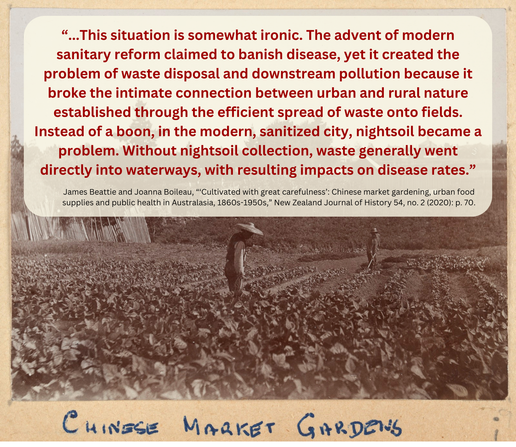
On the ironies of modern sanitation transitions: Beattie & Boileau discuss Cantonese market gardening, nightsoil waste, and tensions of health & hygiene in 19th century colonial Australasia. Worth a read.

https://muse.jhu.edu/article/883380

#ChineseOverseas #healthhumanities #healthscaping

Project MUSE - ‘Cultivated with great carefulness’: Chinese Market Gardening, Urban Food Supplies and Public Health in Australasia, <small class="caps">1860s–1950s</small>

My second reason that this impetus to "humanize" is a problem is that the labor involved in "humanizing" (whatever the fuck that means) is very different than teaching humanities, and that the former undermines the latter's discursive, ideological, and social potential.

More simply, the answer to why the health humanities (or medical humanities) should exist is not "to make more ethical doctors"; instead, it is because humanists use of subjectivity undermines the harmful assumptions which undergird biomedical epistemics. (I use biomedical because 'health' is a bit too broad, and I have my own bone to pick.)
#medicalhumanities #healthhumanities

I say this to lead to my second reason. There is a bigger question about what the *value* of the humanities? (This kind of question assumes a capitalistic value generation relationship, but I can't address that here.)

What the discourse about Humanity avoids is the discussion of method, and the messy, subjective work that starts to emerge when anyone has to do humanistic work. We shouldn't read novels with health topics to "humanize ourselves" but instead use those novels to teach us how to interpret representation, follow the ideological underpinnings of their argument, and understand our our subjectivity. (This could be any humanistic subject. I use novels as a short hand.)

#healthhumanities #medicalhumanities

I say this for two reasons: first, I do not know if you can *humanize* medicine. (Using 'medicine' here because the 'health' in health humanities is useful designation that expands the field beyond medical humanities.) Would the doctors behind the Tuskegee syphilis study have stopped if they were given a history of medicine class? Would the doctors stealing organs from the bodies of children in the Alder Hey scandal not done this because they took a bioethics class? Medicine has larger ethical problems that are epistemic and ontological which the medical and health humanities cannot address if their job is to bandage the open wound that is the medical sciences.

Medicine cannot be humanized. (At least in the context of why the medical humanities should exist.)
#medicalhumanities #healthhumanities

So leaning back on the "we teach doctors to be human" and that our work is about The Human seems a useful approach, but it is a position that leaves the discipline on a weak footing.

#medicalhumanities #healthhumanities

I suspect this is a byproduct of academic resource distribution: it's a lot easier to look important if you oversee millions of dollars in research funding, the publication of dozens of articles every year, and your work provides value for a profession that is seen as an entry into the upper middle class. For humanistic research, which is usually less capitalizable, deals with smaller funding streams, and is often practiced by individuals (DH being an outlier), it is probably hard to convince the inclusion of any humanistic point of view at all, especially in the context of an all-consuming neoliberal research institution, which views all of its employees as value generating machines.
#medicalhumanities #healthhumanities
The second problem sort of assumes that the humanities is a problem free discipline, but ignores all of the problems that cultural scholars, scholars of difference, and posthumanistic researchers have been arguing for decades: the humanities are also entwined in the violences of capitalism, colonialism, white supremacy, ableism and so on. Just saying health humanists study Humanity writ large ignores the metadiscursive critiques other interdisciplinary scholars have been able to make about the broader field.
#medicalhumanities #healthhumanities