Hammocks

YouTube

Chú rể Vĩnh Long tổ chức đám cưới hoành tráng tại vườn dừa 10.000 m², chuẩn bị 80 mâm cỗ và lắp đặt võng cho khách nghỉ ngơi giữa không gian xanh mướt. 🎉🌴 #VinhLong #Wedding #CoconutGarden #Hammocks #ĐámCưới #VườnDừa #HộiNgộ #Vietnam #Love #Celebration

https://vietnamnet.vn/chu-re-vinh-long-lam-80-mam-co-o-vuon-dua-10-000m-mac-vong-cho-khach-nghi-ngoi-2475574.html

Chú rể Vĩnh Long làm 80 mâm cỗ ở vườn dừa 10.000m², mắc võng cho khách nghỉ ngơi

Xung quanh đám cưới được tổ chức tại vườn dừa rộng lớn của chú rể Vĩnh Long, cộng đồng mạng để lại nhiều bình luận hài hước.

Vietnamnet.vn

10-Dec-2025
Love lounging in #hammocks? You can thank #indigenous cultures for that
Quickly adopted by European colonists, hammocks also had cultural meaning, according to Binghamton Professor John Kuhn

https://www.eurekalert.org/news-releases/1109134

#science #textile #culture

Love lounging in hammocks? You can thank indigenous cultures for that

When you’re swaying in a beachside hammock on a lazy summer day, take a moment to thank the Indigenous cultures that invented it. Native to South America and the Caribbean, hammocks were traditionally woven by women, who were frequently fiber-workers in Indigenous cultures, said Binghamton University Associate Professor of English John Kuhn, who recently co-authored an article on the topic. “The oldest preserved specimen is 4,000 years old, but they may actually be much older,” said Kuhn, who also directs the Institute for Advanced Studies in the Humanities at Binghamton. “We just don’t know; textiles don’t preserve well in the tropics.” Co-authored by Marcy Norton at the University of Pennsylvania, “Towards a history of the hammock: An Indigenous technology in the Atlantic world” recently appeared in postmedieval: a journal of medieval cultural studies. Portable, versatile and easy to clean, hammocks are a comfortable way to sleep in a hot climate. They also protect the user from insects, especially when compared to the ground-based bedding common to European colonizers. “Colonists basically adopt them right from the jump,” Kuhn said. “They learn to use them because the hammock was a major component in hospitality rituals that are being extended to them by Indigenous groups who are seeking alliance and friendship.” The technology proved useful for military expeditions in the Americas and was adopted by figures such as English explorer Sir Walter Raleigh. As colonial settlements began to develop, their use was adopted by a wider population, from elites to slaves. Hammocks are also connected to Indigenous culture with deep webs of meaning. In addition to sleep, the bed-slings were used as private spaces to chat, manufacture objects or play music. In short, they were a way to define an individual’s personal space in an otherwise communal culture. “We know from one Kalinago-French dictionary compiled in the early colonial period that the word for hammock was linguistically linked to the word for placenta,” Kuhn said. “It’s kind of poetic: You’re in one kind of container and then, because hammocks are given to babies right away, you move to another one after you’re born.” Not only did individuals enter the world in a hammock, they left it in one, too; hammocks were also used as burial shrouds. They even played a role in religious life, as a vessel for healing rituals and trance states in which shamans would commune with spirits. The spread of hammock use among colonizers belies the common belief that European technology was far superior to that of Indigenous people. It’s far from the only example of cultural borrowing; take chocolate and tobacco, which originated as stimulants developed by Indigenous cultures. Kuhn is currently working on a book about another Indigenous technology: birchbark canoes, which North American colonists immediately adopted for their own use. “Sometimes people have this idea that Indigenous cultures were just destroyed, and they aren’t necessarily seen as huge technological contributors to the Atlantic world that emerges out of colonization,” Kuhn said. “The next time you see a hammock, just take a minute to marvel at the ingenuity of the cultures that it sprang from!” About Binghamton University Binghamton University, State University of New York, is the #1 public university in New York and a top-100 institution nationally. Founded in 1946, Binghamton combines a liberal arts foundation with professional and graduate programs, offering more than 130 academic undergraduate majors, minors, certificates, concentrations, emphases, tracks and specializations, plus more than 90 master's, 40 doctoral and 50 graduate certificate programs. The University is home to nearly 18,000 students and more than 150,000 alumni worldwide. Binghamton's commitment to academic excellence, innovative research, and student success has earned it recognition as a Public Ivy and one of the best values in American higher education.

EurekAlert!
I sleep in a hammock most nights. I've done so for over a decade. This month my hammocks have been full of betrayal--I rolled onto my side and put pressure on one elbow, which ripped a giant hole in the hammock and dropped me on the floor. Three weeks later, same thing happens with a second hammock, except in my sleep. And that's why I slept on the couch last night.

These are the first two times this has happened in a decade. I guess my takeaway is that it's good to keep padding under one's hammock, and not hang it too high up. Both times my fall was less than 2 inches onto soft things.
#hammocklife #hammocks

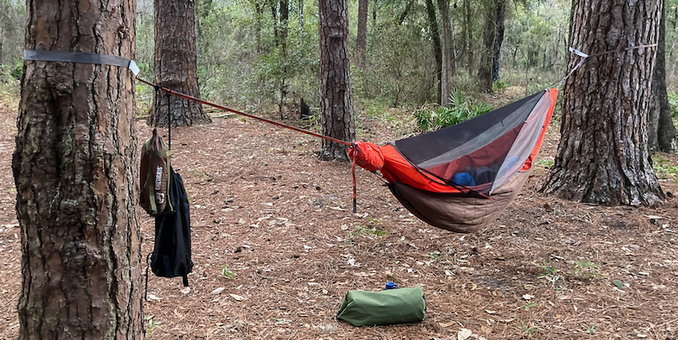
#HammockCamping Anyone?

Hybrid #Hammock / #SleepingBag

Here's an interesting idea—put a hammock INSIDE a standard sleeping bag. The bag has "ports" on both ends to pass the hammock thru. It took me a while to figure out how to pitch it properly, but once I did it worked pretty well as far as staying warm is concerned. But because you are constrained by the bag, you can't really sleep off-axis. So interesting but not really comfortable for a tall adult. Might work for a child?

https://mdpaths.com/rrr/camping/hammocks/hammock_guide/index.html

#Hammocks #Camping

Hammock Camping Guide

Pitching in the Cold ( #HammockCamping )

One advantage of sleeping in a #hammock is it can be very cool in hotter weather. The flip side is it gets cold fast as the temperature drops. This is a big topic so I will just summarize the highlights here:

#SleepingBags give little protection from the cold when compressed by your body weight. This is why you need an insulating #pad when sleeping on the ground. Using a pad in a hammock is possible, but it can be very tricky. I've never gotten it to work myself.

Putting on More Clothing can help. I like to wear a #fleece to bed (since it doesn't compress as much).

I had many cold nights before I invested in a simple #Underquilt. It is basically a blanket shaped like a taco. 😉 The goal is to suspend it under the hammock but not put much weight on it.

Since the part of the sleeping bag that you lie on adds very little, many serious hammock campers use an #Overquilt. These look like mummy-style sleeping bags with the opening in the back! You don't need much of a back if you are using a corresponding underquilt. This also makes them easier to get into! Overquilts generally have a collar that can be closed around your neck, but they do not have hoods, so wear a hat if your head gets cold easily!

If your fly is large enough, you can cut down on exposure to cold winds by wrapping the windward side under the hammock to make a sort of cocoon. This is very easy with a standard diamond-shaped fly.

https://mdpaths.com/rrr/camping/hammocks/hammock_guide/index.html

#Hammocks #Camping

Back with more #HammockCamping Tips 🙂

👉 Know Where Your Towel Is!

One nice thing about hammocks is you don't have crawl around on the ground. You do on occasion have to deal with your wet or dirty feet! It is always a good idea to have a small #towel, cloth, or bandana handy to clean and dry your feet before you hunker down for the night.

👉 Unmentionables

Without going into too much detail… I'll just say it is possible with certain hammocks for men to relieve themselves in the middle of the night—rolled on their sides thru a partially open zipper. The exact details are left as an exercise for the reader. Watch where you put your shoes! 😉

https://mdpaths.com/rrr/camping/hammocks/hammock_guide/index.html

#Hammocks #Camping #TravelTips

Hammock Camping Guide

@tabernac #HammockCamping

I've been camping in my original "cheap" #hammock for eight years (let's say 100+ nights) and it has never let me down. Materials aren't high tech and I've done a few repairs, but nothing serious. I'm 6' 2" and weigh between 200 and 210 pounds depending on how much pasta I have access to... 😉

I've had two #hammocks from major brands (Hennessey and #Kammok). The Henn. hammock was almost unusable due to the knot-based suspension and asymmetrical tarp. I got rid of it. 👎

I really like my Kammok. But even with that premium hammock, I had to correct a defect in manufacture and I've been repairing small rips, etc. along the way.

https://richard.rathe.org/2022/kammok-mantis-camping-hammock-review

My main complaint about the Kammok is the fly. It is just barely big enough and has eight (count 'em!) lines. Clearly that's too many. I'm about to attempt remodeling it to use snake skins for packing/unpacking. I'll post here if I'm successful.

Kammok Mantis Camping Hammock Review – Richard Rathe's Reflections

Continuing Thread on #HammockCamping

Some #hammocks have an absurd number of lines IMO. The fly in the first photo has eight lines! The netting examples in the second image have four or more lines *before* we even get to the fly!!

I quickly discovered that the netting and fly should be attached to the main straps (so you don't have to round the tree a second time). Exactly how this works will vary depending on the hammock design.

https://mdpaths.com/rrr/camping/hammocks/hammock_guide/index.html

#Hammock #Camping #Tents

Hammock Camping Guide

Continuing Thread on #HammockCamping

I prefer hammocks with a "spreader bar" at the shoulders.

These hammocks use a short, flexible tent pole. They can be pitched without additional staked-out lines. The pole supports the bug-netting, keeping it away from your upper body. It can also support the rainfly as is the case with the hammock on the right. The extra weight is minimal. It can be hard to find this configuration. 🙁

https://mdpaths.com/rrr/camping/hammocks/hammock_guide/index.html

#Camping #Hammocks #Tents

Hammock Camping Guide