 Contemporary Classical - Thea Derks
First Ladies at the MET: Ethel Smyth & Kaija Saariaho
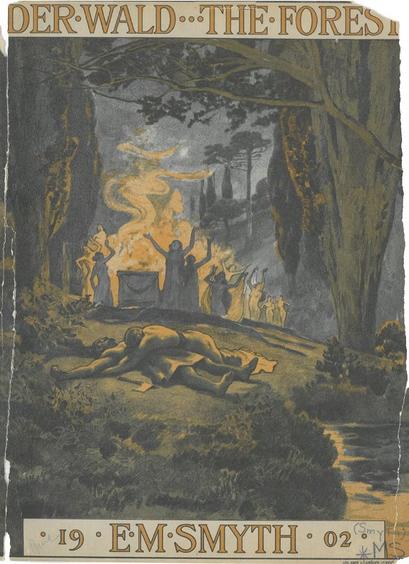
In 1903, Ethel Smyth debuted at the Metropolitan Opera New York with her opera Der Wald, as the first female composer ever. One hundred and thirteen years later, Kaija Saariaho followed in her footsteps with L’Amour de loin. Recently, Der Wald was released on CD. Saariaho died this summer; the MET has scheduled Innocence in 2025-26. This opera had its Dutch premiere in October.
There are people with whom you feel a deep connection, even though you have never met them. Such a person is Ethel Smyth (1858-1944), whose magnificent opera The Wreckers was performed at the 2022 Glyndebourne Opera Festival. The CD recording of this opera so enraptured me in 1994 that I immediately made attempts to have it performed in the Netherlands. Fruitlessly, as I wrote before.
Because…, well. Smyth was a woman, and even long after her death that still proved to be a major handicap, as I myself experienced many times. As a child, for instance, I was not allowed to join the local brass band – because I was a girl. When I was finally admitted, the conductor constantly found new ways to humiliate and/or ignore me. One day I decided I’d had enough. I threw my instrument at his feet and left, never to return. A century before, Smyth had resolutely snatched all parts from the lecterns when a conductor refused to perform her opera Der Wald in full. This made us soulmates.
Struggle to get Der Wald staged
Speaking of the setbacks Smyth faced, previous to the world premiere of Der Wald in 1903 she said: ‘The life of any composer who values his art more than his peace of mind is one long struggle from beginning to end, especially if you are a woman musician. The persistent and ever-increasing pressure on body, mind and soul, make it so hard to bear.’
‘I have exceptional physical fitness. I golf, I ride, I do all outdoor sports. Otherwise, the disappointments, discouragements and inevitable difficulties would have destroyed my health long ago. I managed to win the race. It seems to me that the hour has struck for women’s work in the music world. Any woman after me will find it easier because of my pioneering journey over this barren road.’
Unfortunately, her assessment turned out to be a bit too optimistic, as only in recent years more attention is paid to the work of female composers, especially thanks to the #MeToo movement. These days some male composers even complain that composition commissions mostly go to (young) women. Looking at concert programmes, however, one sees that they are still dominated by men.
Smyth had to fight for her music throughout her life, and the world premiere of Der Wald was no exception. The idea came from writer-philosopher Henry Brewster (1850-1908), her only male lover ever, whom she invariably called H.B. In 1898, they had written the libretto together for her first opera, the also German-language Fantasio. Brewster had even asked her to marry him, but with her characteristic decisiveness, she replied: ‘I wonder why it is so much easier for me to love my own sex more passionately than yours.’ Nevertheless they remained intimate friends until Brewster’s untimely death in 1908.
No care for mortal joys or sorrows
His synopsis of Der Wald immediately appealed to Smyth. She described the story as ‘a short, poignant tragedy which for a moment interrupts the tranquil rites of the Spirits of the Forest’, while the real story was ‘the eternal march of Nature – Nature that enwraps human destiny and recks nothing of mortal joys and sorrows’.
Not surprisingly, the opera is set in a forest. The wood spirits sing of their own immortality in contrast to the short lifespan of humans and animals. The young couple Röschen and Heinrich are to be wed and ask the blessing of the forest, but cruel Iolanthe goes all out to take Heinrich away from his sweetheart. The latter, however, remains steadfast even when Iolanthe threatens him with death. He snaps at her: ‘Then take my life, thou damned witch, and hell take thy soul!’ Whereupon Iolanthe kills Heinrich and Röschen throws herself dying in his arms. Unperturbed the forest spirits resume their rituals.
Powerful score spiced with pinches of Wagner and Debussy
The score of the one-act opera is packed with powerful choral and orchestral passages in Smyth’s signature style. This is rooted in romanticism and laced with pinches of Wagner, Debussy and English folklore. The overwhelming melodic richness and the varied, well-structured set-up are striking. When things get tense, Smyth doesn’t hesitate to virtually shut down the orchestral apparatus, allowing the soloists to convey the dramatic content even more empathically. In more light-hearted passages, we hear preliminary echoes of William Walton’s Façade.
Despite the necessary hurdles, Smyth managed to get Der Wald performed at the Royal Theatre in Berlin. The world premiere on 9 April 1902 was received somewhat coolly by critics, but audiences responded positively, becoming increasingly enthusiastic at the next three performances. In July, the opera was also staged at Covent Garden in an English translation, generating a resounding success. Smyth wrote in her memoirs: ‘It was the only blazing triumph I ever had.’
Der Wald first opera by a woman composer at the MET
Determined to get Der Wald performed in America too, Smyth took the night boat from London to Paris to meet Maurice Grau, manager of the MET. She arrived at 7am, called Grau at his hotel and got on the ferry back at 11am – with a contract. The handwritten document is preserved in Berlin’s State Library. We read that Smyth was to receive 40 British pounds for two performances and 20 pounds for each subsequent production. ‘You are certainly a businesswoman,’ Grau had observed. Still, the fee seems on the low side by modern standards: 40 pounds then are roughly equivalent to 6300 pounds now, somewhat over seven thousand euros.
‘Determined to get Der Wald performed in America too, Smyth took the night boat from London to Paris to meet Maurice Grau, manager of the MET. She arrived at 7am, called Grau at his hotel and got on the ferry back at 11am – with a contract.’
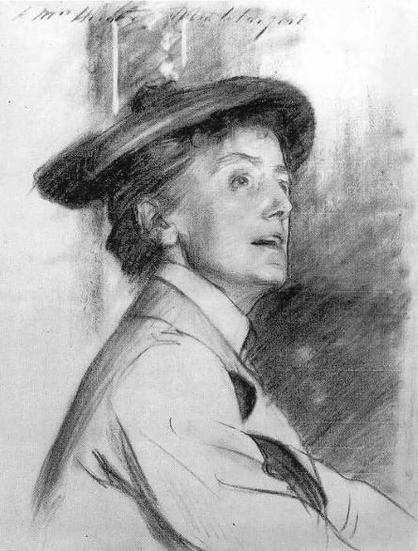
Tweet Ethel Smyth, portrait by John Singer SargentThat the MET would bring an opera by a woman caused quite a stir in the US. Months before the premiere, the occasion was covered in every conceivable media outlet. Smyth herself travelled to New York and gave many interviews. In 2021 American pianist and musicologist Amy Zigler managed to dig up as many as 102 articles, published in 21 different states, ranging from previews, interviews, reviews to simple announcements. A striking constant is that Smyth’s womanhood is explicitly stressed, as well as her connections with the European aristocracy (she was friends with Empress Eugénie and Queen Victoria, among others) and the American upper class (John Singer Sargent drew her portrait in 1901).
US premiere resounding public success
The premiere – in the original German version – on 11 March 1903, conducted by Grau, was a resounding success. The audience rewarded Smyth with a thunderous applause that lasted over 10 minutes, bombarding her with flowers when she appeared on stage. However, reviews from New York critics were extremely negative. ‘The case is one of vaulting ambition and a general incompetency to write anything beyond the most obvious commonplaces’, observes The New York Times. The Sun denounces its ‘vigour and masculinity’, while the Evening World calls the music ‘distinctly unfeminine, it lacks sweetness and grace of expression’. – So precisely the ambitious and powerful nature of her music is held against Smyth.
Her skilful orchestration is reluctantly mentioned at times, invariably followed by the accusation that any melodic ingenuity would be missing, and the music uninspired and without passion. Remarkably often, too, Smyth is called ‘girl’, even though she was already 44 years old. Almost a century later, little had changed: when I started working as a music journalist in the mid-nineties, it struck me that in the sporadic articles featuring women composers, they were invariably referred to by their first names. – A highly effective way to make a person seem small and insignificant.
1903 New York – misogynous and provincial
Today New York may count as the enlightened epicentre of the Western world, a century ago it was rather provincial; its critics had a misogynous disposition and listened with firm ear flaps on. In stark contrast, reviewers in the other 20 states praised Smyth’s overpowering, confident style. The Indianapolis Journal mentions the ‘wealth of musical ideas and a skill of construction which result in a strongly rounded whole’; the Topeka State Journal speaks of ‘a work of refinement, finish and musicality’, while the Telegraph calls her harmonic palette ‘masterful and convincing’, praising her ‘excellent sense of timbre. There is no sparing of brass, and there is no mincing of the means that speak the language of musical passion’.
Smyth herself faced only the reviews from New York, but where years later I still get vicariously furious, she did not let herself off the hook: ‘Der Wald is certainly not fit for that tribe’, she writes to Brewster. – With whom she promptly began work on her next opera, The Wreckers. Just how diametrically opposed the critics’ reaction was to that of the audience is evidenced by the fact that Der Wald produced the biggest box-office success of the entire season.
2016 New York – praise for Kaija Saariaho
It would take a hundred and thirteen years before the MET again ventured into an opera by a woman, L’Amour de loin by Kaija Saariaho (1952-2023), whom I also portrayed before. The reception of Saariaho’s opera in 2016 was considerably more favourable than the acrid bias Smyth had faced in 1903. For one thing women composers were no longer an absolute rarity, but perhaps more importantly, the opera had already made a 16-year-long triumphant tour of international stages.
The contrast between the two composers could hardly be greater. Whereas Smyth had a distinctly powerful style that draws you irrevocably into a musical argument brimming with full stops, commas and exclamation marks, Saariaho paints rather in pastel shades. She spins ever-changing, filigree fabrics of sound without fixed contours, immersing us in a benevolent ocean of sound, which blurs the sense of time and place.
Kaija Saariaho + Thea Derks at Dutch National Opera, February 2016
They were also quite different in temperament: Smyth was outspoken and militant, did not let anything or anyone get her down, and had a great sense of humour; I laughed my ass off at her memoirs. Saariaho was her opposite. Although I love her music, too, and interviewed her several times, we never developed a personal connection. Saariaho was reserved and formulated with extreme caution, piercing me with her ever suspicious gaze. Her pointed eyebrows, raised high, made her facial expression seem even sterner than she probably intended. Nor have I ever caught her laughing out loud; at most, a faint smile sometimes appeared on her lips.
Towards a canon of women composers
Like Smyth, Saariaho composed six operas, but unlike her British predecessor, she was invariably successful; she is considered one of the most important composers of our time. Her last opera, Innocence, was again showered with praise after its premiere in Aix-en-Provence in 2021. ‘An opera for the ages,’ a Dutch newspaper summed it up succinctly.
So in terms of appreciation of women composers, things have changed a bit for the better in the last hundred years. The MET has commissioned new opera’s from Jane Tesori and Missy Mazzoli, and Saariaho’s Innocence is scheduled for its 2025-26 season.
The wait now is for a reappraisal of Ethel Smyth. The splendid recording of Der Wald by the BBC Symphony Orchestra and Chorus and great soloists such as Morgan Pearse and Natalya Romaniw is surely a step in the right direction. It underlines once again that Smyth deserves a permanent place in the opera repertoire. I hope that in the foreseeable future we can rightly speak of a canon of Ladies at the MET.
https://www.youtube.com/watch?v=Fd7sFsDXj9o&ab_channel=BBCSingers-Topic
* Amy Zigler: “What a splendid chance missed!”: Dame Ethel Smyth’s Der Wald at the Met. Opera Journal, December 2021.
This article first appeared in the Nov-Dec issue of the Dutch music magazine De Nieuwe Muze.
I will play Der Wald in my radio show An Ox on the Roof on Concertzender NL on Sunday December between 5-6 pm Central European Time. The broadcast stays online for streaming.