 Contemporary Classical - Thea Derks
Never heard of?!! Ethel Smyth – successful composer, ardent suffragette
In their podcast series Never heard of?! NPO Radio 4 and VPRO Vrije Geluiden showcase female composers. In short episodes of 15 to 18 minutes, Rae Milford and Andrea van Pol alternately shed light on their life and work. On 6 August 2021 it was the turn of Ethel Smyth (1858-1944).
Van Pol en Milford recount how Smyth ended up in prison as a suffragette, where she immediately composed her March of the Women; that she was friends with contemporaries such as Clara Schumann and Johannes Brahms, enjoyed the patronage of celebrities such as Princesse de Polignac and Queen Victoria, and was nevertheless soon forgotten after her death in 1944. ‘But she was convinced that new generations would rediscover her work’, they conclude their podcast. In 2005 Smyth was my Composer of the week for VARA Radio 4.
ETHEL SMYTH: VITAL AND FEARLESS
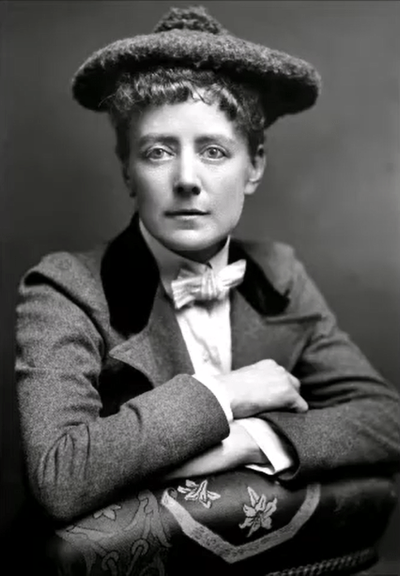
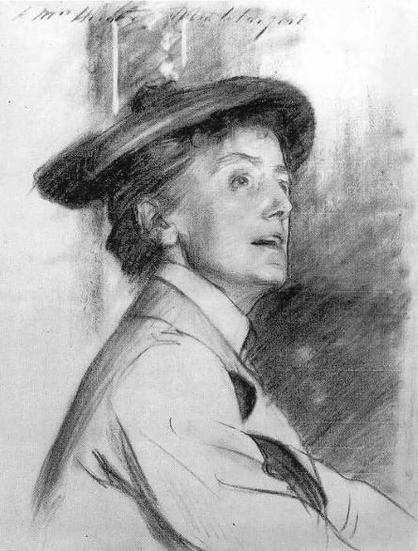
‘If I hadn’t had three things that have nothing to do with music, I would have gone to waste from loneliness and disillusionment at an early age’, wrote Ethel Smyth when she was sixty. Those three things were: ‘A cast iron constitution, an outspoken fighting mentality and a modest but independent income.’ Many people know Smyth mainly as one of the famous English suffragettes, who fought for women’s right to vote and wrote the famous March of the Women, which became a sort of battle song.
Smyth had enormous vitality and led a stormy life, in which she made no secret of her love for women. But most importantly, in a time when women were hardly taken seriously as composers, she created an impressive oeuvre, in which large-scale choral and orchestral works abound. Unlike many of her peers, she did not need to limit herself to composing chamber music.
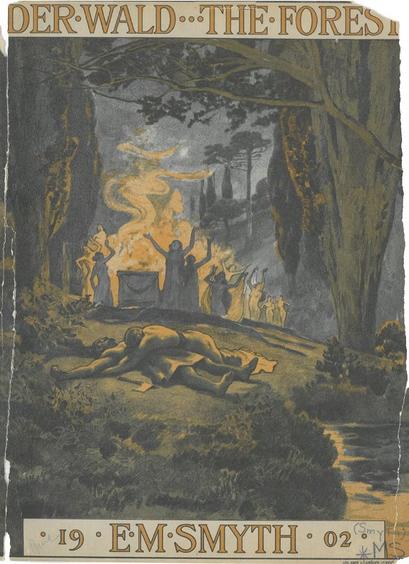
Smyth wrote no less than six operas, of which Der Wald was staged by the Metropolitan Opera in New York in 1903. – Never before had an opera by a woman been heard there, and it would last until 2016 before this occurred once more, when they staged L’amour de loin by Kaija Saariaho. Smyth’s most successful and best-known opera The Wreckers seems to have been the model for the opera Peter Grimes, which Benjamin Britten composed a year after her death.
A LIFE FOR MUSIC
Ethel Smyth was an original and strong-willed soul who did not allow herself to be dictated to by anything or anyone. Her fighting spirit came from no strangers: she was born the daughter of an army general, on 22 April 1858. As was customary in upper-class circles, she was taught by governesses as a child and then sent to a boarding school.
Her upbringing naturally included piano lessons, and when Smyth learned to play Beethoven’s piano sonatas, she decided to ‘devote my life to music’- A salient detail: just like Beethoven, Smyth would become deaf at an early age.
In a time when women were hardly taken seriously as composers, Ethel Smyth created an impressive oeuvre, in which large-scale choral and orchestral works abound.
TweetWhen she announced at 17 that she was going to study composition, her father exclaimed that he would ‘rather see her dead and buried’. Whereupon she decided on the spot to ‘make life at home into such hell that my parents had to let me go’, as she commemorates in her hilarious memoirs. In 1877 she went to the Leipzig Conservatory, where she studied with Carl Reinecke and others.
Characteristic for her critical and independent mind is that after one year only Smyth left the academy, dissatisfied with the teaching climate. She continued to live in Leipzig, however, where she became intensely involved in musical life. She was soon on friendly terms with musicians such as Johannes Brahms, Edvard Grieg, Joseph Joachim, Julius Röntgen and Clara Schumann, who stimulated her compositional aspirations. Because of her fearless, determined attitude and musical intensity, Brahms jokingly called her ‘the oboe’.
She studied privately with Heinrich von Herzogenberg, whose teaching made her blossom. She also fell madly in love with his wife Lisl, the first in a series of fervently loved women. ‘If I ever worshipped a creature on earth, it was Lisl’, she would later say. ‘She was attractive, intelligent and musically extraordinarily gifted’.
Elisabeth had studied with Brahms for a short time, whose music Ethel greatly admired. She also had great respect for Bach, whom she described as ‘the beginning and end of music’. This love is reflected in her Prelude and Fugue for piano solo, which she composed in 1880.
https://www.youtube.com/watch?v=_MNS5woXjZQ
POWERFUL GESTURES – MELODIC RICHNESS
Ethel Smyth gradually developed her own style, rooted in Romanticism and interspersed with Wagner, Debussy and English folklore. Whatever genre she composed in, her music always grabs you by the scruff of the neck with its powerful gestures, overwhelming melodic richness and varied, well-balanced structures.
Her music was frequently performed by famous musicians in prestigious halls. Yet it was not until 1883 that she published her first opus, the String Quintet in E major opus 1. This work is influenced by her affair with Elizabeth von Herzogenberg, who was a fervent advocate of Antonin Dvořák. Smyth had met Dvořák herself and in the first movement of her quintet, we clearly recognise elements of Bohemian folk music.
https://www.youtube.com/watch?v=IZKEigaXFoU
The String Quintet had its premiere in the Leipzig Gewandhaus. ‘The piece lacks the feminine charm one would expect from a female composer’, wrote one critic. Smyth was annoyed by such preconceived judgements, but could let them slide because she did not have to live off her compositions.
Independent and headstrong as she was, she also flouted social conventions. Sometimes she even managed to antagonise her best friends. When, in 1884, her relationship with Elisabeth van Herzogenberg had turned into a close friendship, she began an affair with her Lisl’s brother-in-law Harry Brewster. Lisl was affronted and turned away from her in shock. Though this saddened Smyth, she did not give up on Brewster; to ease the heartache, she bought a little dog, Marco.
LARGE-SCALE COMPOSITIONS
In the same period, Peter Tchaikovsky advised her to start writing orchestral works. He gave her some instrumentation advice and wrote to a friend: ‘She is one of the few female composers who really matter. She has composed several interesting works. The best of these is a Violin Sonata, which I heard in an excellent performance by the composer herself and the violinist A Brodsky.’ – He is referring here to Adolph Brodsky, a famous Russian violinist who spent some time in Leipzig. In response to Tchaikovsky’s exhortation, Smyth wrote her ambitious, almost forty-minute long Serenade in 1889.
https://www.youtube.com/watch?v=JQk2o38c_c8
The Serenade had its world premiere in 1890 in the renowned Chrystal Palace in London. It was also her first composition to be performed in England. Earlier that year she had returned from Leipzig to her native country, where she fell in love with yet another woman, Pauline Trevelyan. ‘Her extreme gentleness and fragile beauty adorn her soul’, she wrote of her new lover.
Trevelyan was a devout Catholic and her intense devotion to this faith inspired Smyth to compose a grand Mass in D for soloists, choir and orchestra. She completed this over one-hour long work in a year, mostly at Cap Martin, near Monaco. Here, her friend Empress Eugénie, the widow of Napoleon III, had a summer villa. When she had finished her Mass in 1891, Smyth played two parts for Eugénie and Queen Victoria during a stay at the royal castle Balmoral in Scotland.
In her memoirs, Smyth reports vividly: ‘It involved me singing both the choral parts and the solos and trumpeting the orchestral effects as well as I could. One particular effect in the drums even involved footwork, and I imagine that – at least in terms of volume – choir and orchestra were hardly missed.’ Queen Victoria was very impressed and invited her to come and play a longer excerpt. Her son Alfred, Duke of Edinburgh, then arranged for the Royal Choral Society to premiere the Mass on 18 January 1893 in the Royal Albert Hall.
https://www.youtube.com/watch?v=IVSpw3srMbc
OPERAS
The premiere of the Mass in 1893 was well received, except for one sour response. ‘It was funny to see a female composer trying to ascend to the higher regions of musical art’, wrote one critic. George Bernard Shaw described the Mass as ‘the light literature of church music’. Such criticisms increasingly antagonised Smyth and contributed to her eventually becoming an active campaigner for women’s suffrage.
Sir Thomas Beecham: ‘The prisoners marched across the courtyard singing March of the Women at the top of their voices, while Ethel Smyth, from a window, beat time in almost Bacchic frenzy with a toothbrush’.
TweetSmyth had always had a great affinity with the human voice, and after the success of her Mass in D, she began work on the first of six operas, Fantasio. She wrote the libretto with Harry Brewster, her only male lover. After endless peddling, the opera was finally performed in Weimar. Shortly afterwards, she completed Der Wald, which was staged with great success at Covent Garden in 1902 – described by Smyth as ‘the only blazing triumph I ever had’.
The American premiere in the New York MET a year later led to questionable praise in The Telegraph: ‘This little woman writes music with a masculine hand and has a sound and logical brain, such as is supposed to be the especial gift of the rougher sex. There is not a weak or effeminate note in Der Wald, nor an unstable sentiment.’
For her next opera, The Wreckers, Harry Brewster again wrote the libretto, based on a legend Smyth had heard in Cornwall. The inhabitants of an 18th century fishing village lure cargo ships onto the cliffs, after which they plunder them. The lovers Thirza and Mark rebel against this and light warning fires. They are discovered and locked up in a cave, where they are drowned in the rising tide.
https://www.youtube.com/watch?v=3mIyT62cBA4
The Wreckers premiered in Leipzig in 1906, in a drastically shortened version. Nevertheless, The Times judged it to be ‘one of the very few modern operas that we should count as Great Art’. In England, the opera was performed three years later, but despite its success and the power of the score, it is rarely if ever performed on stage today. My attempts to interest programmers and conductors invariably came to nothing.
SUFFRAGETTE
At the beginning of the 20th century, when Smyth had a brief affair with Princesse de Polignac and started to spice up her music with touches of French flair. In 1910, she received an honorary doctorate from Durham University and that same year she fell in love with Emmeline Pankhurst, leader of the English women’s movement. She decided to devote the next two years to the cause of women’s suffrage and became one of the militant suffragettes. After throwing a stone through the windows of the Home Office, she was sentenced to six weeks in prison.
While in prison, she promptly wrote the protest piece March of the Women for female choir, which would become the anthem of the women’s movement. When Sir Thomas Beecham visited her in prison, he stumbled on a scene typical of Smyth. The prisoners marched across the courtyard singing March of the Women at the top of their voices, while Smyth, from a window, ‘beaming with delight, beat time in almost Bacchic frenzy with a toothbrush’.
https://www.youtube.com/watch?v=fJ_ppIKBWPY
After this, Smyth composed her comic opera The Boatswain’s Mate, in which the high-spirited Mrs. Waters rejects two suitors because she does not see any point in giving up ‘my independence for Mr. Wrong’. – Smyth herself had always refused to marry her lifelong friend Harry Brewster, who died in 1908. – In her opera she included quotes from March of the Women.
https://www.youtube.com/watch?v=jXDlk63uGkQ
DEATH
In the early twentieth century, Smyth slowly lost her hearing, which made composing more difficult. She therefore developed another talent: writing. In 1919, a two-volume autobiography, Impressions that Remained, was published. Thanks to its lively style it was highly successful, providing her with a welcome extra income. In 1922, she was knighted, in recognition of her great importance to English musical life. Henceforth she went through life as Dame Ethel Smyth; four years later she received an honorary doctorate from Oxford.
Despite her deafness, Ethel Smyth continued to compose. In 1927 she wrote her much-praised Concerto for violin, horn and orchestra. In 1930 she wrote her last large-scale work, the impressive cantata/vocal symphony The Prison for soprano, baritone, choir and orchestra on a metaphysical text by Brewster.
https://www.youtube.com/watch?v=3y_T9pxvv8A
OBLIVION AND BELATED RECOGNITION
Smyth remained militant in the last decades of her life, campaigning for the right of women to play in orchestras and to compose. Her music was heavily promoted by such luminaries as Thomas Beecham and Bruno Walter, who described her as ‘a composer of great significance’.
Towards the end of her life, however, Ethel Smyth’s music fell out of favour and was less frequently performed. Many saw her as an eccentric composer who published amusing memoirs. On the other hand, she also received belated recognition.
Bernard Shaw, for instance, responded enthusiastically to a new performance of her Mass in D: ‘Dear Lady Ethel, thank you for persuading me to listen to that Mass. Wonderful! […] It was your music that cured me forever of the old delusion that women could not do the work of men in art and other things.’ Shaw even confessed that without Smyth he would never have been able to write his play Saint Joan.
After a short illness Ethel Smyth died on 8 May 1944, at the age of 86. Her unfailing confidence in the power of her music proved prophetic, as Van Pol and Milford observe in their podcast. Lately, Smyth’s ever-scintillating music has been resurrected (be it sparsely) in concert halls and on CD.
https://www.youtube.com/watch?v=_VKc3jRxvvE
Contemporary Classical is ranked among the 70 best classical music blogs worldwide. Your support, however small, is welcome through PayPal (friends option) or direct money transfer to NL82 INGB 0004261694, TJM Derks Amsterdam
A 1958 radio documentary features testimonies from Ethel Smyth herself, Thomas Beecham, Bruno Walter, Ethel Davidson (niece of Smyth), C S Lang, Ronald Storrs, Adrian Boult, Herbert van Thal & others.
https://www.youtube.com/watch?v=MP_qrXdKdq8
#ClaraSchumann #DerWald #EmmelinePankhurst #EthelSmyth #HarryBrewster #TheWreckers