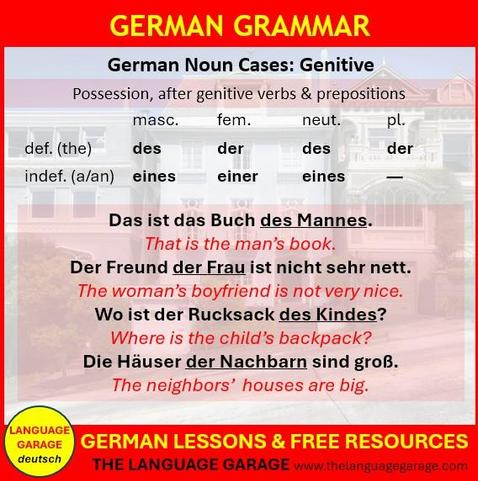
The #German genitive case is the case of possession. The articles are des, der, des, der, eines, einer, eines. #GermanGrammar #GermanCases. Learn more here: https://thelanguagegarage.com/german-noun-cases/

#German prepositions an (at, on), auf (on), hinter (behind), in (in), neben (next to), über (over, above), unter (under, beneath), vor (in front of), and zwischen take the dative when they refer to location. #GermanGrammar #GermanCases. Learn more here: https://thelanguagegarage.com/german-noun-cases/
#German prepositions an (at, onto), auf (onto), hinter (behind), in (into), neben (next to), über (over, above), unter (under, beneath), vor (in front of), and zwischen take the accusative when they refer to movement. #GermanGrammar #GermanCases. Learn more here: https://thelanguagegarage.com/german-noun-cases/
#German prepositions aus (from, out of ), außer (except for, besides, apart from), bei (at, near, by), gegenüber (across from) mit (with, by means of), nach (after, to, according to), seit (since, for), von (from, of), zu (to) are followed by the dative. #GermanGrammar #GermanCases. Learn more here: https://thelanguagegarage.com/german-noun-cases/
Most nouns in the #German dative case add an -n in the plural if they don’t already end in –n. Ich gebe den Kindern etwas zu essen. I give the kids something to eat. #GermanGrammar #GermanCases. Learn more here: https://thelanguagegarage.com/german-noun-cases/
The #German dative case is the case of indirect objects and certain prepositions. The articles are dem, der, dem, den, einem, einer, einem. #GermanGrammar #GermanCases. Learn more here: https://thelanguagegarage.com/german-noun-cases/
#German prepositions durch (through), für (for), gegen (against), ohne (without), and um (around), as well as prepositions expressing motion, take accusative objects. Wir gehen durch einen Park. We walk through a park. #GermanGrammar #GermanCases. Learn more here: https://thelanguagegarage.com/german-noun-cases/
#German N nouns like der Junge (boy), der Student (student), der Mensch (human), or der Nachbar (neighbor), take –(e)n in all forms but the nominative singular. Siehst du den Jungen? Do you see the boy? #GermanGrammar #GermanCases. Learn more here: https://thelanguagegarage.com/german-noun-cases/
The #German accusative case is the case of direct objects and certain prepositions. The articles are den, die, das, die, einen, eine, ein. #GermanGrammar #GermanCases. Learn more here: https://thelanguagegarage.com/german-noun-cases/