How #interdisciplinary do young #geoscientists work? Which challenges do they identify, and how could work across disciplines be better facilitated? We analyzed survey results within the German #Geo.X research network, now out as a #preprint at @EuroGeosciences 📝
https://doi.org/10.5194/egusphere-2026-1858

Interdisciplinary Research in Geosciences: A View from Early Career Scientists

Abstract. Geosciences are often described as interdisciplinary, yet research and training remain fragmented across sub-disciplines and institutions. To understand how early career scientists (ECS) experience and practice interdisciplinarity, and which support structures actually help, we conducted an online survey within the German Geo.X research network. This yielded 151 valid responses that were included in the analysis. Participants broadly value interdisciplinarity for fostering the exchange of ideas across disciplines, providing novel perspectives, and enhancing their capacity to address complex problems. At the same time, they report recurrent barriers that directly affect research efficiency and career progression, including incompatible terminologies, different working speeds, and diverging publication strategies. The results indicate that strengthening interdisciplinary geosciences requires not only incentives for collaboration, but also training in cross-disciplinary communication, and transparent publication and evaluation pathways that acknowledge the increasing coordination efforts. Research networks such as Geo.X provide a strong foundation for initiating advancing interdisciplinary collaboration and can serve as effective instruments. Network structures are particularly well-suited to this purpose, as they are flexible enough to test new formats and innovative ideas as pilot projects. This requires that their initiatives are clearly communicated, easily accessible, and well aligned with the working realities of early career scientists, while also reducing coordination costs by fostering continuity, shared reference frames, and trust across sub-disciplines.

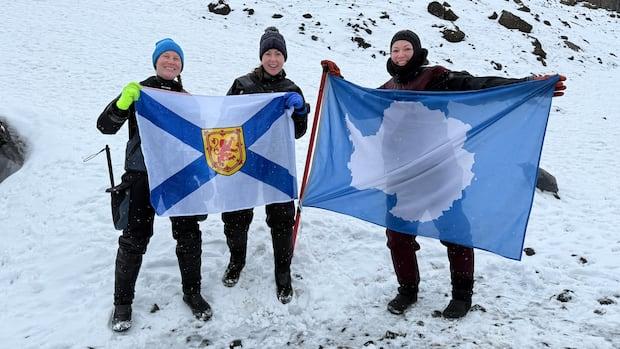
A kitchen party at the bottom of the world: N.S. scientists return from Antarctic research trip
Three Nova Scotian geoscientists have returned from a month-long expedition to Antarctica and now hope to inspire other women to enter their field of work.
https://www.cbc.ca/news/canada/nova-scotia/nova-scotia-geoscientists-finish-antarctic-expedition-9.7140406?cmp=rss
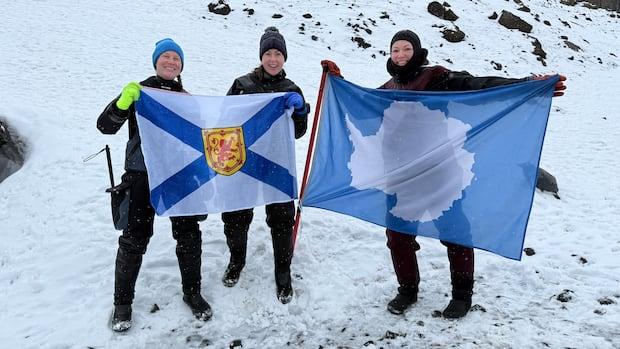
A kitchen party at the bottom of the world: N.S. scientists return from Antarctic research trip
Three Nova Scotian geoscientists have returned from a month-long expedition to Antarctica and now hope to inspire other women to enter their field of work.
https://www.cbc.ca/news/canada/nova-scotia/nova-scotia-geoscientists-finish-antarctic-expedition-9.7140406?cmp=rss
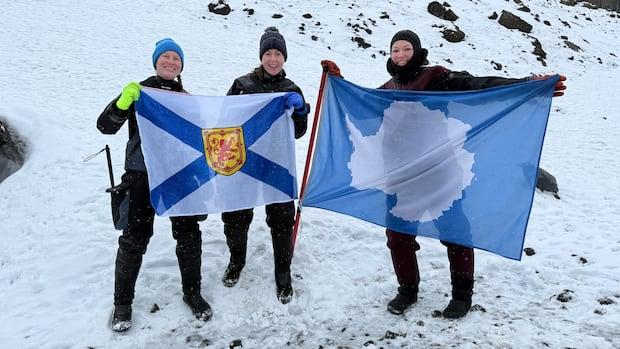
A kitchen party at the bottom of the world: N.S. scientists return from Antarctic research trip
Three Nova Scotian geoscientists have returned from a month-long expedition to Antarctica and now hope to inspire other women to enter their field of work.
https://www.cbc.ca/news/canada/nova-scotia/nova-scotia-geoscientists-finish-antarctic-expedition-9.7140406?cmp=rss
In a former service tunnel built for the Furka-Gotthard rail link, ETH #Geoscientists are looking to move mountains. We take a closer look at the underground lab. Read the full article here: ethz.ch/en/news-and-... @[email protected]

The #EGU26 of the European Geosciences Union will bring together #geoscientists from all over the world for one meeting covering all disciplines of the Earth, planetary, and space sciences. It will be held from 3 - 8 May 2026 in a hybrid format, both in Vienna and virtually.

We are pleased to announce that #media registration for the meeting is now available!

👉 Register Here: https://egu.eu/1RZS3I
📸Kai Boggild on https://imaggeo.egu.eu

How can #geoscientists effectively integrate #AI methods into their research proposals?

Find out in the latest #blog post from EGU Hydrological Sciences Division

Read here: https://egu.eu/6DHHD0/

The free online SENSEI #workshop registration (March 10th, 14:00-16:30 CET) is open https://form.typeform.com/to/cMwbJISb
The SENSEI project aims to develop new tools and methods to provide global telecommunication fiber networks with sensing abilities, useful for environmental monitoring as well as infrastructure surveillance and improvement of the network efficiency. Funded within Horizon Europe for photonic developers, #metrologists, #geoscientists networking experts and operators
https://senseiproject.eu/workshop/
Workshop SENSEI March 10, 2025

Turn data collection into an experience with Typeform. Create beautiful online forms, surveys, quizzes, and so much more. Try it for FREE.

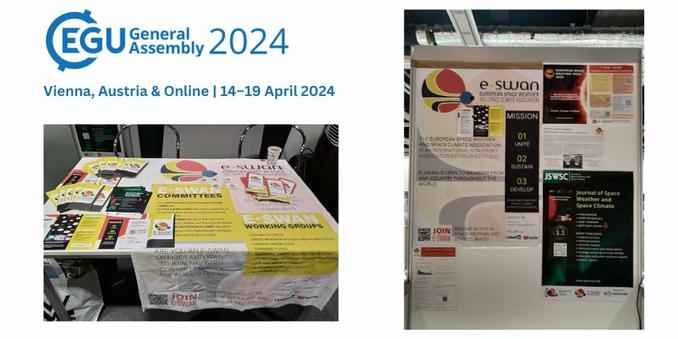
#conférence | EGU 2024
We are glad that the Journal of Space Weather and Space Climate is represented in this enriching conference organised by @EGU_European Geosciences Union, bringing together #geoscientists from all over the world.

➡️ 14-19 April 2024 |Vienna, Austria & Online
Find us on the E-SWAN booth!
#spacesciences
#spaceclimate
#spaceweather
#EDPSciences
#conferences
#austria #vienna

#Geoscientists analyze rocks in mountain belts to reconstruct how they once moved downwards into the depths and then returned to the surface. This history of burial and exhumation sheds light on the mechanisms of plate #tectonics and #mountain building.
#EarthScience #Geology #sflorg
https://www.sflorg.com/2023/10/es10272301.html
Alpine rock reveals dynamics of plate movements in Earth’s interior

Examining how plates move in Earth's mantle and how mountains form is no easy feat