 Daniel Pomarède
in the #arXiv
DESI Peculiar Velocity Survey – Fundamental Plane
by Khaled Said and co-authors
https://arxiv.org/abs/2408.13842
#Cosmology #galaxies #cosmicflows #astronomy #astrophysics #astrodon #science #STEM #DESI #FundamentalPlane #HubbleConstant #TullyFisher

DESI Peculiar Velocity Survey -- Fundamental Plane
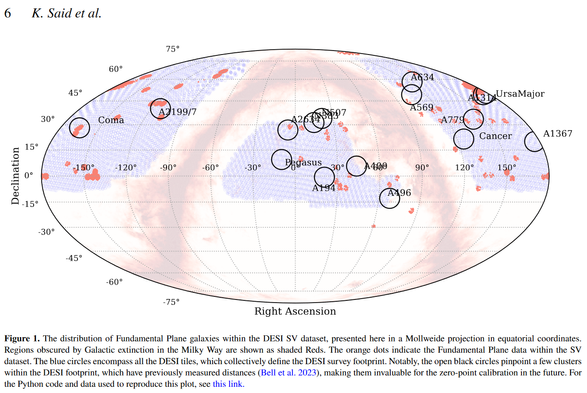
The Dark Energy Spectroscopic Instrument (DESI) Peculiar Velocity Survey aims to measure the peculiar velocities of early and late type galaxies within the DESI footprint using both the Fundamental Plane and optical Tully-Fisher relations. Direct measurements of peculiar velocities can significantly improve constraints on the growth rate of structure, reducing uncertainty by a factor of approximately 2.5 at redshift 0.1 compared to the DESI Bright Galaxy Survey's redshift space distortion measurements alone. We assess the quality of stellar velocity dispersion measurements from DESI spectroscopic data. These measurements, along with photometric data from the Legacy Survey, establish the Fundamental Plane relation and determine distances and peculiar velocities of early-type galaxies. During Survey Validation, we obtain spectra for 6698 unique early-type galaxies, up to a photometric redshift of 0.15. 64\% of observed galaxies (4267) have relative velocity dispersion errors below 10\%. This percentage increases to 75\% if we restrict our sample to galaxies with spectroscopic redshifts below 0.1. We use the measured central velocity dispersion, along with photometry from the DESI Legacy Imaging Surveys, to fit the Fundamental Plane parameters using a 3D Gaussian maximum likelihood algorithm that accounts for measurement uncertainties and selection cuts. In addition, we conduct zero-point calibration using the absolute distance measurements to the Coma cluster, leading to a value of the Hubble constant, $H_0 = 76.05 \pm 0.35$(statistical) $\pm 0.49$(systematic FP) $\pm 4.86$(statistical due to calibration) $\mathrm{km \ s^{-1} Mpc^{-1}}$. This $H_0$ value is within $2σ$ of Planck Cosmic Microwave Background results and within $1σ$, of other low redshift distance indicator-based measurements.