He didn't write that?
The language is more complex than his usual written rants?
Trumps Surrender Plan for Ukraine was Originally written in Russian then Translated into English?
RE: https://lingo.lol/@divlingassoc/115197902826618506
There is now just one month left to apply for the 7th Forensic Linguistics Short Course #FLsc!
Applications close on 13 December 2025 – don't miss your chance to join us in Düsseldorf for four days of forensic linguistic discovery.
Are you interested in #ForensicLinguistics? Then the Aston Institute for Forensic Linguistics research seminars might be something for you.
For more information see: https://discourseanalysis.net/en/aston-institute-forensic-linguistics-research-seminars #Linguistics #DiscourseStudies
Free access for two weeks to our new Cambridge Element (I.e. mini book) “Decoding Terrorism: An interdisciplinary approach to a loan-actor case”, in which we analyze the extreme-right terror attack in Halle from various countries perspectives, including forensic linguistics ones:
https://www.cambridge.org/core/elements/abs/decoding-terrorism/D6AC34F2DD0DC4F507A1E0545898E044
About a month ago we finally managed to drop (Nini et al. 2024), “Authorship Verification based on the Likelihood Ratio of Grammar Models”, on the arXiv. Delving into topics such as authorship verification, grammar and forensics, was quite a detour for me, and I’d like to summarize here some of the ideas and learnings I got from working with all this new and interesting material. The main qualitative idea put forward by Ref. (Nini et al. 2024) is that grammar is a fundamentally personal and unique trait of an individual, therefore providing a sort of “behavioural biometric”. One first goal of this work was to put this general principle under test, by applying it to the problem of Authorship Verification (AV): the process of validating whether a certain document was written by a claimed author. Concretely, we built an algorithm for AV that relies entirely on the grammatical features of the examined textual data, and compared it with the state-of-the-art methods for AV. The results were very encouraging. In fact, our method actually turned out to be generally superior to the previous state-of-the-art on the benchmarks we examined. This is a notable result, keeping also into account that our method uses less textual information (only the grammar part) than other methods to perform its inferences. The algorithm I sketch here a pseudo-implementation of our method in R. For the fit of \(k\)-gram models and perplexity computations, I use my package {kgrams}, which can be installed from CRAN. Model (hyper)parameters such as number of impostors, order of the \(k\)-gram models, etc. are hardcoded, see (Nini et al. 2024) for details. This is just for illustrating the essence of the method. For practical reasons, in the code chunk below I’m not reproducing the definition of the function extract_grammar(), which in our work is embodied by the POS-noise algorithm. This function should transform a regular sentence, such as “He wrote a sentence”, to its underlying grammatical structure, say “[Pronoun] [verb] a [noun]”. #' @param q_doc character. Text document whose authorship is questioned. #' @param auth_corpus character. Text corpus of claimed author. #' @param imp_corpus character. Text corpus of impostors. score
The next talk in our 2023/2024 talk series "Diversity in Linguistics" will be given by Sevena Olgar.
The talk will be on the topic of "Feature Effectiveness in Authorship Attribution". Find more information here: div-ling.org/talks
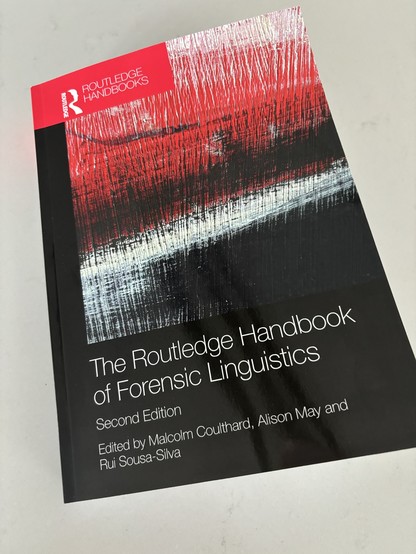
I’m currently reading the 2024 edition of the Routledge Handbook of Forensic Linguistics and I loved every chapter I’ve read so far! This is a must read for anyone interested in the latest research in the field of Forensic Linguistics.
#linguistics #forensiclinguistics @academicchatter @linguistics #routledgebooks
Volume 37, Issue 2 of the International Journal for the Semiotics of Law has some very interesting forensic linguistics articles!
https://link.springer.com/journal/11196/volumes-and-issues/37-2
#forensiclinguistics #linguistics #openaccess @academicchatter @linguistics