Short Fiction Reviews: Eleanor Arnason’s “A Clear Day in the Motor City” (1973), “Ace 167” (1974), and “The Warlord of Saturn’s Moons” (1974)
In the past few months, I’ve put together an informal series on the first three published short fictions by female authors who are completely new to me or whose most famous SF novels fall mostly outside the post-WWII to mid-1980s focus of my reading adventures. So far I’ve featured Carol Emshwiller (1921-2019), Nancy Kress (1948-), Melisa Michaels (1946-2019), and Lee Killough (1942-). To be clear, I do not expect transformative or brilliant things from first stories. Rather, it’s a way to get a sense of subject matter and concerns that first motivated authors to put pen to paper.
Today I’ve selected an author I’ve never read–Eleanor Arnason (1942-). According to SF Encyclopedia, most of her best-known science fiction appeared from the mid-1980s onward with To the Resurrection Station (1986) (which I own), A Woman of the Iron People (1991), Changing Women (1992), and the Hwarhath sequence (1993-2012). Unfortunately, I did not encounter her work in my late teens and early 20s when I read science fiction more widely.
I’d rank Eleanor Arnason’s first three published short fictions as the most auspicious start of the those I’ve covered so far. Her stories–often self-consciously in dialogue with pulp worlds and plots–demonstrate a fascination with ritualized landscapes and behaviors and feature female narrators attempting to find their place in strange new worlds.
Let me know which Arnason fictions–perhaps from much later in her career–resonate with you.
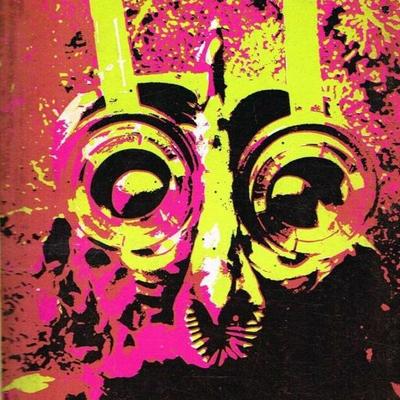
- Bruce Pennington’s cover for New Worlds 6, ed. Michael Moorcock and Charles Platt (1973)
4/5 (Good)
“A Clear Day in the Motor City” first appeared in New Worlds 6, ed. Michael Moorcock and Charles Platt (1973). This does not seem to be available online. If you find it, let me know.
Like a cryptic quilt, a strange ritualized landscape drapes across the polluted industrial expanse of Detroit and Windsor. On clear air holidays, when “the Seven Sisters” were visible from the roof of a nearby office building, CEOs adorn “wreaths of plastic oak leaves” and release pigeons to “whoever’s responsible for the weather, to bear our thanks to him, her, it or them” (187).
On one of these holidays, our narrator wanders the streets observing the rituals of the new age, the Age of Belief, the age of faith induced by psychopharmacological means. She observes the ritual processions of Christ-Adonis, “one of the middle eastern fertility gods,” and a saffron-robed Buddhist (188). She reminisces about her own childhood while watching children playing with plastic yellow stalks that foretell “only happy futures” (189). She giggles as a beginner golfer cannot keep his inflated plastic phallus, a contraption all golfers wear “to attract the favorable notice of the game’s patron gods,” tucked between his legs while he completed his shot (190). In her induced happiness, she barely notices the Doubters that lurk at the fringes. The day’s final ritual yields cracks in her mask of happiness and purpose.
- “The Seven Sisters” — Photograph of Detroit Edison Conners Creek electric power plant, 1954. Demolished in 1996.
In this new age, everyone can now play the role of haruspex because you cannot help but believe. Like a finger assessing the vitality of the land from the entrails of a sacrificial animal, these actions provide an answer that doesn’t lay blame at the feet of humankind. Fidazene provides the possibility of a path through the smog. Or, at least, the kindly eye of an entity that can peer through the nightmarish crush of humanmade catastrophe.
The Detroit of the early 70s was a city moving slowly towards urban decay. After the Twelfth Street riot in 1967–part of a larger protest movement against poverty, racism, and unemployment exacerbated by the departure of businesses from the city centers–more and more denizens of the affluent neighborhoods moved to the suburbs. Right after the story’s publication, the Supreme Court’s 1974 Milliken v. Bradley decision, which ruled suburbs couldn’t be forced to aid with desegregating Detroit’s urban schools, caused further white exodus from the United States’ most segregated city.
Both “A Clear Day in the Motor City” (1973) and “The Warlord of Saturn’s Moons” (1974) (below) provide commentary on the city’s turbulent collapse. Arnason imagines Detroit’s position as an industrial capital continues. But beneath the surface a deeper horror operates–pollution and unrest. A terror that fidazene must keep at bay. A terror in which old gods in new skins must be resurrected to appease.
- Uncredited cover for the 1st edition of Orbit 15, ed. Damon Knight (1974)
3/5 (Average)
“Ace 167” first appeared in Orbit 15, ed. Damon Knight (1974). You can read it online here.
A transient narrator attempting to find her place in the world, recounts her interactions with Ace 167, a genetically and surgically modified human designed to swim in the oceans of Venus. Fresh off a failed job managing a “troupe of precision unicyclists,” she meets Ace in a bar while slurping cheap Venusian wine (149). Created at great cost, the “Gillies” undergo specialized training to work dangerous underwater projects. Like the narrator, Ace wanders… he brushes off the visceral hatred the world throws at him and moves on to the next job. But he fears the dark Venusian seas and resists returning to the depths. Their fleeting interactions over the years causes both to reflect on the passing of youth and the need to connect to something.
Arnason’s Venus is deliberately anachronistic. By the 70s everyone knew there were no oceans on Venus and no way humans could survive in the ferocious elements. In “The Warlord of the Saturn’s Moons” (1974), Arnason explores the immense pull the science fictional pulp locale holds. It’s a place of escape. The problems are simple. The right is right and the wrong is so very wrong. At first glance this Venus looks like a pulp conception of the exotic planet. The city of Isis, replete with “as many canals as streets” and “water gardens” and towering “skyscrapers made of blue glass” (153), feels like something out of a Burroughs story. The Venusian natives paddle by in their canoes and perform their rituals with “god-symbols made of flowers tied together, their tiny cages with brightly colored insects inside of them” (153). But Isis is filled with segregated districts and aimless denizens like the narrator and Ace. And the tourists approach the natives and their displays and “moved in to buy” (153). This is a pulp Venus with an all too real underbelly of reality.
Our narrator, who grew up in Windsor across the ruins of Old Detroit, might have viewed Venus as place to escape. But all life’s problems and pitfalls found her anyway among the splendors of an exotic world.
- Charles Shields’ cover for the 1st edition of The New Women of Wonder, ed. Pamela Sargent (1978)
4.75/5 (Very Good)
“The Warlord of Saturn’s Moons” first appeared in New Worlds 7, ed. Hilary Bailey and Charles Platt (1974). You can read it online here. I read it in The New Women of Wonder, ed. Pamela Sargent (1978). Nominated for the 1976 Nebula Award for Best Novelette.
“Carry me back to Titan
That’s where I want to be.
I want to repose
On the methane snows
At the edge of a frozen sea” (83).
A 35-year-old writer of pulp science fiction, and a “feeder of stray cats” (78), spends her day making tea, smoking cigars, and imagining action-packed adventures on Titan. The real world, a Detroit of the near future, imposes itself on the radio and through her window. And so she returns to Titan with her “read-headed heroine deathraying down the warlord’s minions” so that her nights “aren’t troubled by dreams of murder” (79). But what shall she do with 409, her heroine’s love interest? An escapee of a prison asteroid with a face “burned [..] by years of strong radiation on Mars and in space” (81), 409 yields a strange stoic power. The writer feels drawn to her own character–“I could, of course, kill him off” (81) she muses. But there are more layers… her heroine manifests so many of the writer’s own childhood dreams. And the writer struggles to find her own partner. And back into the story she slips, writing challenge after challenge 409 and his read-headed love must overcome. And while she writes another body is dragged from the Detroit River (83).
The three stories also provide the outline of a future history of Detroit. In “The Warlords of Saturn’s Moons” it seems like a near-future manifestation of the city after the riots of the late 60s, urban decay, and growing white flight. The murder count skyrockets and the pollution grows unbearable. In “A Clear Day in the Motor City,” Arnason suggests drugs will be needed to keep people from seeing the true nature of the decay. And in “Ace 167” Detroit is but ruins…
“The Warlord of Saturn’s Moons” is a powerful conjuration of the allure of writing and reading science fiction. Imaginary worlds where life can be simpler. Imaginary worlds to be destroyed and resurrected and destroyed and resurrected at will while the world writhes outside. This feels like a culmination of Arnason’s first two stories. All the rituals are here–the writer makes tea, smokes her cigar, turns on her radio, turns off her radio, makes tea, starts to write, makes tea. And the pulp adventure becomes a tapestry where every thread intersects with the writer’s being. Pulp as a manifestation of her desires, a manifestation of her agency in a world slipping from grasp.
For book reviews consult the INDEX
For cover art posts consult the INDEX
For TV and film reviews consult the INDEX
#1970s #EleanorArnason #sciFi #scienceFiction
 Michael Hanscom


 Michael Frasca
 Science Fiction and Other Suspect Ruminations