What motivates pollinator protection? ๐Ÿ

Food production is one reason, but not the only one!

Research shows stakeholders support pollinator protection for ethical, ecological and societal reasons.

Read more ๐Ÿ‘‰ https://link.europa.eu/HwRXQV

#EUPollinators
---
https://nitter.net/EU_ENV/status/2050153253342441807#m
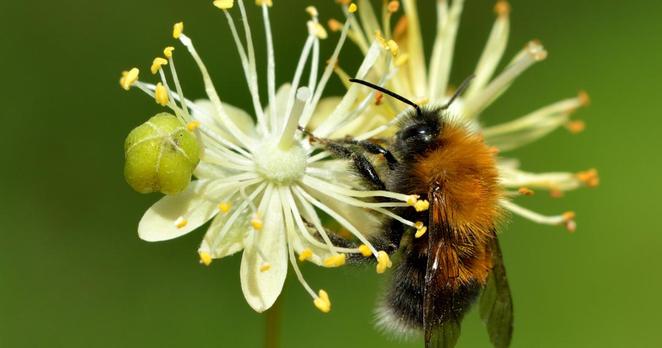
Better engagement in conservation policymaking: Considering ethical values could foster connection across diverse stakeholders, finds pollinator study

Conservation policy often focuses on natureโ€™s right to exist and benefits to human society. A study of influential stakeholders in pollinator policy now highlights other motivations, including moral concerns and responsibility to future generations.
Directorate-General for Environment

RT by @euenvironment: Pollinators ๐Ÿฆ‹๐Ÿ are crucial #ForOurPlanet & for our food security

As we start going #BackToSchool, let's learn more about #EUPollinators, and why we need to protect them

Visit #PollinatorPark for an eye-opening experience of a ๐ŸŒ without pollinators ๐Ÿ‘‰ http://pollinatorpark.eu

[2024-09-10 09:47 UTC]

Pollinator Park

A beautiful virtual reality experience about the ugly future we face without pollinators.

Environment

RT by @EUClimateAction: #BackToSchool, back to busy bees life! ๐Ÿ

#DYK that honeybees have a dance move called the โ€˜waggle danceโ€™ to inform other bees about a new food source?

With the #EUPollinators Initiative, we want to protect all pollinators, and reverse their decline ๐Ÿ‘‰ https://europa.eu/!VqhNg4

[2024-09-02 09:45 UTC]

Pollinators

Reversing the decline of wild pollinators in the EU and contributing to the global action.

Environment

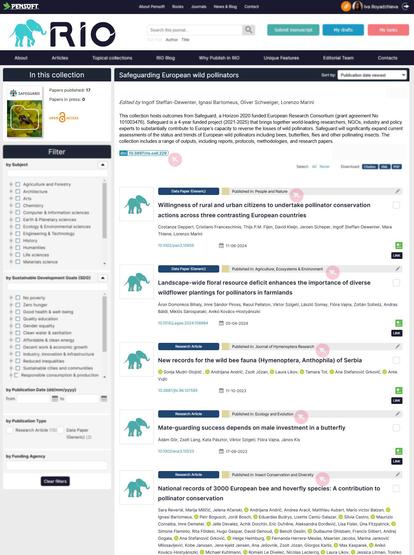
๐Ÿ’ก Your #project #consortium don't need to publish all #papers & #research outputs with us to have them featured in an #openscience collection, where ALL will be sharing a central page & DOI link!

๐Ÿ‘‰ Excellent example from the #Horizon-funded project #Safeguard: https://doi.org/10.3897/rio.coll.229

#pollinators #eupollinators #horizoneu #ecosystem #euprojects

Safeguarding European wild pollinators

This collection hosts outcomes from Safeguard, a Horizon 2020 funded European Research Consortium (grant agreement No 101003476). Safeguard is a 4-year funded project (2021-2025) that brings together world-leading researchers, NGOs, industry and policy experts to substantially contribute to Europeโ€™s capacity to reverse the losses of wild pollinators. Safeguard will significantly expand current assessments of the status and trends of European wild pollinators including bees, butterflies, flies and other pollinating insects. The collection includes a range of outputs, including reports, protocols, methodologies, and research papers.

Research Ideas and Outcomes

RT by @EU_ENV: Happy #WorldBeeDay!๐Ÿ

If you see a bee, would you know it is one?

You might see them less, though: 1 in 3 bee, butterfly and hoverfly species is in decline.

With the #EUPollinators Initiative, we want to reverse this development: https://europa.eu/!6PymrM

[2024-05-20 05:30 UTC]

Pollinators

Reversing the decline of wild pollinators in the EU and contributing to the global action.

Environment

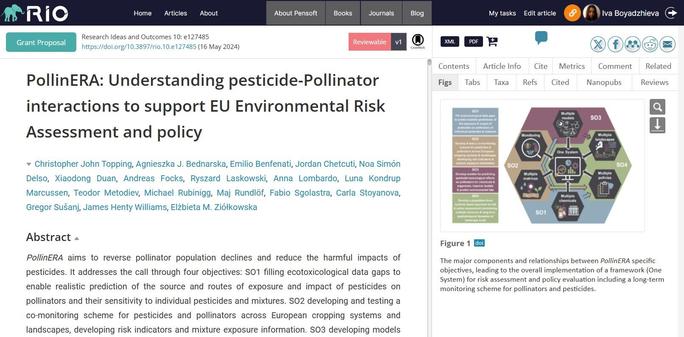
๐Ÿ Over the next 3 years, the #HorizonEurope-funded #PollinERA Project will be addressing #pollinator population declines and harmful #pesticides by supporting ๐Ÿ‡ช๐Ÿ‡บ EU Environmental Risk Assessment & policy.

๐Ÿ“ƒ Grant Proposal: https://doi.org/10.3897/rio.10.e127485

๐Ÿ’ก Over the course of the #PollinERA Project, all key project outputs will be added to the consortium's #openscience project collection: https://doi.org/10.3897/rio.coll.249

#pollinators #pollination #EUPollinators #WorldBeeDay #horizoneu #horizoneurope

PollinERA: Understanding pesticide-Pollinator interactions to support EU Environmental Risk Assessment and policy

PollinERA aims to reverse pollinator population declines and reduce the harmful impacts of pesticides. It addresses the call through four objectives: SO1 filling ecotoxicological data gaps to enable realistic prediction of the source and routes of exposure and impact of pesticides on pollinators and their sensitivity to individual pesticides and mixtures. SO2 developing and testing a co-monitoring scheme for pesticides and pollinators across European cropping systems and landscapes, developing risk indicators and mixture exposure information. SO3 developing models for predicting pesticide toxicological effects on pollinators for chemicals and organisms, environmental fate, toxicokinetic/ toxicodynamic, and population models. SO4 developing a population-level systems-based approach to risk and policy assessment considering multiple stressors and long-term spatiotemporal dynamics at the landscape scale and generating an open database for pollinator/pesticide data and tools.This will be achieved through developing knowledge and protocols for a broad range of toxicological testing, feeding to in silico models (QSARS, toxicokinetic/toxicodynamic, and population). Using a strong stakeholder co-development approach, these models will be combined in a One System framework taking a systems view on risk assessment and policy evaluation, including an international monitoring program.The One System framework is based on EFSAโ€™s system ERA view, expanding on the tools used for bees to include butterflies, moths and hoverflies. The consortium partners are experts in the field needed for this development and are well-placed to facilitate the uptake of tools by European bodies to guarantee the project's future impact.Expected impacts target Destination impacts of better understanding and addressing drivers of biodiversity decline, interconnected biodiversity research using digital technologies, and understanding the biodiversity and health nexus at the ecosystem level.

Research Ideas and Outcomes

RT by @EU_ENV: #EUPollinators are essential for our ecosystems๐ŸŒผ, food security & #EUBiodiversity.

#LIFEProject @parn_apollo is on a mission to recover the Parnassus Apollo butterfly๐Ÿฆ‹ from the brink of extinction in Poland, Czechia & Austria.

๐Ÿ—ž๏ธNew article out now: http://europa.eu/!Dnq8m4

[2024-04-30 09:53 UTC]

Back from the brink: LIFE Apollo aims to save one of Europeโ€™s rarest butterflies

One of our most endangered species, the Parnassus Apollo butterfly, has seen a fifty percent decline in 25 years. LIFE Apollo2020 offers hope, aiming to reverse this trend and secure the future of these vital pollinators.

European Climate, Infrastructure and Environment Executive Agency

RT by @EU_ENV: ๐Ÿ Protecting bees is essential for a thriving planet! ๐ŸŒ

Our new guidelines on #biocides risks to bees is a step towards reversing pollinator decline and preserving biodiversity.

Let's unite in safeguarding the heart of our ecosystems!

#EUPollinators | #EUBiodiversity

๐Ÿฆ๐Ÿ”—: https://nitter.cz/EU_ECHA/status/1757732973049200676#m

[2024-02-14 11:46 UTC]

RT by @EP_Environment: ๐Ÿ“ข The #HorizonEU 2024 calls for proposals are open with โ‚ฌ 111 million available to fund research on:
โœ… Dependence on #EUPollinators
โœ… Digital solutions #ForNature
โœ… #NatureBasedSolutions
โœ… #InvasiveAlienSpecies
... and more!

Apply by 22 February๐Ÿ‘‰ https://europa.eu/!MrmrHx

๐Ÿฆ๐Ÿ”—: https://nitter.cz/EU_ENV/status/1745046619534381351#m

[2024-01-10 11:35 UTC]

Biodiversity and ecosystem services

Under Horizon Europe, the European Commission funds research and innovation that protects biodiversity and ecosystems on land, inland water and sea.

European Research Executive Agency

RT by @LIFEprogramme: Looking back at this 2023 and all we achieved #ForOurPlanet ๐ŸŒ

โ™ป๏ธ #CircularEconomy for textiles
๐ŸŒฑ #EUSoil monitoring law
๐ŸŒฒ Law to fight deforestation
๐Ÿ a New Deal for #EUPollinators
....and much more ๐Ÿ‘‰ https://europa.eu/!9w7rdn

โœ๏ธ ยฉ @KarikaturaLv

#EUGreenDeal

๐Ÿฆ๐Ÿ”—: https://nitter.cz/EU_ENV/status/1740651378278842724#m

[2023-12-29 08:30 UTC]

Environment

EU policies aim to protect the environment and biodiversity, minimize risks to human health, and promote the transition to a circular economy.

Environment