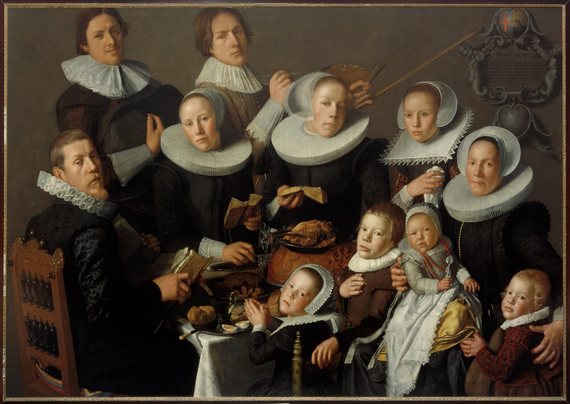
"Portrait of the Painter Andries van Bochoven and His Family," Andries van Bochoven, 1629.

Van Bochoven (1609-34) died young, only 25, and didn't make much of a career as an artist, but he was obviously talented and well-taught. He only completed a handful of known paintings, of which this is the most popular.

His father Rutger, a prosperous merchant, sits at one end of the small table, about to lead the family in prayer. His wife Johanna sits at the other end, with the smallest children. The painter's grown sisters sit at the table, holding their own books, as if ready to follow along in the prayer. The grown brothers, with Andries holding brushes, stand in the back.

It has a certain charm but Andries, and several other members of the family, passed away during a plague epidemic in 1634-8. The painting stayed in the family until Rutger's death, evidently a reminder of times past.

Happy Portrait Monday, A Day Late! (I got the days mixed up....)

From the Centraal Museum, Utrecht.

#Art #AndriesVanBochoven #DutchGoldenAge #GroupPortrait #PortraitMonday #FamilyDinner

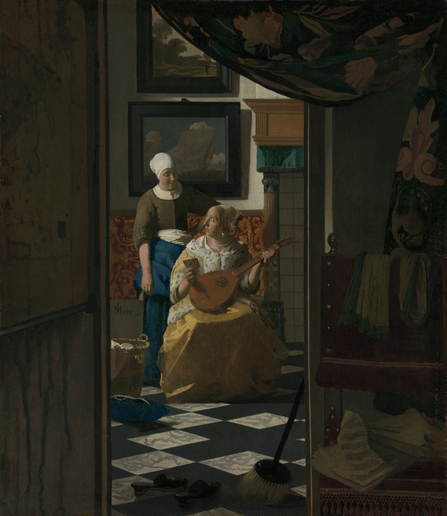
"The Love Letter," Johannes Vermeer, c. 1669-70.

Vermeer (16321675) is a much-acclaimed and much-studied painter of the Dutch Golden Age, and hailed as one of the all-time greatest.

His output was almost entirely scenes of middle-class life, although sometimes with religious or allegorical meaning, and all painted in the same two rooms of his house, but with expertly-depicted light. He was famous in his hometown of Delft but after his death he was largely forgotten until the 19th century when he was rediscovered and his work acclaimed for modern generations. Today, only about 34 paintings of his survive, although a number of fakes were produced over the years, including one forger who sold to Nazi soldiers.

Here we have an interior scene of a woman being handed a letter, but her expression is an eager one. Her instrument, a cittern, was a symbol of passionate love, and the loss of one of her slippers is also a racy hint. The paintings behind her, of a stormy sea and a traveler on a road, suggest her lover is on a voyage.

From the Rijksmuseum, Amsterdam.

#Art #JohannesVermeer #DutchGoldenAge #WomenInArt

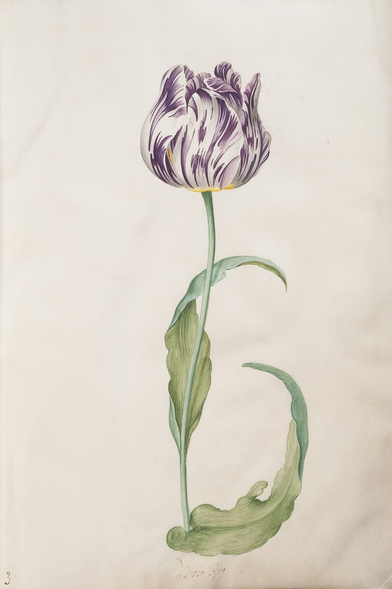
"The Tulip," Judith Leyster, 1643.

Leyster (1609-60) suffered a fate common to many women artists....she was respected and popular in her time, but after her death her work was attributed to male artists.

Leyster was a busy painter of still lifes, portraits, and genre scenes (everyday life). Details of her early life and education are scant, but she joined the local artists' guild when she was 20. She busily painted until her marriage in 1636 to another painter, Jan Molenaer, when she slowed down, and she died at 50. After her passing, her work was credited either to her husband or to painter Frans Hals, whom she once sued, but also may have been her teacher, as their styles are very similar.

Her work was rediscovered in 1893 and a huge project was undertaken to analyze various works. Now a substantial body of work is credited to her.

Happy Flower Friday!

From the Frans Hals Museum, Haarlem.

#Art #DutchGoldenAge #JudithLeyster #WomenArtists #FlowerFriday

The Girl With the Pixel Earring

Artist Amanda Measday By Amanda Measday in Adelaide, Australia. Comments: pic.twitter.com/uGGnId7a9z— STREET ART UTOPIA 🖼️ (@StreetArtUtopia) April 18, 2022

https://streetartutopia.com/2024/04/07/the-girl-with-the-pixel-earring/

The Girl With the Pixel Earring - STREET ART UTOPIA

Artist Amanda Measday By Amanda Measday in Adelaide, Australia. Comments: pic.twitter.com/uGGnId7a9z — STREET ART UTOPIA 🖼️ (@StreetArtUtopia) April 18, 2022

STREET ART UTOPIA

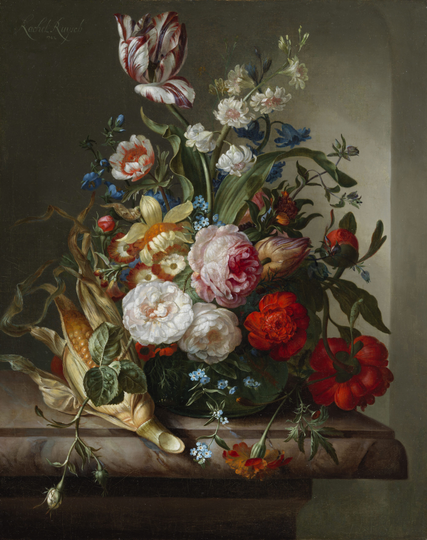
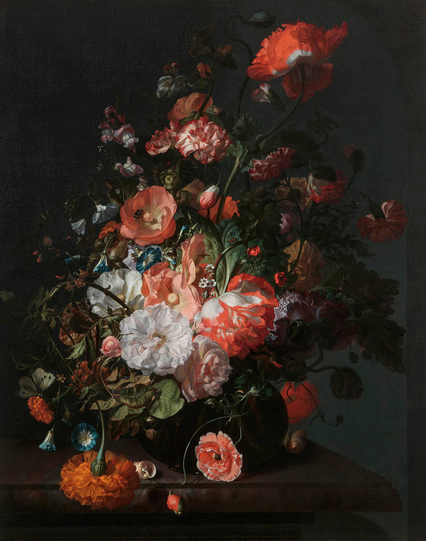
"Flower Still Life," Rachel Ruysch, c. 1716-20.

Here's our old friend Rachel Ruysch (1664-1750) with another one of her lovely floral still lifes.

The flowers here include poppies, roses, carnations, and I think I see some tulips as well. There's a bee, a moth, and a caterpillar visible as well, and maybe a few other small creatures. Some of the flowers are drooping, and some leaves are brown and have been nibble on by insects.

Ruysch, the daughter of a scientist, depicted flowers and insects with great precision and detail. There's a lot of realism in the individual flowers, but the overall painting is not realistic, as these flowers would not be in bloom at the same time!

I won't go on about her life, having talked about her before, but she had a long and successful career and achieved greater fame and wealth than many other painters of her time, and even today she is regarded as one of the greatest and most talented still life artists of any sex, of any era. All hail Rachel Ruysch!

Happy Flower Friday!

From the Toledo Museum of Art, Toledo, OH.

#Art #RachelRuysch #DutchGoldenAge #FlowerFriday #StillLife #Floral #AllTimeGreatPainters #WomenArtists #ILoveYouRachelRuysch
#WomensHistory #Herstory

"Titus van Rijn, the Artist's Son, Reading," Rembrandt van Rijn, 1656/7.

What can I say about Rembrandt (1606-69), other than he's one of the most recognizable names in art? A painter and printmaker, he pretty much defines the Dutch Golden Age. But unlike may other artists of the period, he didn't specialize.

Unlike, say, our friend Rachel Ruysch, who specialized in flowers, Rembrandt did all sorts of genres. Portraits, historic, religious, landscapes, mythical scenes, animals...he was all over the artistic map. Some of his work courted controversy; a painting of Bathsheba created a furor as everyone knew the nude Bathsheba was Rembrandt's mistress. He also had persistent financial troubles that led to him being ruled incompetent and his affairs managed by his son.

Titus van Rijn (1641-68) was the only child by Rembrandt's wife Saskia to live to adulthood. He was a frequent model for his father, and his death at 26 was a sad blow. Here he is, absorbed in a book, and looking like the apple of his father's eye.

Happy Portrait Monday!

From the Kunsthistorisches Museum, Vienna.

#Art #DutchGoldenAge #Rembrandt #PortraitMonday #TitusVanRijn
During the 17th c. #DutchGoldenAge, the #Netherlands had the highest per-capita income and pioneered many of #capitalism's features. #TulipMania, the first major #FinancialBubble, popped on #ThisDayInHistory in 1637, but had little effect on the economy unlike many later bubbles.

"Titus at His Desk," Rembrandt van Rijn, 1655.

Who doesn't know Rembrandt?

This is a portrait of his one surviving son by his first wife, Saskia van Uylenburgh. (Three other children died within weeks of their birth.) Saskia herself died of tuberculosis a year after Titus' birth, and her illness and death affected him greatly, as we can see from his paintings of her on her deathbed. There is a tender sort of anxiety in his depictions of Titus, who he painted frequently, as if fearful that he could leave any day.

Titus van Rijn (1641-1668) was by all accounts an intelligent and willful child who adored his father and did everything he could to help him, especially when Rembrandt's financial problems led to a bankruptcy. When Titus got older, he and Rembrandt's mistress Hendrickje set up a corporation as art dealers to generate work and support for his father.

Titus married in 1668 to Magdalena van Loo, but died a few months later of unstated causes. His daughter Titia was born six months after his passing. Rembrandt himself passed on the following year.

Happy Portrait Monday!

From the Museum Boijmans Van Beuningen, Rotterdam.

#Art #DutchGoldenAge #RembrandtVanRijn #PortraitMonday #Portraits

"Tree Trunk Surrounded by Flowers, Butterflies, and Animals," Rachel Ruysch, 1685.

Here's our old friend Rachel Ruysch (1664-1750), one of the greatest still life artists of all time.

Here we've got an arrangement of flowers around a tree trunk in a wild landscape that can be glimpsed in the upper left. Seeming to sprout from the trunk are roses, lilies, and poppies, amongst others, but these are cultivated flowers, not wild ones. Still, it's a pleasing image. A few butterflies can be seen, and by a mushroom at the bottom right there's a lizard, and a snail crawls away at the bottom left.

Everything is done with great precision and dedication. Even the mushroom at the bottom right looks real. I like to think that she loved what she did.

This is actually a pretty large painting for a still life of the period (32 by 38 inches) which indicates the popularity of her work.

I love sharing Ruysch's work. She depicted her subjects with loving precision, and she lived a rich, full life, enjoying success and acclaim. When so many women artists get forgotten or their work attributed to male artists, Ruysch shows us that women artists can (and should) have the same respect as men.

Happy Flower Friday!

From the Museum Boijmans Van Beuningen, Rotterdam.

#Art #RachelRuysch #DutchGoldenAge #StillLife #FlowerFriday

"The Feast of St. Nicholas," Jan Steen, 1665-8.

Steen (1626-79) was famous for his scenes of everyday life, which were both sentimental but also humorous.

In this Yuletide scene, the good little girl has a bucket of treats, while the sobbing brother has none...but grandmother seems to be beckoning to him from the back, hinting she may have a surprise for him. Another brother points up the chimney to amaze a youngster. There's a miniature still life in the lower left corner, and an assortment of goodies here and there. One child holds a gingerbread man in the form of St. Nicholas himself.

The scene is chaotic and jumbled, a hallmark of Steen's work, and many feel it was his way of depicting the society of the time. There's also a possible hint of darkness. The little girl's doll is John the Baptist; an odd selection for a child's toy. Some scholars have noted that John the Baptist is the patron of epileptics, and perhaps that it's an indication the girl has convulsions and that he's meant to watch over her.

Scenes of everyday life were popular in the Netherlands at the time, and Steen was popular for his visual storytelling & his tendency to poke gentle fun at society.

From the Rijksmuseum, Amsterdam.

#Art #JanSteen #DutchGoldenAge #GenreArt #StNicholas #HoHoHo