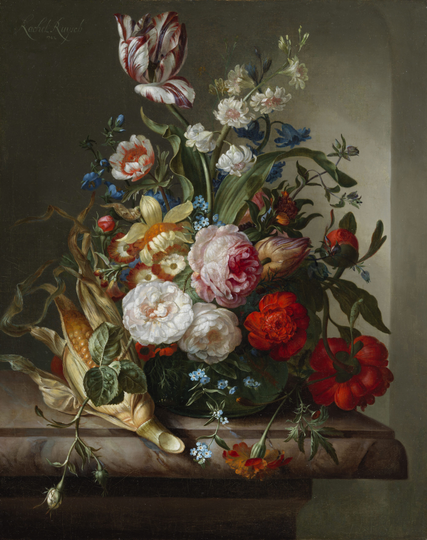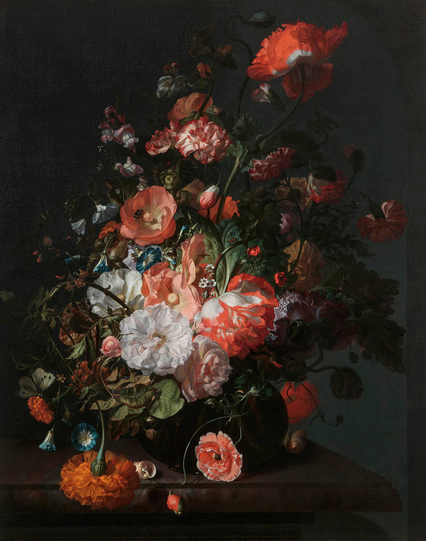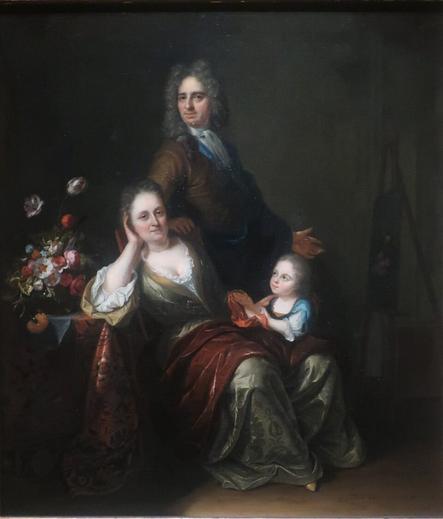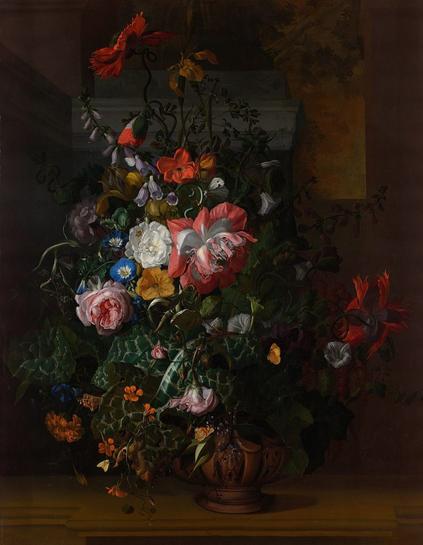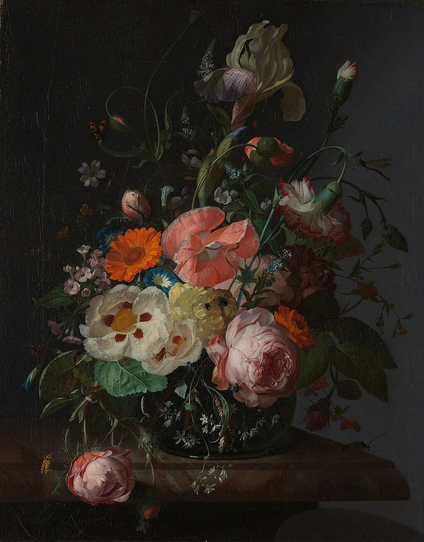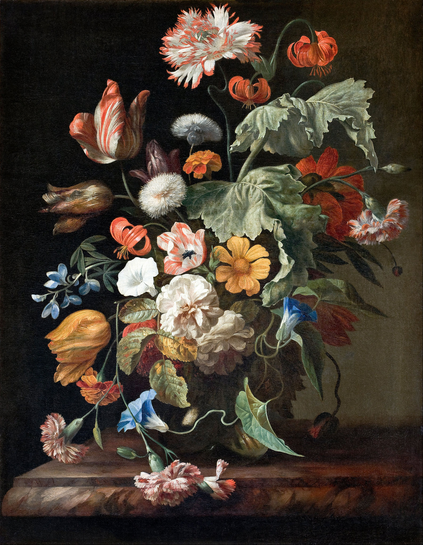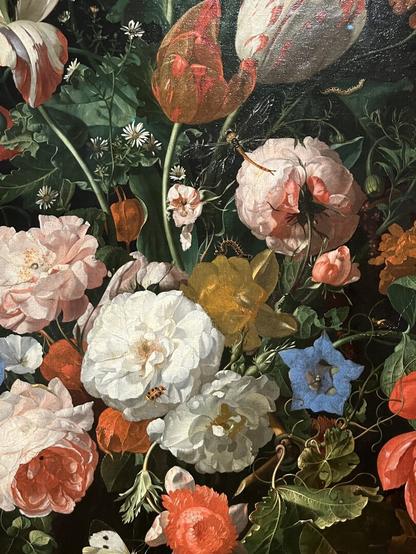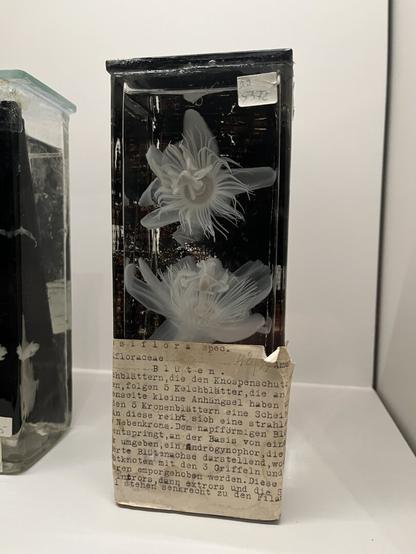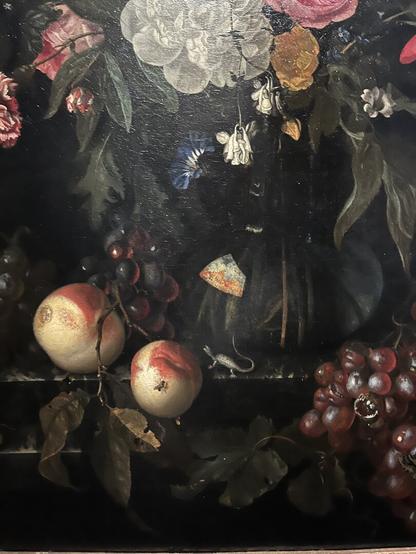
"Flower Still Life," Rachel Ruysch, c. 1716-20.

Here's our old friend Rachel Ruysch (1664-1750) with another one of her lovely floral still lifes.

The flowers here include poppies, roses, carnations, and I think I see some tulips as well. There's a bee, a moth, and a caterpillar visible as well, and maybe a few other small creatures. Some of the flowers are drooping, and some leaves are brown and have been nibble on by insects.

Ruysch, the daughter of a scientist, depicted flowers and insects with great precision and detail. There's a lot of realism in the individual flowers, but the overall painting is not realistic, as these flowers would not be in bloom at the same time!

I won't go on about her life, having talked about her before, but she had a long and successful career and achieved greater fame and wealth than many other painters of her time, and even today she is regarded as one of the greatest and most talented still life artists of any sex, of any era. All hail Rachel Ruysch!

Happy Flower Friday!

From the Toledo Museum of Art, Toledo, OH.

#Art #RachelRuysch #DutchGoldenAge #FlowerFriday #StillLife #Floral #AllTimeGreatPainters #WomenArtists #ILoveYouRachelRuysch
#WomensHistory #Herstory

Künstler und ihre Nebenjobs, Teil 2

Peter Paul Rubens, William Blake, Henri Rousseau, Paul Gauguin oder Jan Vermeer - was haben diese Künstler miteinander gemein? Richtig! Sie hatten noch weitere Berufe, die sie ausübten. Jetzt gibt es den zweiten Teil

https://little-arthistories.com/2026/02/kuenstler-und-ihre-nebenjobs-teil-2/

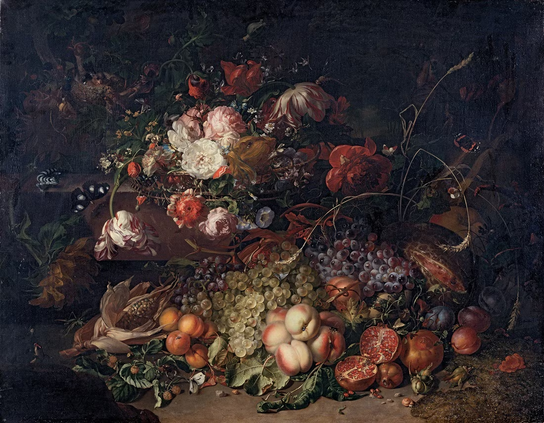
"Flowers and Fruit in a Forest," Rachel Ruysch, 1714.

Here's our old friend Rachel Ruysch (1664-1750), one of the greatest still life artists of all time, bar none. The daughter of a scientist, she learned to observe nature and painted it with amazing detail.

She is celebrated for the detail and precision of her work, straddling the line between scientific illustration and art. Here we have a heap of fruit (apricots, plums, peaches, grapes, melons, pomegranates, and even an ear of Indian corn) crowned with an array of flowers (mostly roses and tulips, and I think a peony and some morning glories). Fluttering about are moths and butterflies and other insects. In the upper left a bird sits in a nest, and a lizard creeps along a branch.

While it all looks glorious, it is a bit of a fantasy. Not all of this would be in season at the same time; by the time the peaches and plums would be ripe, the tulips would only be a memory, and the grapes not quite ready.

She had a long and full life, a happy marriage, earned a good living, and won great acclaim in her lifetime. Quite a lady!

Happy Flower Friday!

From the Städtische Kunstsammlungen, Augsburg, Germany.

#Art #RachelRuysch #WomenArtists #StillLife #FlowerFriday #ThisMakesMeHungry

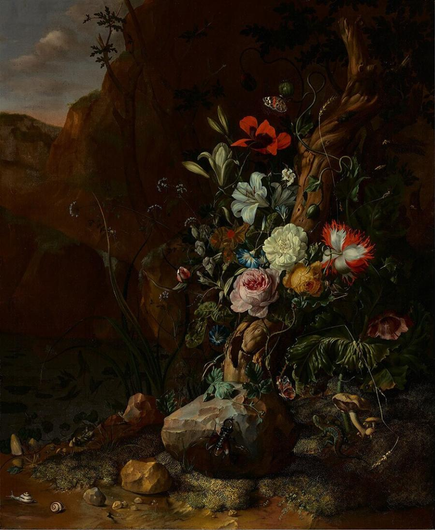
"Tree Trunk Surrounded by Flowers, Butterflies, and Animals," Rachel Ruysch, 1685.

Here's our old friend Rachel Ruysch (1664-1750), one of the greatest still life artists of all time.

Here we've got an arrangement of flowers around a tree trunk in a wild landscape that can be glimpsed in the upper left. Seeming to sprout from the trunk are roses, lilies, and poppies, amongst others, but these are cultivated flowers, not wild ones. Still, it's a pleasing image. A few butterflies can be seen, and by a mushroom at the bottom right there's a lizard, and a snail crawls away at the bottom left.

Everything is done with great precision and dedication. Even the mushroom at the bottom right looks real. I like to think that she loved what she did.

This is actually a pretty large painting for a still life of the period (32 by 38 inches) which indicates the popularity of her work.

I love sharing Ruysch's work. She depicted her subjects with loving precision, and she lived a rich, full life, enjoying success and acclaim. When so many women artists get forgotten or their work attributed to male artists, Ruysch shows us that women artists can (and should) have the same respect as men.

Happy Flower Friday!

From the Museum Boijmans Van Beuningen, Rotterdam.

#Art #RachelRuysch #DutchGoldenAge #StillLife #FlowerFriday

"Still Life with Rose Branch, Beetle, and Bee," Rachel Ruysch, 1741.

An artist of the Dutch Golden Age, Ruysch (1664-1750) was meticulous about signing and dating her works, making her one of the best documented artists of her time. Her level of skill and talent has led to her being praised as one of the all-time great still life painters.

The daughter of a scientist/teacher, she had many examples of plants, insects, minerals, and animals to work with. By the age of 18 she was selling her own work under her own name, and her career spanned six decades. When so many women artists went unknown or neglected, she fetched top prices for her work, earning more than Rembrandt did. She was respected and acclaimed in her lifetime and for a long time after her death.

She married a portrait artist, Juriaen Pool, and bore him ten children...and yet she kept on painting, earning more than he did. She even managed to outlive him.

Painted when she was in her mid-70s, this lovely picture shows no sign of her slowing down. The flowers and insects all show her attention to detail and scientific accuracy. One gets a sense that she loved what she was doing.

Happy Flower Friday!

From the Kunstmuseum Basel, Switzerland.

#Art #RachelRuysch #WomenArtists #DutchGoldenAge #StillLife #FlowerFriday

"Still Life with Flowers on a Marble Tabletop," Rachel Ruysch, 1716.

Rachel Ruysch's still lifes are always worth revisiting. I've talked about her before, so I won't repeat myself, except to say the basics: She was a painter of florals and still lifes who was enormously popular and charged high prices in her lifetime, and is also the best-documented female artist of her time, thanks her to habit of adding her age to her signature on all her paintings. She is regarded as one of the greatest still life artists of all time.

Here we have a lovely bouquet with roses, pansies, irises, calendula, dianthus, and others, with a few insects buzzing about or landing on the petals. Her father was a teacher of anatomy and botany, so she learned to look at flowers and insects closely and examine their structure, to recreate them realistically on the canvas.

A perfect painting for Flower Friday!

From the Rijksmuseum, Amsterdam.

#Art #DutchGoldenAge #RachelRuysch #WomenArtists #FlowerFriday

Heute letzte Chance für den Besuch der Ausstellung „Rachel Ruysch – Nature into Art“ in der Alten Pinakothek!

https://www.pinakothek.de/de/nature-into-art

#ausstellung #münchen #kunst #RachelRuysch

Rachel Ruysch

"Still Life with Flowers," Rachel Ruysch, 18th century.

I've talked about Ruysch before, but to recap quickly, she was the best-documented woman painter of her time, with an enormously successful career, getting commissions from many wealthy and influential clients. Poets wrote elegies in honor of her death in 1750, and despite the fact that she specialized in florals, her work was highly praised and fetched high prices after her passing; she even outsold Rembrandt!

The daughter of a scientist and professor of botany, Ruysch depicted plants and flowers with meticulous detail, developing her own style that straddled the line between Baroque and Rococo. Even today, she is regarded as one of the most talented still life artists of all time, bar none.

Happy Flower Friday!

From the Hallwyl Museum, Stockholm.

#Art #DutchArt #WomanArtists #Baroque #Rococo #RachelRuysch #FlowerFriday #Floral #StillLife

Calendario "Barroca TÚ" 2025

PREVENTA HASTA 1 DICIEMBRE (INCLUSIVE).Calendario Barroca TÚ 2025 con 12 mujeres artistas para descubrir: Elisabetta Sirani, Giovanna Garzoni, Margarita Caffi, Maria Sibylla Merian, Rachel Ruysch, Catarina Ykens II, Judith Leyster, Luisa Roldán La Roldana, Barbara Regina Dietzsch, Michaelina Wautier, Madeleine Boullogne y Maria Van Oosterwijck.

Gumroad