 Felix Bartels
On this Saturday that kind of feels like a Sunday, it was time for a little spring cleaning. Taking the time to fix some internal ci flows and tooling. Now no more #DroneCI but only #giteaactions Actions for my internal services. #springcleaning

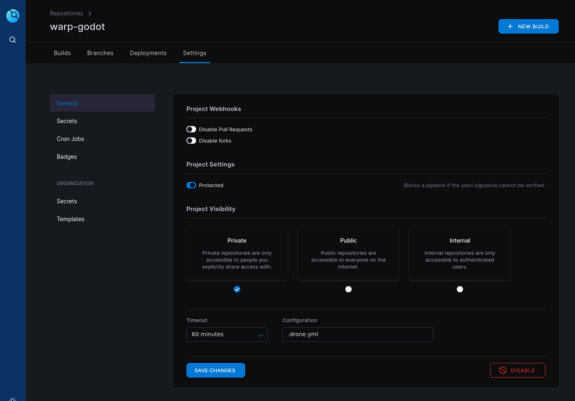
Yay, no more MissingRegion error! So, I'm sad to see I had to revert/nuke my entire #DroneCI setup after only briefly trying plugging in MinIO.
So I guess just because you can comment something back out in docker-compose, doesn't mean there's no linger side effects.
I'm trying to wrap my head around how to get my #docker #DroneCI (docker) pipeline to publish my final builds to the machine it's on.
Ideally I'd like it to do a direct transfer (scp or rsync) without having to hit the LAN.
Idk if the pipeline builds exist on the same docker network as the host image; are they allowed to communicate directly? If so then does that mean the network that Drone is in, that the pipeline image can communicate with another hosted service?
A bit over a year ago, I set out to replace my CI. As of a few days ago, the adventure concluded, I fully migrated every project I care about off of #DroneCI to #Forgejo Actions.
It's not perfect, not by far. But it's a better fit for me than any other alternative I considered then, and since. It's Good Enough that I no longer feel the need to write my own (at least, not anytime soon). I'll take that win.
So I took a quick look at this new #Gitness thing by #Harness (who also bought #DroneCI in 2020), and... wow. It's just #DroneCI with a very barebones "Forge" support slapped on top. You can navigate the repo, there's support for pull requests and CI pipelines.
No issues, however. No projects. No package registries.
And on top of that, an UI that's slow. I go to the repositories list, and the single repo I imported (with a whole 3 commits to a single README) appears 2(!) seconds after the rest of the page loads.
How can you even consider announcing a forge without support for issues? With an UI that's closer to Jira than to anything remotely usable?
This is gonna be a hard pass. Mind you, I would've dismissed it even if it was a viable alternative, because I don't trust Harness to keep it open source. They didn't do that with Drone, why would they do it with Gitness? Feels better to dismiss it because it's not a viable alternative, though.
The announcement is surprising, however. This isn't even MVP, let alone something worth to announce.
I've been poking at my #Forgejo Actions setup these past few days, and I got to a point where I think I know what I'm doing. At least some of the time.
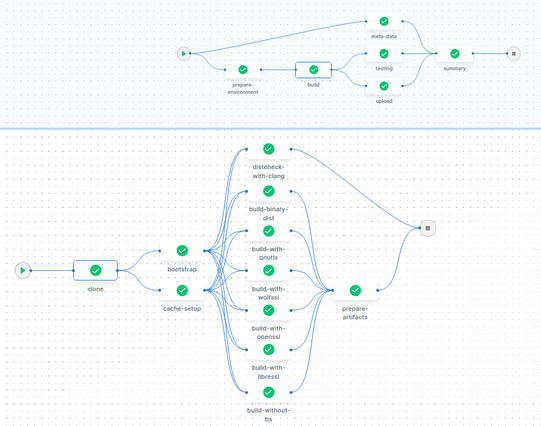
Figured this would be a good point to try and translate the #DroneCI workflow I have for riemann-c-client (screenshot of the workflow's partial dependency graph is attached) to Forgejo.
It... will be difficult. There are a few pain points:
 Jimmy B.
 leetNightshade
 ... (FKA Gergely Nagy 🐁)