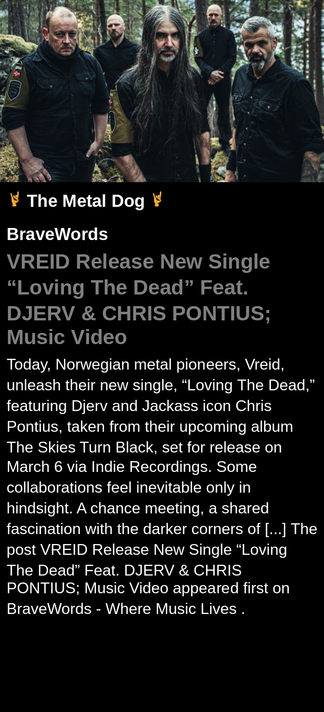
Rocking collaboration from Vreid and Djerv for #MusicWomenWednesday

Loving the Dead: https://youtu.be/V5lV0fEv0Co?si=m3MaRDt_NnvjV2Oy

#Vreid #Djerv #BlackMetal #HardRock

Vreid, Djerv feat. Chris Pontius - Loving the dead (Official Music Video)

YouTube
Vreid – The Skies Turn Black Review By Dr. A.N. Grier

It’s been a long five years since we’ve had an album from this Norwegian foursome. Which is probably a good thing, considering their last few releases haven’t been their best by a long shot. Basically, since 2011’s V, the band has struggled to retain their days-of-yore sound while trying to expand on it and deliver something fresh. Having left Season of Mist and returned to Indie Recordings, now is the time to drop something new and exciting—especially if you’ve once again enlisted the mighty Mistur’s keyboard wizard, Espen Bakketeig, to lend a hand in the finished product. One spin in and Vreid fans will find a lot of what you’ve come to expect from the band, while also exploring some surprising new directions that are sure to drop your jaw. But, is that a good or bad thing for The Skies Turn Black?

As has become the norm for the band, we’re blessed with some killer guest appearances by the aforementioned Espen Bakketeig and Djerv’s Agnete Kjølsrud, a smart decision by Kampfar on the amazing Ofidians Manifest. While Bakketeig’s performance on 2021’s solid Wild North West, I felt he was underutilized when crafting his key atmospheres or lustful piano passages. Thankfully, that is not the case for The Skies Turn Black. Outside of the emotional piano interludes, you’ll find plenty of powerful, spacey, and quirky key atmospheres throughout. And Kjølsrud’s contributions to the almost gothy “Loving the Dead” make it one of the best songs the band has ever penned.1

The album begins on a strong note with “From These Woods,” which is one of the longer and more epic tracks. After opening with some soothing clean and acoustic guitars, the black metal assault ensues. After passing through a dark alley of echoing clean-vocal support, the new riff change is nastier and heavier than ever. But the moment you get settled in, the song comes to a screeching halt, unloading beautiful piano, soaring guitars, and lush, clean vocals. When it concludes, you’re whiplashed with a vicious attack because the fucking song still has two minutes to go. Another track that has similarities is “Smile of Hate.” This one has a simple but headbangable riff in the vein of Amon Amarth, that marches along at one point and collapses into another impressive piano passage. This time, a little less ethereal and more like the piano and key work of Dimmu Borgir.

But, like all Vreid records in the last decade, there’s a point where things get real weird. Not in a negative way, like some previous material. On The Skies Turn Black, it begins with “Kraken.” It turns out this track is part of the soundtrack to this year’s Norwegian “blockbuster,” Kraken.2 But being more synth-driven than guitar-driven, it has an eerie vibe that actually would work equally well in the movie Sorcerer.3 It’s not a standout track, but it’s the perfect introduction to “Loving the Dead” because it uses the same elements. As mentioned, this song stands way out because Kjølsrud dominates on vocals. This eight-minute epic takes you through so many emotions, from Kjølsrud’s vocals to the intertwined guitar work and the climactic finish. This special piece is definitely a Grier SotY contender.

There are plenty of other high moments on this record, which is hella nice to hear for a change. The track that really loses me, though, is “Echoes of Life.” It’s not a bad song, but it’s an odd duck of ’70s progness. While it’s smooth and clean, it’s too old-timey to fit with the rest of the album. Thankfully, the follow-up closer “The Earth Rumbles” reignites the fire before the album concludes. If “Echoes of Life” ended the record, I might be a bit more upset. But, I’m pleased to say The Skies Turn Black is Vreid’s best album since V. Which is wild to say considering there are four full-lengths in that time. The master is nicely done, letting everyone shine when it matters—especially the bass, which has always been a major staple to their sound. If the skies really are going to turn black, I’m here for it. After all, that’s better than the color they are these days.


Rating: 3.5/5.0
DR: Stream | Format Reviewed: Stream deez nutz
Label: Indie Recordings
Websites: vreid.bandcamp.com | vreid.no | facebook.com/vreidofficial
Releases Worldwide: March 6th, 2026

#2026 #35 #AmonAmarth #BlackMetal #DimmuBorgir #Djerv #IndieRecordings #Kampfar #Mar26 #NorwegianMetal #Review #Reviews #TheSkiesTurnBlack #Vreid

#Jackass goes #blacknroll:
https://youtu.be/V5lV0fEv0Co

Apparently, Pontius is filming a documentary about Norwegian rock and metal?

Intriguing.

#Djerv #Vreid #LovingTheDead

Vreid, Djerv feat. Chris Pontius - Loving the dead (Official Music Video)

YouTube

Djerv release “Rebel Heart” video (as features in ‘Arcane’ season 2)

Last autumn, Djerv released the song ‘Rebel Heart’ as part of the official soundtrack for Season Two of the critically acclaimed Netflix series Arcane. What happens when Norwegian hard rock collides with one of the world’s most iconic series? The answer is ‘Rebel Heart’ - a track that creat

https://www.moshville.co.uk/misc/2025/03/djerv-release-rebel-heart-video-as-features-in-arcane-season-2/

#Misc #Djerv

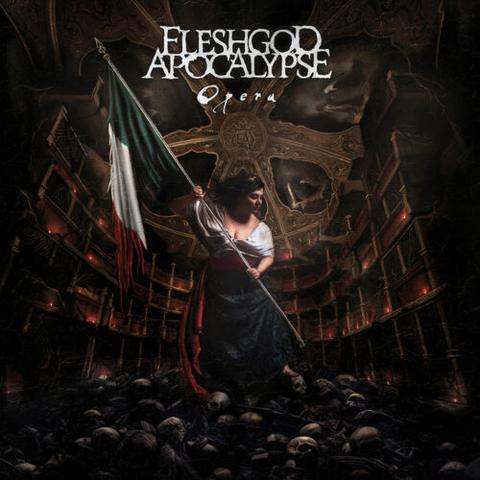
Fleshgod Apocalypse – Opera Review

By Angry Metal Guy

Opera, the fifth full-length LP from the Italian symphonic death metal juggernaut Fleshgod Apocalypse, marks the band’s first record since 2019’s Veleno. Some may recall that in 2021, the band’s mastermind, Francesco Paoli (bass and vocals), suffered from a mountain climbing accident that landed him in the hospital. During the harrowing ordeal that followed, he and the band had little sense of the future of Fleshgod Apocalypse. It should come as no surprise that Francesco and the others burst into a creative frenzy upon improving and returning to band activities. From the remnants of this tragedy, Opera was born.

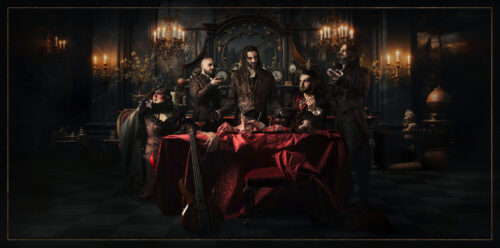
Opera marks a significant change in Fleshgod Apocalypse’s trajectory. Inspired by the Opéra Lyrique, a genre less grandiose than the opera you’re thinking of, Opera contains episodic dialogues or confessionals with the imaginary characters of Francesco’s episode. To accomplish this, Veronica Bordacchini—featured on the album’s cover—was enlisted to play the role of these companions: death, life, and hope.1 And while the band has not changed, with Francesco Ferrini (Piano), Fabio Bartoletti (Guitar), and Eugene Ryabchenko (“Drums”) filling out the act, Opera is not your Monarch’s Fleshgod Apocalypse.

The core of Fleshgod Apocalypse’s sound hasn’t changed markedly. Blasty, heavily replaced drums prop up guitars and orchestras that trade places as the leading musical characters. The mix sports audible but unremarkable bass, and Paoli’s guttural vocal attack over the top. In its peak—and most recognizable—form, Fleshgod Apocalypse is fast, heavy, and evokes Europe in the time when wigs were a common fashion accessory, with the guitars carrying melodies and engaging in Vivaldian gymnastics2 (“Morphine Walz”). Elsewhere, the sound is dark, dramatic, and heavy, utilizing grinding drums and blasting French horns or orchestral hits to create an undeniable tension (“At War with My Soul,” which recalls the excellent horn compositions from King). The songwriting isn’t progressive, but it sure as hell is technical, with ridiculous riffs that, at their best, dance on a bed made by lush orchestrations (“Per Aspera Ad Astra”). And when it’s less successful, the guitars take a Nightwishian backseat, leaving the orchestrations to do the heavy lifting.

Rather than being the “darker” or “heavier” album bands often tout in meaningless interviews, Opera is a significantly tighter and—Padre, perdonami—poppier record than its predecessors. Opera features short songs, including an instrumental intro and outro, and the album clocks in at a tight 44 minutes. This means there are eight episodes, none longer than roughly five and a half minutes. But rather than just tightening the writing, Paoli and company also made new stylistic choices that differentiate Opera from its predecessors. “I Can Never Die” features a piano breakdown of the chorus and a Eurovision key change. “Matricide 8.21” starts sounding like a Nightwish song from Once; no double kick, 4/4 time signature, and heavy on Veronica’s voice. More tellingly, the song also features simple melodies carried on the guitars, with almost no neoclassical affectation. Moments like these speak to a significant perspective shift.

The other major change is, as noted above, how Veronica’s voice becomes a shifting character throughout Opera. Rather than sticking to her opera soprano—as she did so charmingly on “Paramour” from King—Bordacchini performs different vocal interpretations meant to embody different characters. On “I Can Never Die,” she (mostly) eschews her formal technique for a straight tone, while “Bloodclock” finds her straddling an unaffected pop approach with operatic emphases. Veronica’s most effective and unexpected performance comes on “Morphine Waltz,” where she adopts an almost punky scream like Agnete Kjølsrud (Djerv). Of course, opera is her greatest strength and part of Fleshgod Apocalypse’s core idiom, and she does that frequently and well. But while Opera showcases Veronica’s ample gifts, the use of straight tone and poppy cleans unexpectedly pushes Fleshgod into territory fitting of Napalm Records.

The combination of all these elements gives the album an undeniably poppy feel. The varied songwriting that, at times, leans into more heartfelt and balladesque territory (“Till Death Do Us Part”) or seems to be drawing from pop writing (“I Can Never Die,” “Matricide 8.21,” “Bloodclock”). Prominent melodic vocals from Veronica, with clean, tight songwriting, give the creeping sensation that Fleshgod is trying to take a Nightwishian turn toward more accessible, less grandiose music. The final element is Opera’s slick and polished presentation. Working with Jacob Hansen again, the album clocks in at a DR6 and is loud, but well-balanced. Even though King’s drum tone was better, Hansen’s grip on Fleshgod’s sound is firmer on Opera. He deftly handles Ferrini’s orchestrations and helps the vocal arrangements to ascend into the same stratosphere as Turilli’s excellent vocal compositions. The choral parts are huge and lend operatic gravity to the band’s sound.

Opera does an excellent job of balancing the old and the new, and most importantly, it justifies its artistic choices. Framing Opera as a lyric opera is a brilliant strategic move because it discredits criticisms of a poppier sound by foregrounding the artist’s vision and post-traumatic growth of what was a harrowing time for Paoli and his compatriots. Furthermore, Opera is simultaneously and undeniably fun, heady, and technically impressive. While I suspect Fleshgod Apocalypse ‘lost’ its trvest death metal fans after Oracles, I can see Opera being a divisive record for current fans because of its novel traits. And yet, I find it hard to argue with quality and the ability to take a base of brutal death metal and forge a product this addictive and immediate. Despite not being in love with the idea of a future Fleshgod that eschews its brutal base and embraces more simplistic melodies and composition, that day has not yet arrived. So, while I miss King’s grand opera aspirations, I admire the execution of the unified vision from which the album benefits.

Rating: Great
DR: 6 | Format Reviewed: 192 kb/s mp33
Label: Nuclear Blast Records
Websites: fleshgodapocalypse.bandcamp.com | facebook.com/fleshgodapocalypse
Release Date: August 23rd, 2024

#LucaTurilliSLioneRhapsodyOfFire_ #2024 #40 #Aug24 #Blog #DeathMetal #Djerv #FleshgodApocalypse #King #Nightwish #NuclearBlastRecords #Opera #orchestralDeathMetal #Review #SyymphonicDeathMetal #Veleno

AMG Himself reviews Fleshgod Apocalypse's "Opera"

New Fleshgod Apocalypse after 5 years! What's AMG think of it?

Angry Metal Guy