"What is an ocean but a multitude of drops." — David Mitchell

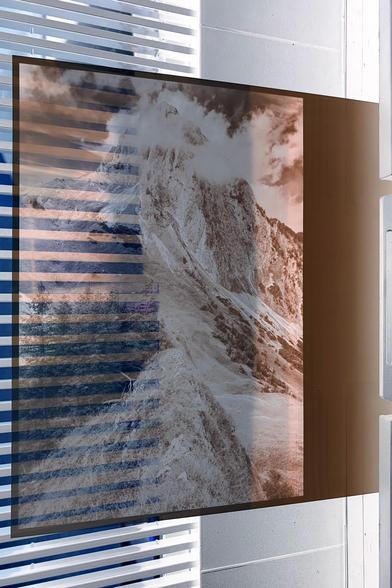
Final tweaks (version 11 by now) of the tone curve for digital negatives for my current combination of emulsion & developer: It's pretty impressive how even minute changes to black & white points of the curve have quite noticeable impact on the rest. I've also been experimenting with reducing emulsion from 8+8+1 drops to 7+7+1 drops, but that makes that 1 drop of contrast agent ~13% stronger (too strong), also creating more grainy results.

Never underestimate the power/impact of a single drop!

#AltProcess #Kallitype #Photography #BlackAndWhite #NoirCountry #DigitalNegative #Quote

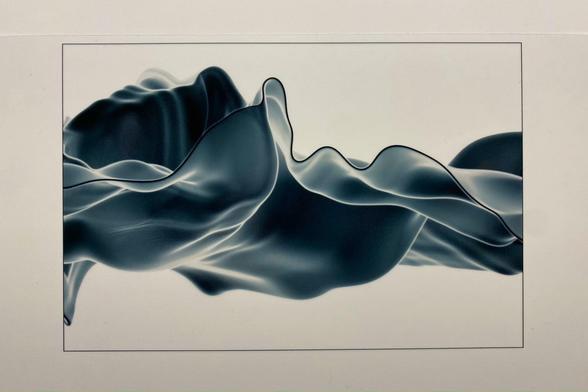
Prepping a digital negative of one of my old generative art projects (from 2008) for #Kallitype printing tomorrow. The form is actually _not_ 3D, but merely the time trace of a 2D physics sim of a single line (over hundreds of frames) and using spatial velocity deltas as metric for creating faux shading...

#DigitalNegative #AltProcess #GenerativeArt #Physics #Simulation #Toxiclibs

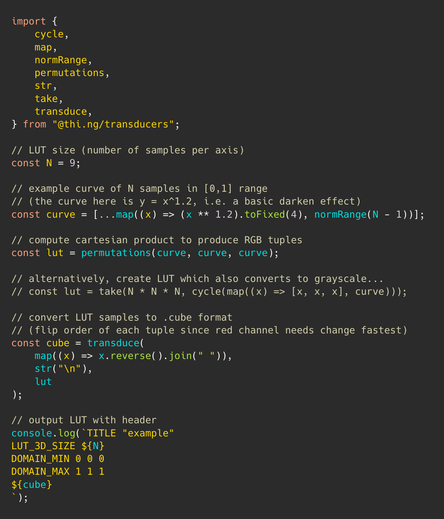
Neither #Affinity nor #Darktable seemingly support 1D LUTs, which would have been too easy and useful for my #DigitalNegative preparation tool... Instead they both insist on using only 3D LUTs. Converting 1D to 3D takes a bit more effort, but thanks to https://thi.ng/transducers, it's still very easy...

#ThingUmbrella #TypeScript #JavaScript #FunctionalProgramming #Transducers #LUT #Photography

Researching DIY solutions for preparing digital negatives for my salt/kallitype printing experiments. Working on a little curve fitting tool/library (of course using https://thi.ng/umbrella) for computing tone mapping curves derived from sample swatches (here 5% steps of gray/density). The screenshot shows 2nd - 5th degree polynomials. Looks like a quartic is more than good enough... (I know there are ready-made tools for this, but I'm learning more this way... :)

#ThingUmbrella #CurveFitting #Regression #DigitalNegative