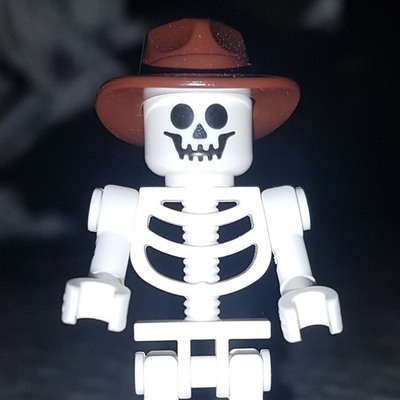
This weeks #Lego #FossilFriday is #Desmodus #draculae

In 1965, Omar J. Linares found the first fossils in Cueva del GuΓ‘charo in Venezuela.

In 1968, he noted the fossils as evidence of a large Desmodus in the Pleistocene.

In 1988 a formal description was written and published, naming the species Desmodus draculae.

This weeks #Lego #FossilFriday is #Desmodus #draculae

Fossils of draculae have been found in Argentina, Mexico, Ecuador, Brazil, Venezuela, Belize, and Bolivia.

They date from the late Pleistocene until possibly 300 years ago. Some of the fossils are partially or fully unmineralized. This means that they are still bones, and not yet turned permineralized into fossils.

This bat is the largest known vampire bat at up to 32mm in length. Its wingspan is estimated to be around 50cm wide.

Bats (Play Visions)

There are two mammals, or perhaps broadly groups of mammals, that exemplify Halloween. One is the black cat. The other is the bat. Bats have a long history in human folklore, tradition, and fictional literature and cinema. In North America, the Creek, Cherokee, and Apache viewed the bat as a trickster god. In Aztec mythology they were associated with dead, destruction, and decay. The witches […]

Read more... https://animaltoyforum.com/blog/bats-play-visions/ #CaliforniaLeafNosedBat #Centurio #CenturioSenax #commonVampireBat #Desmodus #DesmodusRotundus #EgyptianFruitBat #Euderma #EudermaMaculatum #horseshoeBat #Macrotus #MacrotusCalifornicus #Rhinolophus #Rousettus #RousettusAegyptiacus #spottedBat #wrinkleFacedBat

#halloween #funfact πŸŽƒ πŸŽƒ πŸŽƒ

#Draculin is a glycoprotein found in the saliva of #VampireBats specifically the #Desmodus #rotundus species

Further reading:

https://wikiless.org/wiki/Draculin?lang=en

Draculin - Wikipedia