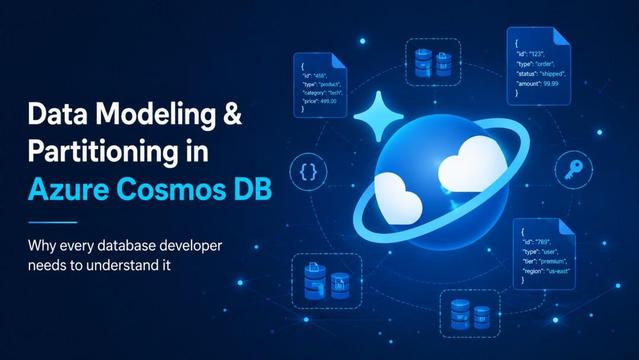
Read my latest blog post on Data Modeling and Partitioning in Azure Cosmos DB: The Concepts Every Database Developer Must Understand. https://thetrainingboss.com/data-modeling-and-partitioning-in-azure-cosmos-db/
#Partitioning #DataModeling #CosmosDB #QueryPatterns

Cloud thinking: Data in 3rd denormalised form

One schema to rule them all and in the darkness bind them.

That’s the SQL way. One schema, many tables, be efficient with space. Join, don’t duplicate. Third normal form and structured data. More structure.

But that’s not always the best way to scale. How important is it that everything is identical everywhere? How important is history? When a customer moves house, do you want to know the difference between the address they want their next order delivered to and the address the last order was delivered to?

When you let go of SQL and joins, and when storage is cheap, does it matter if you have multiple copies, so long as each document has the right copy for itself?

When you aggregate data, when your change log turns multiple orders into 1 delivery schedule for your driver, does it matter that the driver has their own copy for when they lose signal? Does it matter that there’s a copy of the addresses in the route that will be deleted tomorrow because it serves no more purpose?

If storage is cheap and joins and transmissions are expensive, wouldn’t you want to cache data and trade storage for speed?

Shouldn’t you embrace heterogeneous data? The address on your payment looks like the address on the order, but it serves a different purpose, it’s embedded in a different context, and it has a different lifecycle.

It’s sometimes hard to change your mental model, but it can save you from doing the wrong thing.

#cloudcomputing #cosmosdb #data #nosql

Hi #PyConUS, Patty and I will be running a sprint Monday on #DocumentDB (and you can also ask us about the #k8s operator and #CosmosDB)
Made it to #PyConUS Find me to chat #DocumentDB, our #kubernetes operator, #OpenSource (we have an #Azure #AWS #YugabyteDB collaboration), or #CosmosDB
The Azure Cosmos DB Data Migration Desktop Tool makes it easy to move data into Azure Cosmos DB without building a one-off importer.
#Azure #CosmosDB #Mongodb #docker
https://github.com/AzureCosmosDB/data-migration-desktop-tool
GitHub - AzureCosmosDB/data-migration-desktop-tool

Contribute to AzureCosmosDB/data-migration-desktop-tool development by creating an account on GitHub.

GitHub
#PyConUS will be in Long Beach, CA, just a few hours north from me and thanks to some (to me) free tickets I will be there ready to chat #documentdb and our #kubernetes. #cnpg operator - I can also chat #Pyrhon on #CosmosDB - very curious what’s going on with Python, too - used it a ton during my #OpenStack days
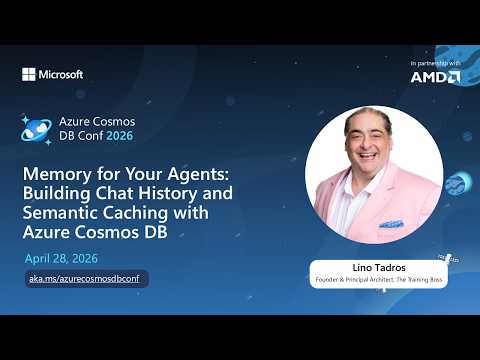
In case you missed it, here is the recording of the Azure CosmosDB Conf 2026 session on Chat History and Semantic Caching using Microsoft Agent Framework.
https://youtu.be/atbRswDKruY?si=U7IF7fJVcrm77qkv
#CosmosDB #AgentFramework #SemanticCaching #ChatHistory
AI Agent Memory: Chat History & Semantic Caching | Lino Tadros | Azure Cosmos DB Conf 2026

YouTube
Thrilled to present at the Azure Cosmos DB Conf 2026 https://developer.azurecosmosdb.com/conf/. Join me on April 28th 2026, to hear the latest and greatest about Building Chat History and Semantic Caching with Azure Cosmos DB. #CosmosDB #Azure #AI #semantic
Vector Data in .NET - Building Blocks for AI Part 2 - .NET Blog

Explore the power of Vector Data in .NET AI for enhancing semantic searches and intelligent applications.

.NET Blog
https://www.youtube.com/watch?v=FAc873nQ5KU - OmniRAG: how to do #AI #RAG with #Azure #CosmosDB. Thanks for the walk-through Aleksey Savateyev.
OmniRAG - the right way to do Retrieval Augmented Generation with Azure Cosmos DB

YouTube