Think I managed to rip out all the remaining slop from SBCL's 2.6.2 release. Builds on Linux x86-64 so seems fine for me™. Probably going to use this personal fork for the foreseeable future. Might try to update it to future releases but depends on the complexity and amount of slop.

(Stainless) Steel Bank Common Lisp: https://codeberg.org/zyd/sbcl

The name is very cute, admit it.

#lisp #commonlisp

sbcl

(Stainless) Steel Bank Common Lisp

Codeberg.org

Kent Pitman on Technology, LLMs, AI, the environment, MOOsaico, and LambdaMOO + #lispyGopherClimate

https://toobnix.org/w/jQkCWCeFNRL9Utcr2GWurM

Kent Pitman on Technology, LLMs, AI, the environment, MOOsaico, and LambdaMOO + #lispyGopherClimate

PeerTube

#lispyGopherClimate #live #technology #podcast (?!) https://toobnix.org/w/jQkCWCeFNRL9Utcr2GWurM
Chat live in #lambdaMOO as always https://lambda.moo.mud.org/
(@join screwtape
"hey
)

- I release NZ government secrets about #AI and #LLMs senior managers keep sending me

- I start /actually/ multimooing my own personal moos LambdaMOO

- Otherwise, my #commonLisp brain is entirely inside my #DL #DeepLearning #roc #statistics original formulation https://lispy-gopher-show.itch.io/dl-roc-lisp

@kentpitman featuring.

@m3tti I completely agree. I am also amazed by the fact that it's such a usable language as well as a glorious abstraction machine. I am currently writing all my music in #commonlisp and don't see myself switching to anything else any time soon. I still have to use C++ for sensors and graphics programming, but I'm hoping that I will be able to find ways around that as well in the future.
#NASA JPL solar system explorer, made with #Datastar and #CommonLisp .
https://codeberg.org/fsm/horizons
#Kubernetes ingress gets a lot of attention – Gateway API, Ingress controllers, service meshes – compared with the Egress, mostly ignored until someone asks “what exactly is our cluster talking to?”, or, in even simple deployments, “Can we see what we are talking to?”. This is a (very) simple approach to that, using the venerable Squid proxy and a NetworkPolicy, without reaching for heavier machinery (but beginning to understand why we would).
https://interlaye.red/kubernetes_002degress_002dsquid.html
horizons

NASA JPL solar system explorer, made with Datastar and Common Lisp.

Codeberg.org
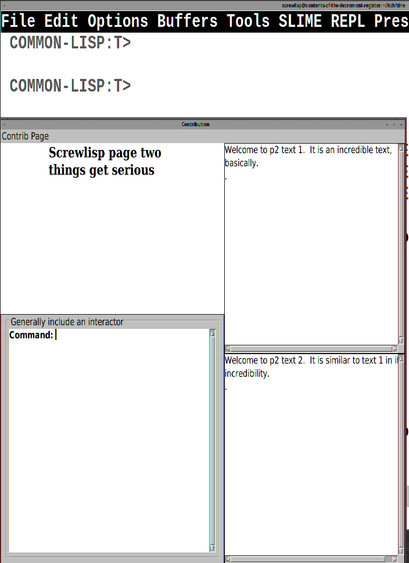
A screenshot of my initial-stages ncurses like Common Lisp zero dependencies library running on my Android phone with sbcl and termux.
I can connect my phone to the external monitor with keyboard and continue to develop it in CL/sbcl with Emacs ;) Life is so much fun these days
#commonlisp

Have been pretty quiet lately as I've been refactoring some of my existing work to better support future exploration/experimentation, while at the same time reacquainting myself with programming in Common Lisp. Feels so good to be back working with this toolset. (❤️)

#CommonLisp #Lisp #CreativeCoding #AbstractArt #AlgorithmicArt

SBCL Fibers: Lightweight Cooperative Threads

A draft design document describing lightweight userland cooperative threads for SBCL.

REPL Yell!

Tip for using #Pulsar IDE with #CommonLisp: Edit your .asd files as lisp files by adding the following snippet to your config.cson:

core:
customFileTypes:
'source.lisp': [
'asd'
]

A Preview of Coalton 0.2

By Robert Smith Coalton is a statically typed functional programming language that lives inside Common Lisp. It has had an exciting few years. It is being used for industrial purposes, being put to its limits as a production language to build good, reliable, efficient, and robust products. Happily, with Coalton, many products shipped with tremendous success. But as we built these products, we noticed gaps in the language. As such, we’re setting the stage for the next tranche of Coalton work, and we’re going to preview some of these improvements here, including how Coalton can prove $\sqrt{2+\sqrt{3}} = \sqrt{2}(\sqrt{3}+1)/2$ exactly.

The Coalton Programming Language