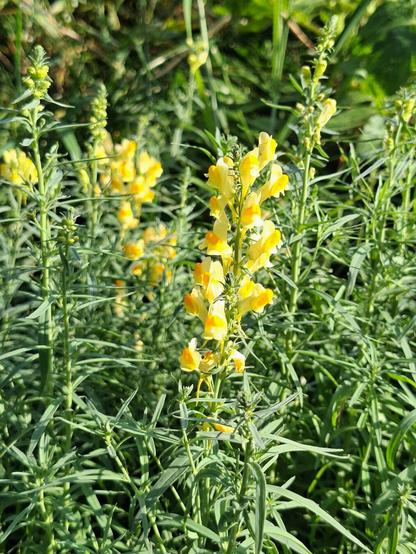
Keltakannusruoho, Linaria vulgaris

I used to call this "munakaskukka", a (bullseye) omelette flower🍳 later I found out that the flower was called butter-and-eggs in some English speaking areas of our world. So I think the naming I did as a child was some pure childhood wisdom! Great minds think alike☝️


#bloomscrolling #CommonToadflax #keltakannusruoho #LinariaVulgaris #kannusruoho #Linaria #luonto #nature #suomi
Common Toadflax (Linaria vulgaris, Gewöhnliches Leinkraut) is a hardy perennial native to Europe and Asia, often found in meadows, roadsides, and dry, sunny habitats. Its bright yellow and orange, snapdragon-like flowers bloom from summer into autumn, attracting bees, bumblebees, butterflies, and other pollinators, thus contributing to late-season nectar availability. Ecologically, it also provides shelter for small insects and serves as a host plant for certain moth species. Traditionally, it has been used in herbal medicine for its diuretic, mild laxative, and anti-inflammatory properties, particularly in treating liver and gallbladder issues, skin irritations, and hemorrhoids, though its internal use should be approached cautiously due to the presence of potentially toxic compounds.

#commontoadflax #toadflax #linaria #linariavulgaris #leinkraut #yellowflower #flower
📷 Canon EOS 90D · Tamron SP 60mm f/2 Macro Di II (G005) · 1/160s · f/2.8 · ISO 100 · 📅 2023-09-24 · 14:13 UTC · Processed with ART


View more macros in my gallery.

#Makro #GewöhnlichesLeinkraut #Macro #CommonToadflax #LinariaVulgaris #MyWork

Für Insekten-/Spinnen-Makros war heute einfach nicht der Tag: Es war zu windig und die Tierchen schneller auf der Flucht als man die Kamera einstellen konnte. Manchmal klappt einfach nichts, das muss man akzeptieren.

Dafür konnte ich den noch jungen Blütenstand des Gewöhnlichen Leinkrauts, auch Kleines Löwenmaul oder Frauenflachs genannt, ablichten. Die Wiese, auf der er wächst, liegt an einem Verbindungsgraben zwischen Wesel-Datteln-Kanal und Lippe und wurde erst vor einer Woche abgemäht, was sehr schade ist. Offensichtlich hat diese Pflanze das Mähen aber gut überstanden und ist weiter prächtig gewachsen. Dieses Exemplar war erst ca. 10 cm hoch, wird aber 20–40 cm, selten sogar 80 cm hoch.

Generell erfreuen mich diese schönen Wildblumen viel mehr als künstlich angelegte Gärten oder unsere Zierpflanzen. Wenn man die Insektenwelt fragt, so fällt das Urteil ähnlich aus, was man an der Akzeptanz leicht erkennen kann. ;-)

#^https://de.wikipedia.org/wiki/Echtes_Leinkraut
agriggio / ART / wiki / Home — Bitbucket